
© 2011 Dorann Weber/Getty Images
- More and more college grads are settling for jobs that don’t necessarily require a degree.
- Underemployment can have long-term career consequences and differs by major.
- The share of bachelor’s degree holders in non-degree-requiring jobs could remain elevated.
It’s getting harder for college graduates to be optimistic about what’s next after throwing their graduation caps in the air.
While unemployment among recent college graduates has been cooling as the job market has improved in the past few months, more and more graduates are having to settle for jobs that don’t require the years of schooling they’ve just invested in. Based on data from the job-search platform Indeed, the share of bachelor’s degree holders in jobs 12 months after graduation that don’t require a college degree, or being underemployed, has risen dramatically in recent years.
Half of the class of 2025 were considered underemployed, above the 2017 to 2019 average of 39%.
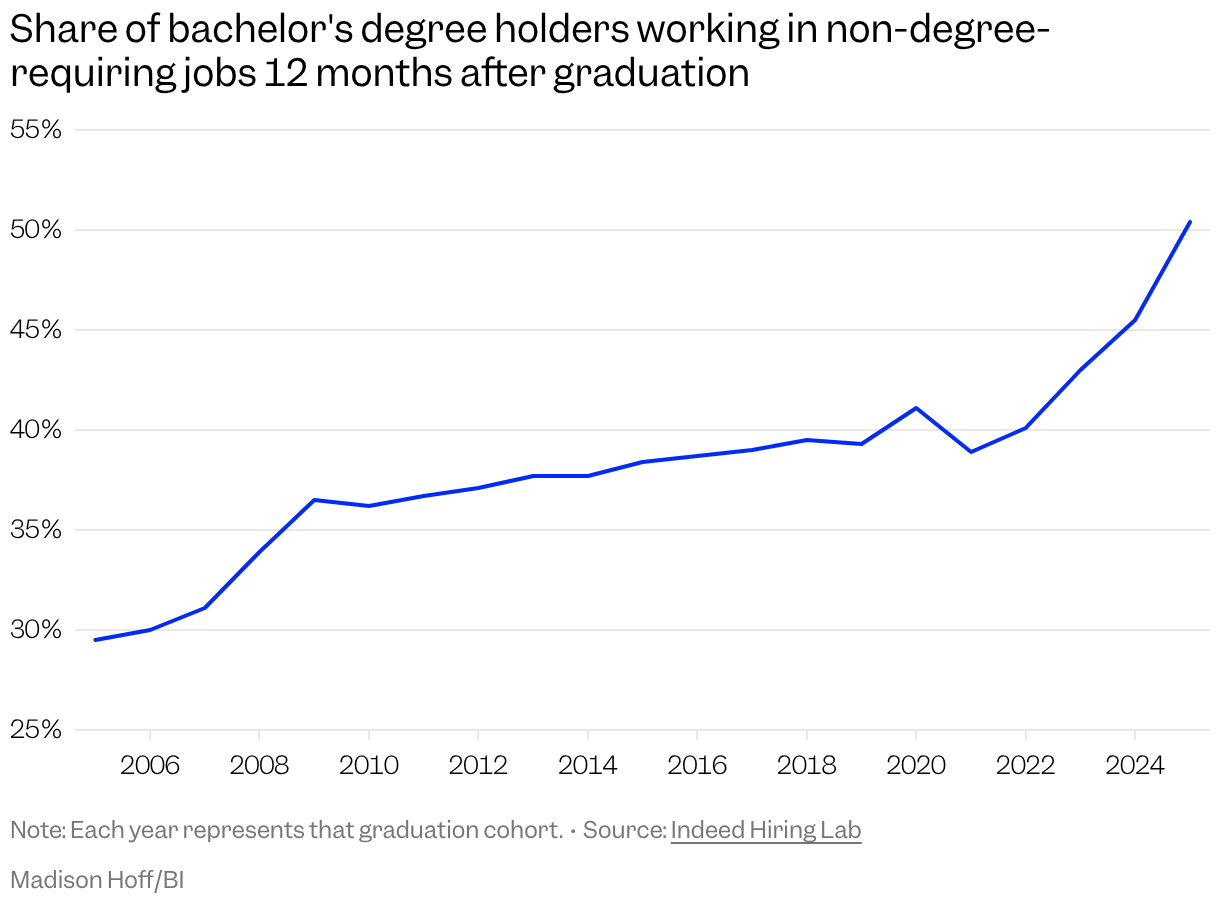
Indeed economist Sneha Puri said the surge is due to the low-hire, low-fire job market that has been the story for the past few years. New grads also face a lot of competition for entry-level jobs. Puri said when employers do hire talent, they’ve been leaning on people “who can hit the ground running, as evident from the growth in job postings being driven by senior-level roles.”
“That hits new graduates hardest, because they’re most likely to apply for entry-level positions, which not only have seen job postings decline but also get several times as many applications as mid- and senior-level roles, including from people with more experience,” Puri said.
Landing a job that doesn’t require a college degree can be a short-term solution for new graduates, with long-term consequences.
“For workers who are underemployed or unemployed in their early years after graduating, that can have a stacking effect on their career over time, where they get knocked into a career trajectory that isn’t as rewarding, isn’t as engaging,” Daniel Zhao, chief economist at Glassdoor, told Business Insider.
It could also affect their earning potential, as jobs that don’t require degrees often pay less than those that do. For instance, the Bureau of Labor Statistics said there’s no formal educational credential required to become a retail salesperson. That job paid an average annual wage of $37,310, per the latest 2025 BLS data, short of the overall average of $69,770. Software developers typically need a bachelor’s degree, and Indeed said the average base salary for an entry-level software engineer in the US was about $82,000.
It can be tough to break free from underemployment.
“Seventy-three percent of graduates who start out underemployed remain so 10 years after completing college, making them at that point about 3.5 times more likely to be underemployed compared with those who start out in a college-level job,” a 2024 report from the Burning Glass Institute and Strada Institute said.
Zhao said there’s also a risk for employers if they hire a college grad who isn’t engaged in their work duties or who would be a better fit in a different position.
It can be easier to find a job in your field depending on your major. The New York Fed found, based on Census Bureau data, that criminal justice, performing arts, and fine arts majors had the top three underemployment rates in 2024. Nursing, aerospace engineering, and civil engineering made up the bottom three.
While computer engineering was among the majors with low underemployment, this major had the second-highest unemployment rate.
Puri expects underemployment to remain elevated for the class of 2026. “An uptick would only reverse once employers again start to recognize the importance of hiring and investing in entry-level talent to train tomorrow’s senior level experts,” she said.