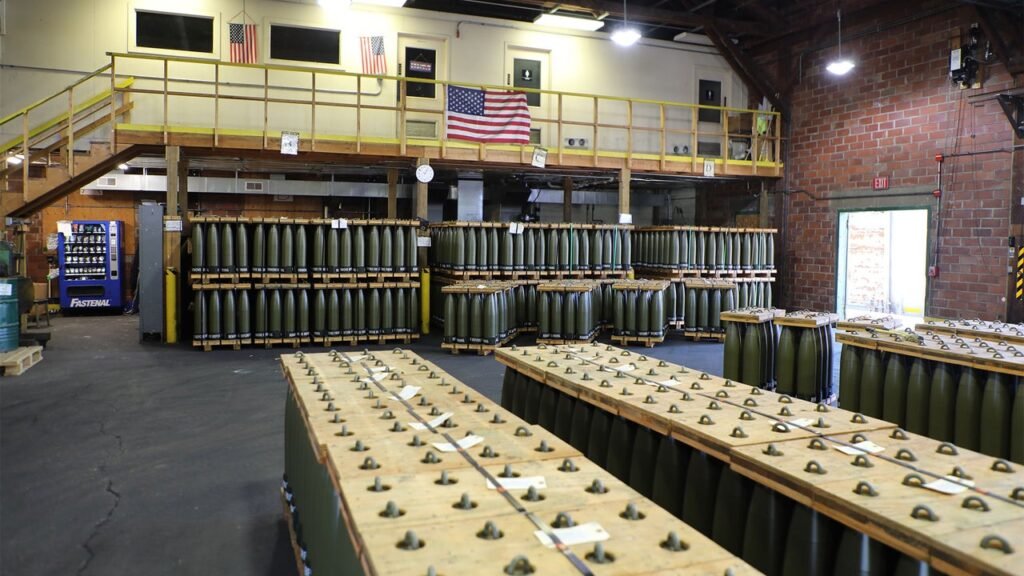
The U.S. Army is planning to blow up roughly 5 tons of bomb-making materials in Iowa on Friday, a volatile event expected to send a plume of toxic lead dust into the air as far as 90 miles away. The chemicals are unstable enough that moving them poses a high risk of explosion, a fact that makes a planned detonation the comparatively safe option.
The unusual event may sound like a sidequest straight out of Grand Theft Auto VI, but it holds potentially serious health consequences for people in the area. The detonation is set to take place at noon central time at the Iowa Army Ammunition Plant in Middletown, a small town in the southeast corner of the state.
The Army described the planned explosion’s hazards in an advisory to local residents, noting that the long-stored barrels of unstable lead azide are expected to create elevated levels of airborne lead when detonated. The advisory states that lead levels are expected to remain below the threshold “at which EPA would require protective actions be taken,” but goes on to describe many measures that residents should take to protect themselves during the event.
“The detonation will result in an air plume with some lead-containing particles which will disperse in the air and deposit on the ground,” the advisory states. “Residents in Middletown will hear a loud noise; feel vibrations from two consecutive, rapid detonations; and see a plume of dust which is expected to linger for no more than one hour after the detonation, depending on wind speed.”
The explosion is expected to be large enough that locals close to Middletown City Park and Butterfly Park could experience “localized window damage” and have been asked to leave their houses for six hours on the day of the detonation. Both locations are less than a quarter of a mile from the detonation zone.
Two forms of lead pose serious dangers
The Army is also cautioning people who live or work nearby to avoid the area, stay indoors, keep windows closed, and set their heating and cooling units to recirculate air within their homes in order to minimize potential exposure. Schools in communities including Danville and Mediapolis will close Friday to protect students from lead exposure.
“Deposition of lead-containing dust may occur after the detonation on surfaces within certain areas affected by the detonation plume,” the Army’s warning states, encouraging residents to wet-clean surfaces exposed to the chemical dust after the explosion takes place. The advisory, which also includes a map predicting the path of the toxic dust, warns that children, pregnant women, and older adults in particular should avoid contact with lead particles.
Only about 400 people live in the Iowa town where the blast will take place, but toxic dust is expected to drift into the air and deposit itself 30 miles north in more populated neighboring communities like Morning Sun, Mediapolis, and Wapello. Airborne lead dust could cause problems to people who inhale it as far away as Cedar Rapids, which is 90 miles from the Iowa Army Ammunition Plant.
Even Illinois, the state next door, is on high alert for the explosion. “There is no safe level of lead in the body, and when inhaled or swallowed, it can pose serious health risks,” Director of the Illinois Department of Public Health Dr. Sameer Vohra said in a health advisory. “Illinois residents who may be affected by the detonation can stay safe by staying indoors and keeping windows closed for 24-48 hours.”