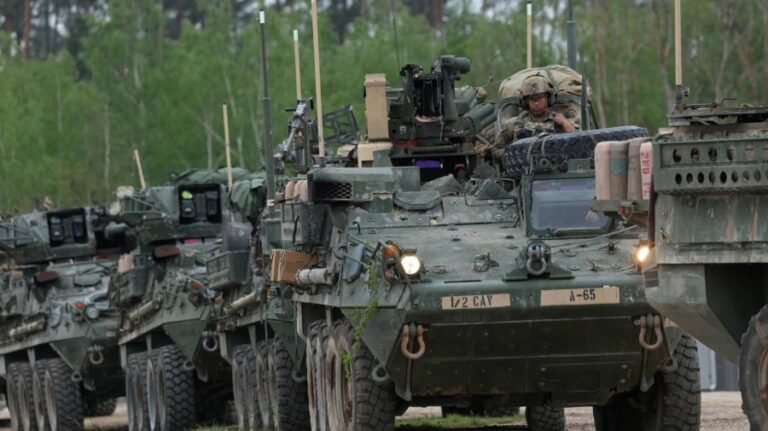
While President Trump has pledged to be a friend to the fossil fuel industry and taken steps intended to bolster it, several of his recent moves have garnered pushback from oil, gas and coal executives.
In a recent anonymous survey, oil and gas companies expressed that Trump was creating “uncertainty” and pushed back against his tariff efforts.
Meanwhile, the coal industry has said Trump’s proposed port fees on Chinese ships make exports difficult.
The discord underscores the tension between Trump’s “America first” agenda and his promise to bolster the fossil fuel industry.
“Firms do not like economic uncertainty,” said Christopher Knittel, a professor of applied economics and dean for climate and sustainability at the Massachusetts Institute of Technology.
“The ‘drill baby drill’ goal is not coming into fruition because of all this economic uncertainty,” he said.
Last week, Trump announced tariffs on nearly every country in the world — spurring crashes in the stock market and fears of a recession. Oil prices have dropped amid the fallout, with U.S. benchmark WTI down to about $61 per barrel on Monday afternoon from as high as nearly $72 per barrel a week ago.
And while a leading oil lobbying group released a statement thanking Trump for excluding oil and gas commodities from the tariffs, other players in the industry have criticized the uncertainty they could cause overall.
A few days before the import taxes were officially announced, the Federal Reserve Bank of Dallas published an anonymous survey of oil and gas companies that warned the Trump administration’s anticipated action was causing an issue.
“The administration’s chaos is a disaster for the commodity markets,” one company said in the survey “‘Drill, baby, drill’ is nothing short of a myth and populist rallying cry. Tariff policy is impossible for us to predict and doesn’t have a clear goal. We want more stability.”
“I have never felt more uncertainty about our business in my entire 40-plus-year career,” said another.
“The administration’s tariffs immediately increased the cost of our casing and tubing by 25 percent even though inventory costs our pipe brokers less,” said a third. “The threat of $50 oil prices by the administration has caused our firm to reduce its 2025 and 2026 capital expenditures.”
The Trump administration has made moves to bolster the fossil fuel industry, too, seeking to speed up approvals for oil, gas and coal and boost production on federal lands.
It has vowed to demolish Biden-era regulations that constrained the fossil fuel industry, including by targeting gas-powered cars and coal plants, opening up new lands and water for drilling and issuing executive orders that aim to lift restrictions on coal mining on public lands.
Asked about the criticism, White House spokesperson Taylor Rogers pointed to Trump’s recent meeting with oil executives.
“For the first time in four years, representatives of the oil and gas industry were welcomed back to the White House. President Trump reaffirmed his commitment to restore America’s energy dominance and drill, baby, drill,” Rogers said.
Tariffs did not come up during that meeting, according to a White House official.
Prior to the worldwide tariffs, the Trump administration also put separate import taxes on Canada and Mexico, which did include oil.
Thomas Rowlands-Rees, head of North America Research at BloombergNEF, noted those tariffs may also complicate the picture for U.S. industry — as American refiners have historically relied on Canadian crude.
“When it comes to the oil industry, there’s a little bit of an ecosystem between neighboring countries, and so taking a step towards isolationism, sort of cuts off parts of [that] ecosystem from each other,” Rowlands-Rees said.
A separate — but similarly protectionist — issue is rankling the coal industry: a proposed fee on Chinese ships.
In its comments on the proposal, the National Mining Association said that several coal companies have reported “the loss of nearly all their export orders for the remainder of the year due to uncertainty surrounding the proposed action’s service fee.”
“As a result, companies must now reassess their current contract demand and production levels, which may lead to significant cutbacks or even closures at their mines,” the trade group said. “If these operators eliminate service to the U.S. to avoid fees, there will be an insufficient number of vessels remaining to meet U.S. export and import demands, including U.S. coal exports.”
Meanwhile, the United Mine Workers of America, a union representing coal workers, recently described the action in a press release as being part of a broader “war on coal miners.”
“This proposal will add such significant costs to exported coal as to make it uncompetitive in the global marketplace. Mines will close and thousands will be laid off,” said Cecil Roberts, the union’s international president, in a written statement.
In new executive orders on Tuesday, the White House did direct the administration to “take all necessary and appropriate actions to promote and identify export opportunities for coal and coal technologies and facilitate international offtake agreements for United States coal.” It’s not immediately clear whether that order or other Trump policy would lead to a change the port fee proposal.
While some Trump moves may be harming the fossil fuel industry, they may not necessarily help the climate, since the tariffs in particular also impact low-carbon technologies like solar, wind and batteries.
“The way I see this is those technologies in America get a lot more expensive,” Rowlands-Rees said. “Maybe oil will get more expensive. Maybe gasoline will get a bit more expensive, but the alternatives will be getting expensive too, and probably more so.”
However, Knittel, with MIT, noted that if there’s a recession, that may come with some emissions reductions.
“A recession by definition is a reduction in economic activity. And one of those main economic activities is consumption of energy,” he said. “Recessions historically have meant less energy is being consumed …When we have a drop in economic activity, we often have a drop in greenhouse gas emissions as well.”