
Hello again, and welcome back to Fast Company’s Plugged In.
Not long after ChatGPT launched, I visited Box’s Aaron Levie at his office. Looking slightly awed and conspiratorial, the CEO of the collaboration platform showed me a tech experiment he was not yet willing to make public. It involved feeding a business document that was thousands of words long into an LLM. The algorithm quickly ground all that verbiage down into a summary that was concise, clear, accurate . . . and useful.
Suddenly, I could see AI having a profound impact on how knowledge workers got stuff done that went way beyond chatbots. And the fact that Levie thought summarization would matter was one reason I took it seriously.
Levie, who cofounded Box in 2005, has long been one of the tech industry’s clearest thinkers and crispest explainers when it comes to the future of productivity. Lately, reading his Twitter/X commentary on how to best make use of AI is one of the few reasons I still find time to grudgingly lurk on that service.
I recently visited him again to talk about why he posts about AI, how quickly the technology is likely to live up to its potential on an array of fronts, and the ways Box and its customers are putting it to use in their own workflows. Our conversation has been edited for length and clarity.
Did you set out to have a Twitter feed that’s dominated by discussion of AI, or did it just happen naturally?
For what it’s worth, this is my happy place, because the amount of awesome stuff happening in technology right now is just kind of amazing. And so the only things I write about are the things that I’m either thinking about, talking to friends about, or seeing from customers or within our business.
It’s a very easy thing to do. I’m just writing as I see it. I’m having an unbelievable amount of fun with everything going on.
To what degree are you trying to frame things so businesses can understand what’s happening and take advantage of it?
It’s interesting. I don’t know if I’m more trying to explain to businesses what’s going on to take advantage of, or explain to Silicon Valley what businesses need to be able to actually use AI.
If I had to guess, two-thirds of the time I’m writing for Silicon Valley and trying to bring tales from the road and reflect on, for instance, why coding adoption is going fully vertical, whereas other forms of knowledge work are diffusing at a slower pace. What’s causing that, and what do we need to think about as a tech industry to better enable that adoption?
A lot of the time, I’m actually more kind of being introspective, on the tech side of the conversation, and that’s what I’m probably mostly doing at the moment.
Is there still a big divide between the Valley and tech companies and startups and the rest of the world?
There is a very big divide, but it’s in axes that are not always 100% predictable. I would say that engineering is probably converging at a faster rate. If you go to a lot of leading banks, and you look at some of their most modern agentic practices around using Cognition or Factory or Cursor or Claude Code, a lot of that might look very similar to what leading companies in Silicon Valley are starting to do. And that’s because engineers generally are pretty tapped into what’s going on.
There’s always 5% of an engineering team that’s super online. They’re paying attention to every new announcement, and then they pull down that new set of best practices, and then that starts to go viral within the organization.
If you’re in a startup, you have a lot more ability to just go. And the person right next to you is maybe the head of IT or the engineer who can help you implement something. Or maybe you’re technical yourself, even if you’re in a marketing or sales role.
The adoption rate tends to actually be faster in the startups by a meaningful amount versus the rest of the world. Large enterprises end up having a lot of compliance, regulatory, and security challenges.
It’s pretty obvious why coding has taken off from a technical standpoint. But what are the most likely candidates for the next things to diffuse?
The capabilities of AI models are quite advanced relative to what we’ve ultimately been able to use them for. And that’s this capability overhang, which basically amounts to, does the rest of the world have some way of connecting the intelligence from these models into a real workflow where they can actually get the gains of that intelligence?
And that’s a hard problem, because if you’re in life sciences and you’re doing massive drug discovery, you might have the world’s most intelligent AI model. But is that AI model able to get access to your proprietary research? Is it able to tap into your clinical drug trial workflow? Are you able to connect it up to all of your various data systems?
If this all happened overnight, it’d be stressful and people wouldn’t have enough time to catch up. But I think we’re in for years of diffusion of AI into these workflows, through an entire applied AI layer of products and companies that go after every single one of these verticals, every single one of these lines of business, and can bridge the model capability with the business process.
You’re going to see them in life sciences. We’ve seen them certainly in legal, with products like Harvey or Legora. We’re going to see them in financial services. We’re going to see them in manufacturing.
And the frontier labs won’t render those specialists irrelevant over time?
The way I think about it approximates most other technologies in history. At almost all times, you have super über-horizontal technologies, and then highly verticalized or specialized tools.
Let’s look at some random examples. If you went backwards 15 years from today, and you looked at the entire product portfolio of AWS and Google Cloud and said, “What do you think the landscape of security products or data service companies or databases or analytics tools will be, given all of the features?” You 100% would not conclude that Snowflake would be a $100 billion company, that Databricks would be a $175 billion company, that ServiceNow would be a $100 billion company, that Palo Alto Networks would be a $250 billion company.
You’d be, like, “Well, wait a second, these gigantic clouds have every feature that every enterprise would ever need for all these services.” It just turns out that that gets you 80% of the way in a lot of the use cases you need to solve. And then the extra 20%, where you just go super deep in a domain, is that applied layer.
They’re not zero-sum. Every dollar that Snowflake or Databricks makes, the underlying cloud providers also make 80 cents of that, or whatever the right number is. That will also be true for AI. The labs will make an unbelievable amount of money based on the applied layer driving workloads through those models. But you still need that bridge layer to be able to connect the workflow into the intelligence.
What advice would you give to knowledge workers who know that AI is important, but are not yet experts, and maybe in some cases are somewhat intimidated by it in terms of what they can do to get value out of it and not be left behind?
You just have to start playing with the tools. And I think people will see a wide range of productivity gain. There are some functions where, even with the best AI in the world, you might only get a 10% or 20% productivity gain. There are some functions—and we’re seeing this with engineering—where you could get a 200% or 300% or 400% productivity gain. But the only way to know where your job function lands, or how to use these tools in the right way, is to adopt them.
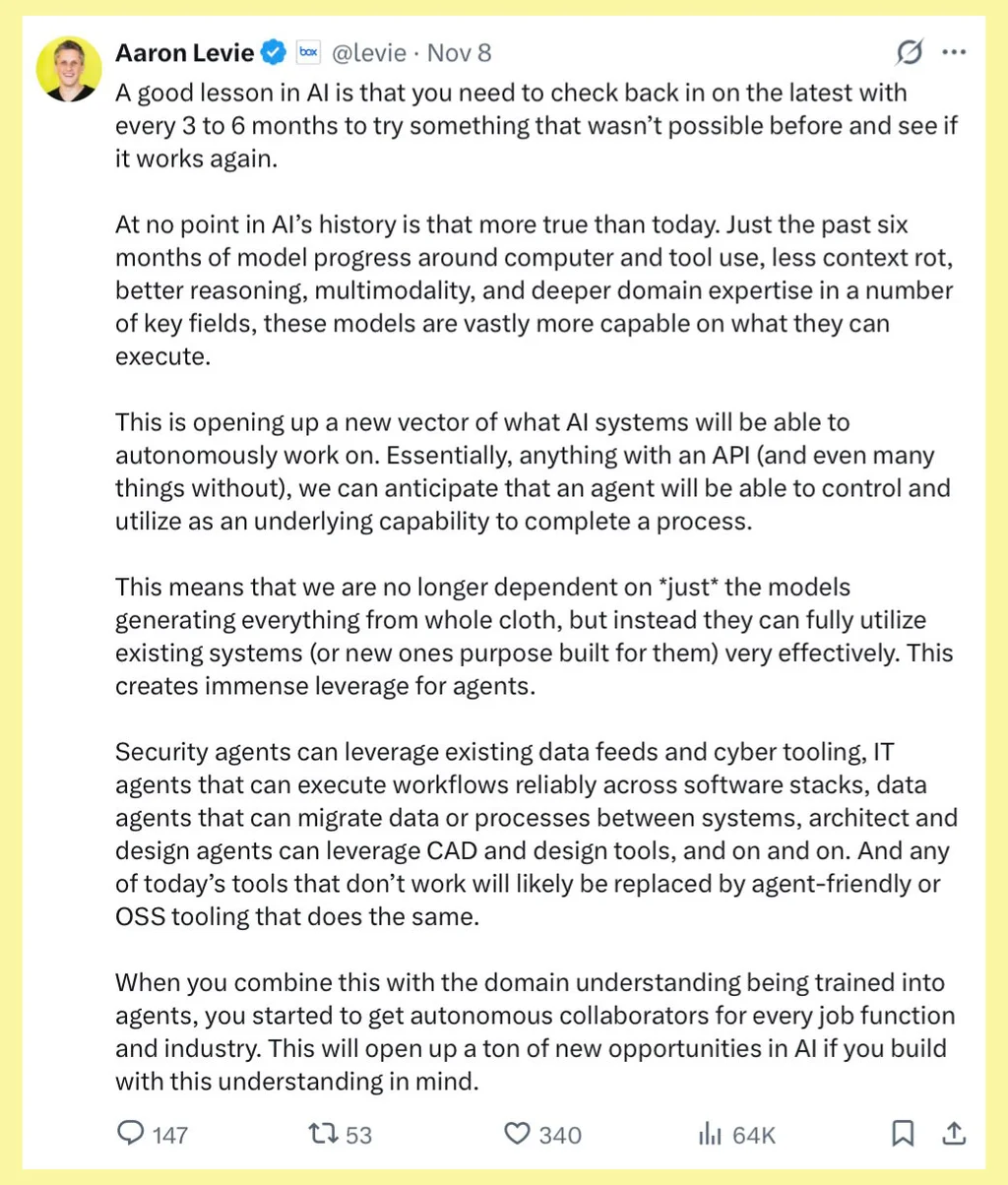
The thing that is probably the most interesting—and unnerving to some extent—about this space is you have to keep trying things on an ongoing basis. There are things right now that large percentages of people have written off that AI will not be able to do. And then a new model breakthrough happens, and it finally can do that.
I’d say 90% of the things I do with AI today were not possible two years ago. Somewhere between two years ago and today, there’s been a breakthrough in each of these areas that makes AI more useful, more enjoyable, more effective, more accurate. And I wouldn’t have known that if I didn’t just keep trying and being, like, “Yep, AI is not ready for that use case. I’ll check back in six months.”
How much of Box’s code is being written by AI these days?
Maybe the better stat is that the significant majority of all code that we write has an agent involved in it. I don’t know the percentage of lines, but I would assume it’s the majority of lines written at this point.
I’m 1,000% a believer in agent coding. It’s allowing us to ship way faster. We’re building more features than ever before. We’re solving customer problems way faster. It’s letting us innovate far more than before.
And what does that do to hiring decisions or your general take on how many people you need and what those people will be doing?
I’m inclined to hire more people as a result of AI in most areas. Because if I can increase the productivity of a job function because of AI, and assuming that we don’t have a shortage of things we want to go do, then that just means more output. Which to me translates to more competitiveness, more innovation, more revenue, more opportunities to go serve customers.
Other than a couple of areas, we are firmly on the side of AI as a job creator, and we’re putting our money where our mouth is. We’re still hiring in most job areas right now, and that will continue to be the case.
Other than coding, how are people using AI within Box?
Kind of for everything, across people’s jobs. One of the benefits of Box itself as a company is nearly all of our data is in Box. It creates an automatic knowledge base for everything you’d want to know: project status, onboarding, a new sales rep who needs to learn how to sell our product, decisions that we made two years ago that now have an implication in some new thing that we’re doing. Product architecture, strategy, all your classic knowledge work use cases of learning about the business and being able to accelerate projects.
That’s how we use it day to day. And then people use ChatGPT and they use Claude for a bunch of other kind of workflows.
How’s the cost? Are people tokenmaxxing and bankrupting you?
We never leaned into the tokenmaxxing side. Nor have we leaned into “You must justify all of your AI usage.” We think people are going to be adults about this. Especially for engineering, we have very disciplined product road maps. And so almost by definition, if we agree on the product road map, then we actually would want to build that product as fast as possible.
So then definitionally you would spend as much money as you could, assuming you could afford it, to get that product done as quickly as possible. And to whatever extent AI can accelerate that in a safe way and a robust way, we want to go and do that.
What should people be worried about with AI?
I think people have an initial relatively myopic view of automation, which is, well, obviously companies are going to use automation to get rid of people. And what I actually find in working with customers is that they mostly want automation so they can accelerate their business on whatever dimension is valuable to their company.
If you’re in life sciences, you want to accelerate drug discovery and clinical drug trials. If you’re in banking, you want to accelerate client onboarding. If you’re in engineering, you want to accelerate software development.
Most companies don’t make that much money by saving money and then just making that into profit. You often can make money by saving money and then redeploying those saved dollars to something else. But then what you usually redeploy them to is also a thing that has labor and has people involved in it. The reason I tend to be pretty optimistic is because when I spend time with customers, they’re optimistic, and they’re not doing the dystopian things that I think people imagine companies are doing with this technology.
The reality is that most companies are saying, “Hey, if you can make my employees 20% more productive, that doesn’t mean I get rid of 20% of my employees. It means I’m going to fight like hell to be even more competitive in my market, to generate more leads and be able to better serve customers and build more features and get more intelligence about the market that I’m in.”
That’s ultimately what I’m seeing play out in a lot of customer environments. And we’re seeing the same thing within our own business.
You’ve been reading Plugged In, Fast Company’s weekly tech newsletter from me, global technology editor Harry McCracken. If a friend or colleague forwarded this edition to you—or if you’re reading it on fastcompany.com—you can check out previous issues and sign up to get it yourself every Friday morning. I’m also on Bluesky, Mastodon, and Threads, and you can follow Plugged In on Flipboard.
More top tech stories on Fast Company
How Jensen Huang’s personal brand boomeranged
A potent public image didn’t help the now-resigned Nvidia CEO. Read More →
The smartphone isn’t dead. But the battle to replace it is already on
Apple, Meta, Google, and OpenAI are fighting to control the next gateway to consumers. For businesses, the stakes go far beyond the next gadget. Read More →
Bending Spoons is buying up the internet. Can its business model last?
The software giant is snapping up familiar brands, cutting costs, and leaning heavily on AI. Its financial results are impressive, but its long-term strategy carries risks. Read More →
Kalshi will pay you $120,000 to play ‘Grand Theft Auto VI’
The job listing is going viral just days ahead of one of the most-anticipated media launches of all time. Read More →
This former Facebook employee wants to show AI in all its glory—and all its flaws
Dave Goldblatt’s new website, Because of AI, tracks the technology’s real-world successes and failures. Read More →
The AI boom was built around Jensen Huang. What happens now?
Nvidia’s former CEO created a sprawling web of investments and partnerships that helped fuel the AI gold rush. His departure could reveal how precarious it all is. Read More →