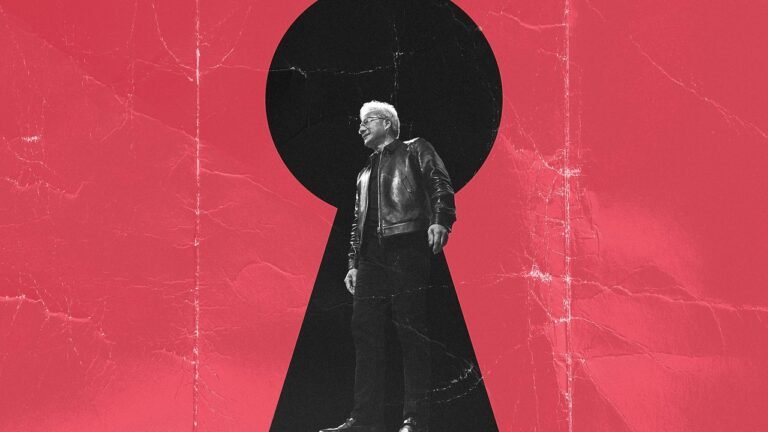
Nvidia CEO Jensen Huang has found himself embroiled in a scandal involving an alleged affair, a suspected Chinese spy, and some of America’s most closely guarded technology. Not exactly your garden-variety corporate indiscretion.
There’s a lot to worry about. Experts are concerned that Huang’s repeated calls to loosen restrictions on advanced chip exports to China may have been influenced by the relationship. The affair also raises questions about Nvidia’s dealings with Megaspeed, a Singapore-based customer led by Alice Huang. The Commerce Department began investigating Megaspeed last year, the New York Times reported, but transferred the probe to the Justice Department after Nvidia reached out.
One of the stranger twists in the still-unfolding scandal is that the Trump administration appears to have known about the relationship—and Alice Huang’s suspected ties to the Chinese government—for some time. Yet intelligence officials apparently never warned Jensen Huang, and Trump seems to be brushing off the scandal. Despite an FBI investigation, the president has called Nvidia’s CEO an “honorable guy” and says he believes Huang didn’t know Alice was a spy. Nvidia’s board, meanwhile, says it has “no reason to believe that either national security or NVIDIA secrets were compromised” and has “confidence in Jensen and his leadership team.”
But current and former government tech officials say the assurances from Trump and Nvidia’s board do little to dispel their concerns. “A sophisticated individual should not have fallen prey to these advances,” a senior government official who focuses on AI issues tells Fast Company.
“Obvious targets for espionage”
The concern extends beyond Jensen Huang’s call for U.S. regulators to clear advanced chips to China. It’s possible Alice Huang may have picked up classified information—anything Trump might have mentioned—from the Nvidia CEO, given his close relationship with the president, suggests David Nesting, a former White House AI and cybersecurity official. Alice Huang may have had access to Nvidia information, too. (CHIPS for America, the Commerce Department initiative overseeing federal investments in semiconductor manufacturing and research, did not respond to Fast Company’s request for comment.)
“His home, office, electronic devices, and private and professional communications would all be attractive intelligence targets,” Nesting tells Fast Company. “China would be enormously interested in Nvidia’s intellectual property, technology, roadmaps, supply chain, and how they might circumvent their export controls.”
People who have sensitive and classified information are supposed to protect that information, but also work with security officials and alert them to anyone who might be asking about it, says the senior government official. “This is not just personal foibles,” the official adds. “Nvidia’s power and integral role in AI means that all decisions made by Mr. Huang inure not only to Nvidia but to the AI industry.”
The affair, and its corresponding national security implications, underscore the risks of concentrating so much of the AI industry in the hands of a single company. Nvidia controls an estimated 80% of the market for GPUs used in AI, according to the OECD. That dependence has, in effect, exposed the country to an “enormous single point of failure,” argues Varoon Mathur, who formerly worked on AI issues at the White House.
“When so much depends on one company, that company and its leadership become obvious targets for espionage, coercion, and foreign interference,” he says.
“The wake-up call we all need”
Pamela Jennings, a former senior policy officer at the CHIPS Research and Development program, housed inside the National Institute of Standards and Technology, sees the immediate fallout as a corporate crisis for Nvidia’s board to address. But the scandal also raises broader questions about how the U.S. cultivates a more resilient tech sector.
“It’s kind of interesting to think about where we are in terms of—particularly in the U.S.—looking at innovation and how we are supporting and resourcing innovation,” Jennings says. “It’s not so much whether Nvidia has a lot of power or not a lot of power, but what feeds into those larger companies and branches from them to make us even more robust and more of a leader globally.”
For another former AI official at the Transportation Department, the scandal raises an even more fundamental concern: how much influence unelected technology executives wield over American foreign policy.
“We’ve handed the keys of international statecraft to CEOs who answer to no voter,” the official says. “The fact that one executive’s bedroom partner could impact worldwide AI and data sovereignty initiatives is the wake-up call we all need.”