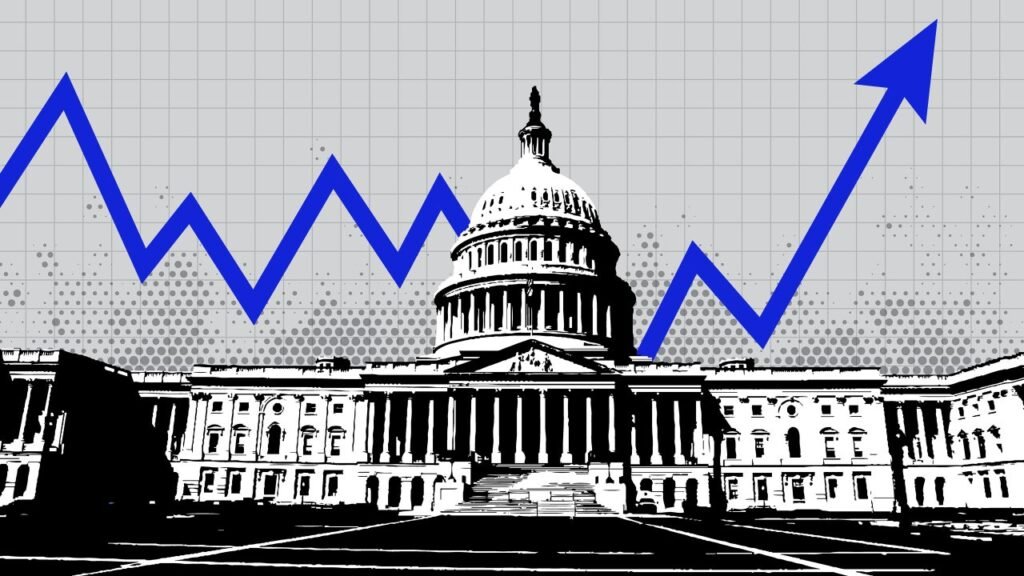
Whether or not Tuesday’s midterm elections deliver a so-called blue wave, one thing is for certain: More volatility will likely ripple through financial markets.
Midterm years have been historically weak for the U.S. stock market, delivering annual gains of just 7.5% versus an average return of 12.4% during non-midterm years, according to figures compiled by BlackRock. And even though more money has been pumped into this year’s midterm campaign than any other in history—to the tune of nearly $12 billion—your 401(k) portfolio isn’t likely to benefit so much.
Despite polling that points to Democrats gaining seats, nay the majority, in Congress, investors haven’t been positioning for such an outcome. Rather, a survey of more than 100 institutional investors conducted by Wolfe Research suggests that these key market players haven’t positioned themselves for any particular result, according to CNBC.
“Investors seem to have a significant dose of skepticism about whether the final outcome is going to be quite as favorable to Democrats as the polling suggests,” Tobin Marcus, the firm’s head of U.S. policy and politics, told the outlet.
Likewise, veteran market strategist Ed Yardeni warns that the stock market hasn’t fully priced in a blue wave, as such an outcome could lead to “much worse” partisanship in Washington, D.C. “It could be a very cold shower for the market in terms of the gridlock,” Yardeni, president of Yardeni Research, told Bloomberg.
WHY HISTORY FAVORS INVESTORS
For long-term investors, the best course of action is ignoring the election results and staying invested. BlackRock cautions that “letting politics guide investment decisions has come at a significant cost” in recent years, as a $100,000 investment in the S&P 500 Index would have grown to nearly $400,000 at the start of this year, if left untouched, whereas investors who moved money out of the market in that timeframe based on their politics would have resulted in much lower returns.
What’s more, any kneejerk reaction to the election outcomes may not be as dire as some people are warning.
JPMorgan’s trading desk puts the odds of a Democratic sweep at 66%, which would lead to a rather tepid kneejerk immediate reaction for the S&P 500. Instead, the less-likely outcomes of Republicans retaining control of both the House and Senate (with odds of only 7%) or Democrats taking the House while Republicans maintain control of the Senate (with odds of 26%) could see stocks rise as much as 1.25%.
And any dips or spikes in the stock market are likely to be short-lived. The S&P 500 has risen by an average of 14.1% in the six months following midterm elections since 1970, according to BlackRock, though scenarios where one party lost its majority control in the House and Senate—as polling suggests could happen this year—delivered returns of only 10.4% in that same period.
HOW THE OUTCOME COULD AFFECT INVESTORS
Complicating matters for this particular midterm election is the surge in stocks this year that’s been fueled by unprecedented spending to support the AI buildout. Meanwhile, the Treasury market just suffered its worst quarterly selloff since 1994.
That’s meant a mixed bag for retirement savers as the classic 60/40 portfolio has delivered lackluster results this year. This allocation model, popularized by the likes of famed investor John Bogle, is made up of 60% stocks and 40% bonds. So far this year, the classic 60/40 portfolio has delivered a return of nearly 7.1%, well below the 10.1% annualized return in the last 10 years, according to estimates by PortfoliosLab.
A Democratic sweep of Congress could put more pressure on stocks—and particularly the high-flying AI stocks that have fueled most of the market’s rally this year. That’s because Democrats are seen as being more likely to pump the brakes on the data center projects that are crucial to the AI buildout and, hence, the market’s continued gains.
Because of how key the AI trade has become to the overall market, investors will closely watch a few key governor’s races—and particularly Texas, which Republican Governor Greg Abbott has called the “epicenter of AI development.” A surprise loss for the incumbent governor has the “potential to spook” the stock market in the short term, as Marcus told CNBC.
On the other hand, if Republicans somehow manage to maintain control of both the House and Senate, it would have the most dramatic implications for the bond market, according to Reuters. That’s because the Republican policy agenda could continue, further expanding the deficit and therefore push Treasury yields even higher.
But no matter what happens, at the very least Wednesday will bring an end to the deluge of political advertisements and texts to voters—as well as the pre-election anxiety that can grip markets, as Ryan Detrick, chief market strategist at Carson Group, told CNBC.
“Once you are through it, it’s a big relief and markets tend to do pretty well.”