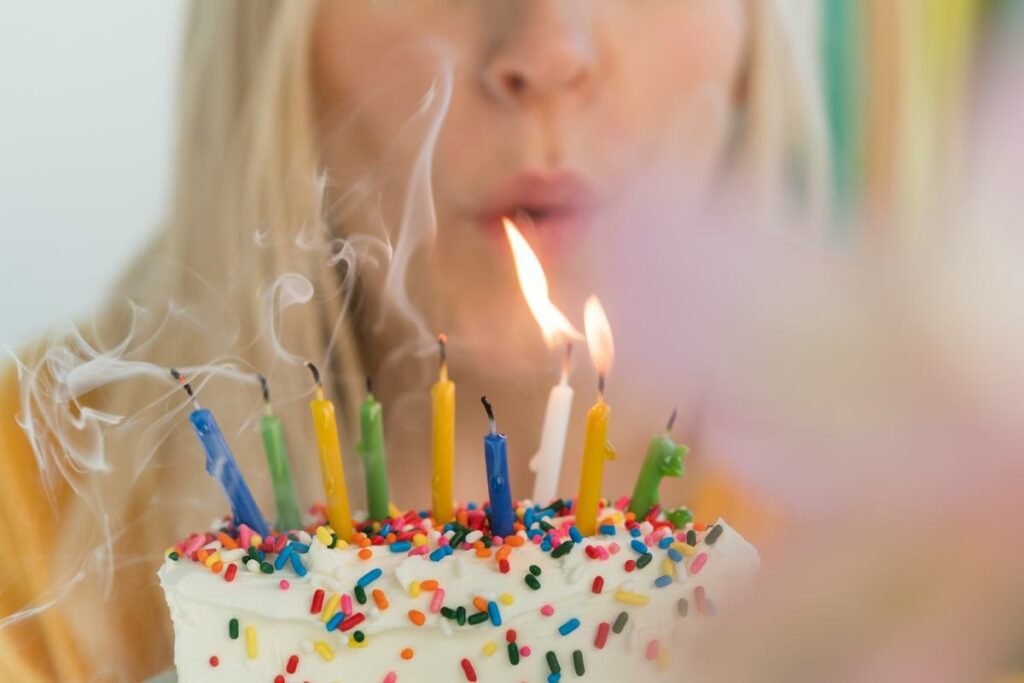
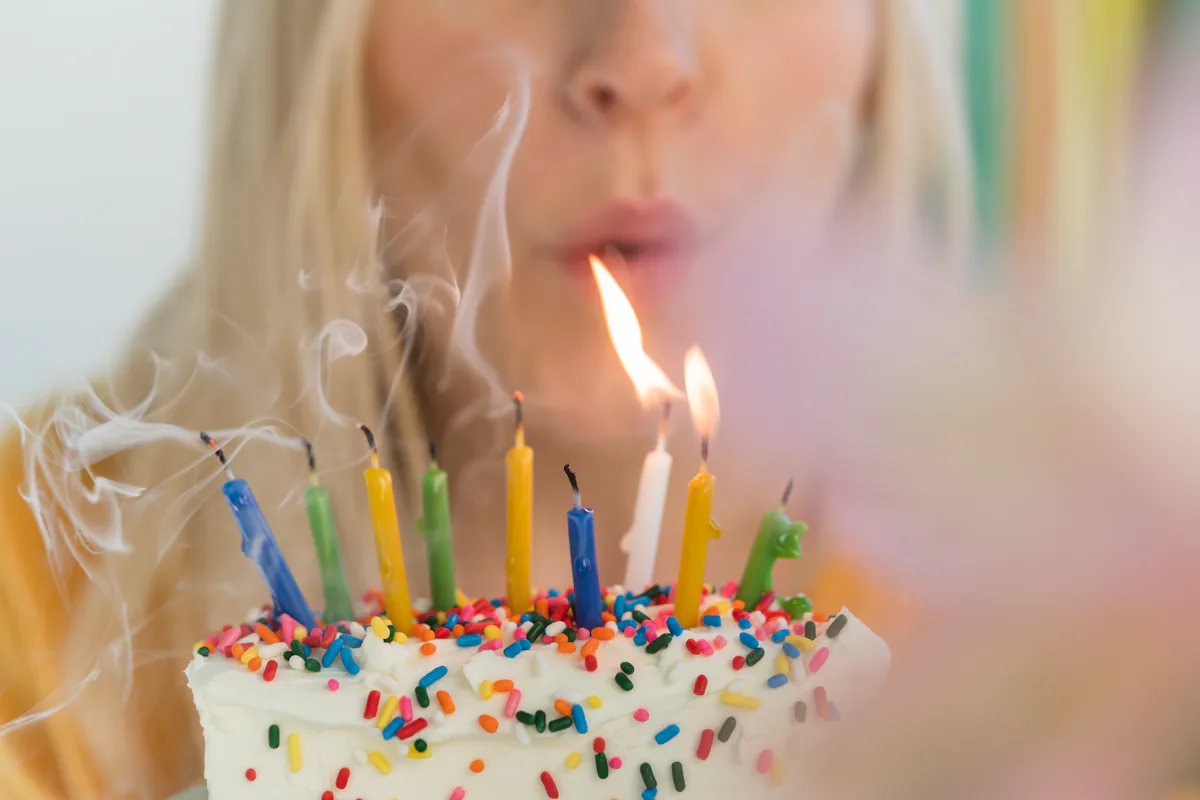
Happy 40th birthday to me. Holy crap, I’m 40.
I’ll be honest, my first instinct was to treat it like a countdown. Forty feels like the year the body starts sending memos. Mammograms. Estrogen quietly packing its bags. The slow arrival of puppy jowls. A sudden, urgent relationship with protein, to the point that even my coffee has protein in it now, and I have made my peace with that.
The questions show up too, usually around 2 a.m. What am I doing with my life? What do I actually want to do with it? Why am I tired and achy and forgetting words in the middle of a sentence? And the one I can’t quite shake: why are men getting more attractive on zero skincare while I run an 11-step routine and negotiate nightly with my jowls and still feel like they’re aging better than me?
We tend to call this stretch of life a midlife crisis. I understand the branding, but crisis isn’t the right word for what I’m feeling. It feels more like an awakening. A quiet rolling-back of everything that once seemed so urgent into something gentler and more deliberate. Turning 40 set me down squarely in the present, and truth-be-told there has been relief in that. Real relief, sitting right next to some real aches and a fog thick enough that I once went looking for the phone I was already holding.
As a kid, I always gravitated toward people decades older than me. As an autistic person, that makes complete sense to me now. Older adults tended to be direct and unambiguous, and they offered a kind of peace, a predictability I could trust. My brain has always reached for the clear and the stable in the people I love. That was never a flaw in how I connected, but it was simply how I connected, and it still is.
And here is what caught me off guard: I looked around one day recently and realized my peers are now the age of the very adults I once found safety in. It isn’t Meg and her friends’ parents anymore, or Meg and her teachers. It’s just Meg and her friends. Somewhere in that quiet math, something came loose in the best possible way. My friends are the ones carrying the wisdom now, the healed-over scars, the stories of growth. They are the grown-ups I used to feel safe beside, except this time we chose each other on purpose. We ask one another to be vulnerable, and we handle that vulnerability with care.
When it isn’t handled with care, when a relationship starts taking up precious space and giving nothing back, we know what to do. My friend, a magnificent Julie Andrews look-alike in her mid-60s, calls it “weeding the garden”. You pull what’s crowding out the good things and make room for new growth.
So in this next decade I plan to weed the garden. For me, this looks like physically listing out who is in my life or who I call “friend” and going through that list to determine if they make my garden more lively and beautiful (oh heck, Marie Kondo that list! Do they bring me joy or no?), do they have qualities I admire and want to be around and do they return the same energy to me that I offer to them? And of course I get there are seasons where that isn’t always possible. Sometimes health and life circumstances cause that give-and-take to shift for a bit. That’s life. That also only amplifies the importance of weeding my garden, because I myself have health issues and know sometimes I can’t show up how I want because my health is taking the reins. I also know I don’t want to be alone when I am at my lowest, same as I don’t want to be alone when I’m at my highest, most excited self. I want community.
There’s another reason 40 is landing differently for me. I’m an autistic speech-language pathologist, and I spend my days with kids and adults of every age who live with invisible disabilities. I work for a nonprofit that champions sensory inclusion, built on the simple idea that the world should be designed to hold people rather than test them. Part of my job is training people on the very tools that help with memory and word retrieval after a stroke. So there’s a particular kind of comedy in the fact that I teach people how to find the words they’ve lost, then go home and stand in my kitchen hunting for the word “phone” while I am holding the phone.
If I’m going to grow older, and I am, I want to do it having actually lived. I want to grow older surrounded by the friends and family I love, in a loud, blended, three-kid house I would not trade for anything quieter. I want to grow older having finally stepped into this strange, aching, wonderful Meg-body and claimed her as my own while trying to look as fashionable and fabulous as the late great Iris Apfel. I want to grow older having learned, even a little, how to stay here in the today instead of stuck back in yesterday or bracing for tomorrow.
So no, this isn’t a crisis. It’s the year I stopped keeping what no longer belonged and started making room for what does.
Happy birthday to me. Go weed your garden.
Meg Raby is a mom, children’s author of the My Brother Otto series, and Autistic residing in Salt Lake City where you can find her playing and working with neurodivergent children as a Speech Language Pathologist and friend, or writing and planning big things in the second booth at her local coffee shop that overlooks the Wasatch Mountains while sipping on her Americano. Meg believes the essence of life is to understand, love and welcome others (aka, to give a damn about humans).