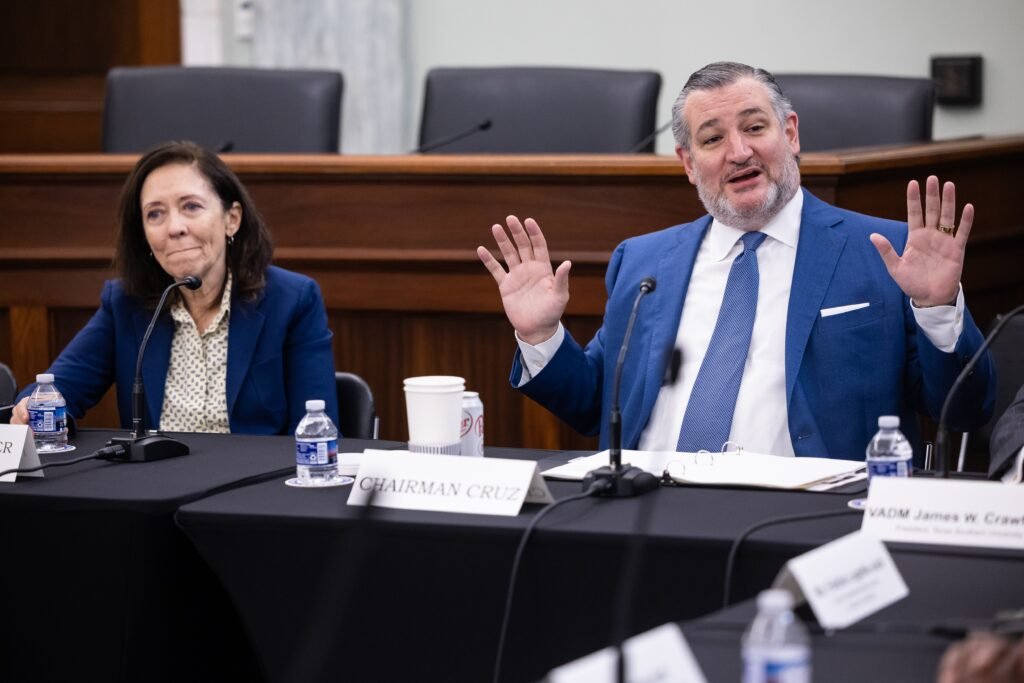
Sens. Ted Cruz and Maria Cantwell typically find themselves at odds, but in the past week each expressed optimism that their major bipartisan breakthrough on college sports could set them up to tackle other big things — like artificial intelligence.
Evidence suggests that confidence ought to be tempered.
Cruz, a Texas Republican, and Cantwell, a Washington Democrat, have served together atop the Senate Commerce Committee for nearly four years — with Cantwell first serving as chair before turning the gavel over to Cruz in 2025.
They have occasionally found common ground, such as trying to eliminate hidden ticket fees for concerts and sporting events, and enacting safety measures after the deadly plane crash near Ronald Reagan Washington National Airport. Their bill to overhaul the multibillion-dollar college sports industry, which overwhelmingly passed the Senate last week, has been their highest-profile achievement to date, requiring months of brass-tacks negotiations, painful compromises and uncomfortable divisions with colleagues and key constituencies.
Asked if her partnership with Cruz on college sports could translate into an agreement on AI, Cantwell did not exactly embrace the idea.
“I thought a century ago … if we all worked together and got something done on the sports thing, it would be a good basis to show we could get something done on privacy and AI,” she said. “And look how long it took.”
After a pause, she added, “I think this is showing people that you can get something done.”
Posed the same question, Cruz said in an interview he did think the college sports win bodes well for future collaborations.
“Senator Cantwell and I have a very good, productive working relationship, and she is someone who works very hard,” he said. “And without her tireless work and commitment to getting this done, we’d never be here.”
But among the dozen lawmakers, aides and industry experts who spoke to POLITICO, few expect the two senators to shed their well-established ideologies and styles. That could doom their ability to replicate their latest achievement in something as complex and divisive as an AI regulatory framework.
“I believe that bipartisanship is a muscle and therefore does atrophy. And I think that when you have one success, that is a good omen for future success,” said Sen. John Hickenlooper (D-Colo.), who sits on the Commerce Committee and was involved in negotiations over the college sports package.
“It is no guarantee,” he acknowledged, “and AI is a whole different kettle of fish.”
Cantwell is a longtime Democratic politician and former tech executive — so firm in her belief in strong federal AI guardrails it’s hard to imagine a path to consensus with Cruz, whom she has a history of publicly bashing when the two are divided on an issue.
Cruz is a staunch conservative with a popular podcast and well-known desire to be president. He has sought to balance his concern that AI threats are “scary as hell” with his allegiance to the White House, which argues that heavy regulations on the industry would cede ground to China.
With college sports regulation, they shared the belief that there was a problem for Congress to solve — that a wide range of college sports programs risked being canceled in an era when powerhouse schools could pay huge sums of money to attract top athletes.
Both Cruz and Cantwell wanted to establish national rules on compensation, eligibility and transfers while preserving the rights of students to earn money from their name, image and likeness.
The senators and their aides spent countless hours together in conference rooms, with Cruz often saying he would bring out “very sweet Cuban coffee” when discussions became tense. Cruz, eager to advance a bill backed by Trump, was willing to make concessions to win Democratic support after failing to move an earlier version of the package. For instance, he backed off his insistence that student-athletes be defined in the bill as non-employees.
Cantwell, for her part, broke with years of Democratic resistance to granting the NCAA any antitrust protections at all. An earlier bill she sponsored dealing with student-athlete rights did not include such protections. And when her bill with Cruz passed, Cantwell acknowledged there was still “more to do.”
Their approach to AI legislation so far is not as clear cut. While Cantwell has pushed for stricter regulations, Cruz’s exact perspective is harder to pin down. And while he’s been promising for months to convene hearings and markups on bipartisan AI safety legislation, he has yet to do so. In September, he blamed stalled negotiations between Senate Majority Leader John Thune and Sen. Amy Klobuchar (D-Minn.).
Even as Cruz and Cantwell were busy making progress on college sports over the summer, Cantwell was openly telling reporters that Cruz had tried to undermine her on AI policy in late 2024. That’s when she, as Commerce chair, attempted without success to bring seven bipartisan measures related to AI to the Senate floor that had advanced through the committee.
“There’s a lot of bipartisan bills that he put his big foot on” and “basically stonewalled” in the previous Congress, Cantwell griped — a sign of the deep distrust that still remains between the two lawmakers. Cruz’s aides at the time disputed he had sought to undercut her efforts.
Back in 2024, Cruz was also regularly blasting Democratic-led efforts to regulate the AI industry. At one Committee Committee hearing, he warned that creating a new bureaucracy to prevent AI models from annihilating the human race amounted to “an absurd exaggeration that would make Arthur C. Clarke and Isaac Asimov laugh” — references to the famous science fiction writers.
With the college sports legislation, Cantwell and Cruz were united enough in their larger mission they were each willing to take on powerful forces inside their own parties.
Cantwell forged ahead despite deep opposition from members of the Congressional Black Caucus and organized labor. Cruz had to arm-twist GOP senators who had objections, including former college football coach-turned-Alabama Sen. Tommy Tuberville. Their bill eventually passed the Senate 77-22, but there’s still no guarantee it will be victorious in the House.
With AI legislation, it’s not clear whether either senator has the fortitude to lock arms around a framework and take similar risks.
The results of the midterm elections also will determine whether it’s Cruz or Cantwell who will hold the Commerce gavel in January. That dynamic will, in turn, affect what sort of dealmaking can be achieved going forward.
Sen. Todd Young, an Indiana Republican who sits on the Senate Commerce Committee and was initially opposed to the college athletics legislation before voting “yes,” said in an interview he was trying to remain positive.
“Do I think that the sports initiative is a confidence-building measure to bring them together and sweet harmony on AI?” Young said. “Maybe. I hope so.”