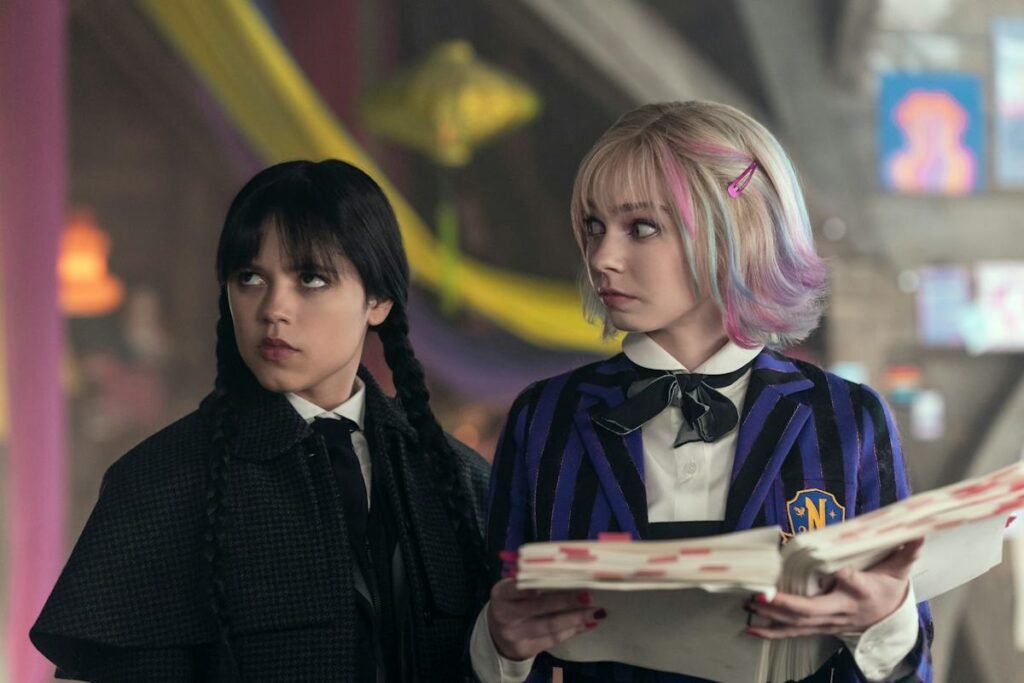
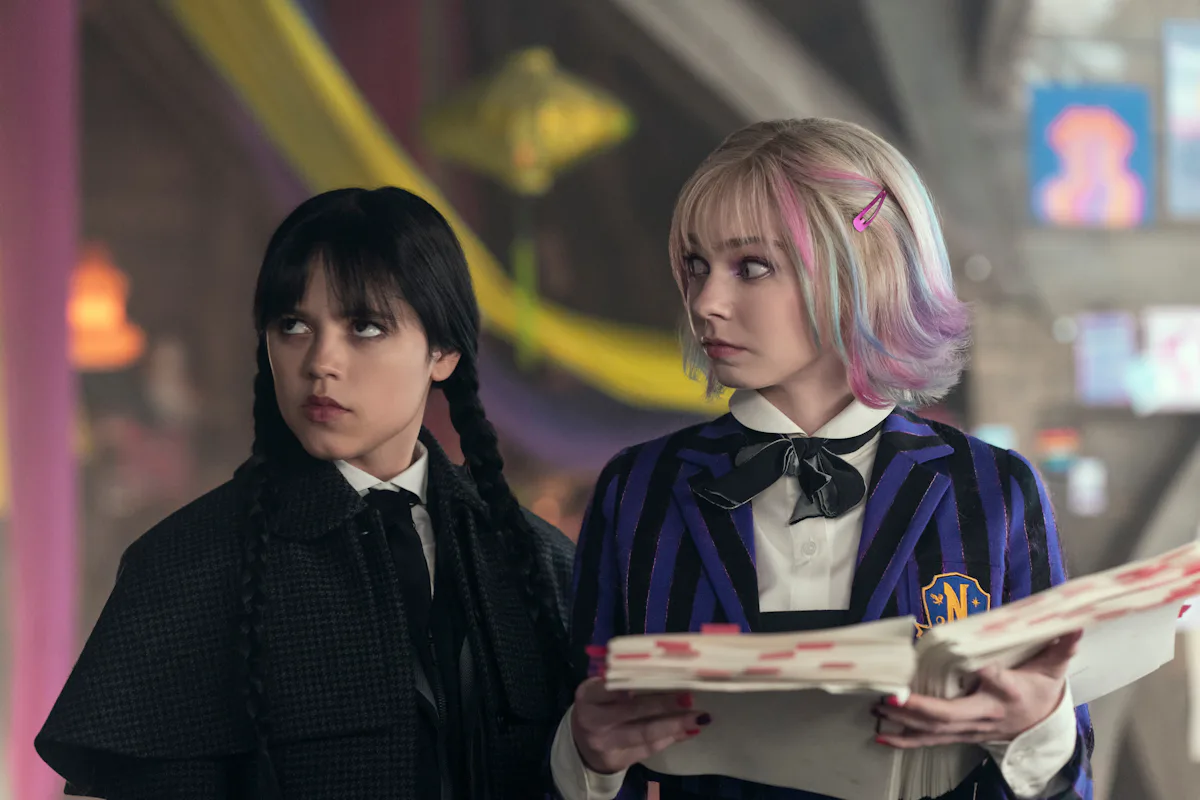
One of my favorite elements of The Addams Family revival show, Wednesday, is the polar opposite personalities of roommates Enid and Wednesday. While Wednesday is all doom and gloom and monochrome, Enid is a colorful explosion of extroversion.
My daughter is a hybrid of the two, a talkative rainbow lover who also has interest in more morbid topics. It has led to some interesting conversations. Like when she asked me how “the dinosaurs’ bones got out of their bodies” at the natural history museum, and I ended up discussing decomposition, caskets, and embalming over a snack of Goldfish.
But when she starts talking about chopping my limbs off or crafting coffins for her stuffed animals, I do wonder whether this is normal behavior. If your child leans more Wednesday than Enid, you might be wondering the same.
Developmentally Appropriate Curiosity
While your child’s interest in death, horror movies, or violence might be giving you the creeps, it isn’t necessarily a cause for concern. In fact, this curiosity can actually be developmentally appropriate, says Dr. Monika Roots, child/adolescent psychiatrist and co-founder at Bend Health, a provider of pediatric mental healthcare.
“Kids use imagination and play to explore ideas that feel big, confusing, or emotionally charged. That can show up as dramatic stories, dark humor, or pretend scenarios that sound alarming to adults,” explains Dr. Roots. “This can also include interest in gothic characters, spooky imagery, or dark humor as part of identity exploration, especially in later childhood and adolescence.”
She encourages parents to remember that asking questions about or having interests involving these topics doesn’t equal intent. “A child talking about death or dark ideas is often trying to understand concepts they’ve encountered in stories, media, or conversations, not expressing a desire to cause harm,” Dr. Roots says.
Jillian Amodio, a licensed social worker who works with adolescents, agrees that curiosity about these topics is natural, since we all at some point consider questions about death, dying, and why people hurt each other.
“For teens especially, this is a time of life where they are developing the ability [for] more abstract thinking,” says Amodio. “A focus on or interest in things like true crime, death, and danger or suspense is an excellent and enticing way to explore emotions and process the complexities of human existence. It is a way to safely test boundaries or explore themes that would not be safe or socially acceptable to put into practice.”
Having Conversations About Dark Topics
When parents are open to having conversations about topics like death, it can create a safe space for children to process their concerns and ask questions. Roots recommends answering any questions simply and calmly, remaining curious about dark-themed play, and establishing that processes such as death and dying are natural, rather than something to be afraid of.
“If a child references something provocative they’ve seen … like a dark slogan or violent-sounding phrase, it’s often more helpful to ask what it means to them before assuming it reflects how they feel,” Roots reminds parents. “This keeps communication open and reinforces that difficult or uncomfortable topics are safe to talk about at home.”
Shutting down these conversations or responding negatively can make these kinds of topics feel scary or more mysterious, explains Roots. And this can make it more likely for older children and teens to look for the answers to their questions from their peers, social media, or the internet, which could lead them to inaccurate information or materials of a more disturbing nature.
Parents asking more questions about an interest or fixation can also provide an opportunity to dispel worries. Amodio recalls a client’s parents expressing concern because their child was carrying around a doll and saying it was dead. “Turns out the child was watching a lot of cartoons featuring vampires, he knew that vampires were ‘dead,’ and he had decided that his doll was also a vampire,” she says. “He had no preoccupation with death or dying; he simply was connecting his toy to a cartoon.”
Red Flags To Look Out For
While in most cases an interest in the macabre is nothing to worry about, sometimes it could be a sign of something more serious going on. With younger children, Roots recommends paying attention to the tone of their play.
“There is a difference between exploring dark themes as fantasy or humor and play that feels rigid, distressing, or rooted in real-world intent,” she says. “A child telling a spooky story while smiling, laughing, or moving easily between themes is very different from a child who seems tense, fearful, or stuck.”
For adolescents, Amodio says, “It is more about how teens engage with this type of content or interest, rather than the interest itself. If an interest in true crime, or the afterlife, for instance, becomes an obsession or fixation rather than a topic of curiosity, that is a red flag to watch out for and address.”
Other red flag behaviors cited by Roots and Amodio include:
- Physical aggression directed at themselves, other people, or animals
- Exhibiting a lack of empathy
- Obsession with and overconsumption of violent content
- Obsession or identification with violent perpetrators such as serial killers, school shooters, etc.
- Creating artwork or writing that explores themes of self-harm or harming others
- Withdrawal from and difficulty functioning in school and relationships, and rejecting activities they once enjoyed
- Difficulty sleeping
- Expressing feelings of numbness, hopelessness, detachment, or suicidal ideation
Roots reassures, “A dark aesthetic, a spooky phase, or provocative language doesn’t automatically signal danger. What matters most is how the child feels and functions underneath it.” If your child or teen is experiencing some of these behaviors or symptoms, she recommends seeking a consultation with a mental health professional such as a psychiatrist or therapist.