Editors’ Highlights are summaries of recent papers by AGU’s journal editors.
Source: Journal of Geophysical Research: Solid Earth
Changes in how often earthquakes occur can reveal the evolution of stress on faults, providing a window into processes that are otherwise difficult to observe. Jiang et al. [2026] introduce T-rate, a Bayesian method that evaluates many possible stress histories to reconstruct stress changes from earthquake records and quantify the associated uncertainty. The method represents each episode of stress loading as a flexible rise, steady phase, and decline. Tests with simulated earthquake sequences show that T-rate can recover complex stress histories under a range of conditions.
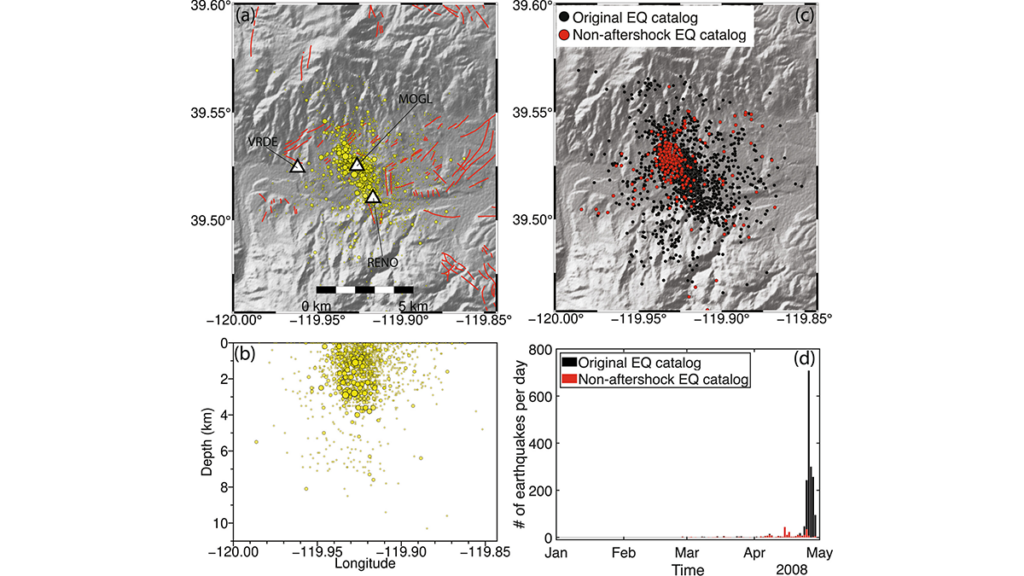
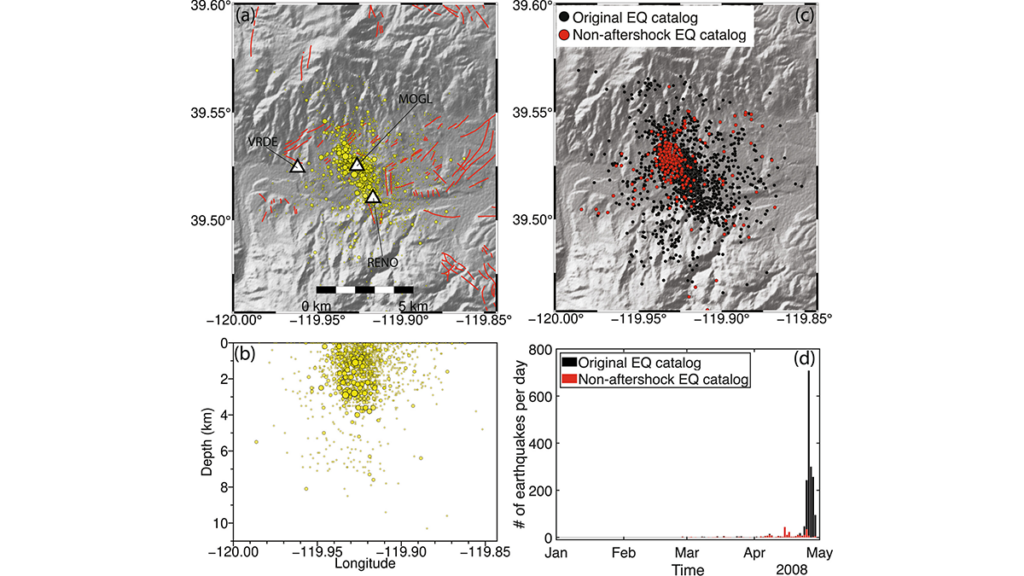
Applied to the 2008 Reno–Mogul swarm, the preferred model identifies four loading phases, including a sharp increase beginning about three days before the magnitude 5.1 earthquake. The timing of this late increase remains relatively stable across the tested data-processing choices. Combined with independent GPS measurements of ground deformation and observations of rapid earthquake migration, the result points to slow fault motion without detectable earthquakes as a plausible source of the final loading phase. By turning widely available earthquake records into uncertainty-aware estimates of stress evolution, the openly available T-rate tool complements ground-deformation measurements, especially where they are sparse, and supports studies of earthquake swarms and other transient fault processes.
Citation: Jiang, Y., Trugman, D. T., & González, P. J. (2026). Bayesian inference of complex stress evolution in rate-and-state governed faults constrained by seismicity rate observations. Journal of Geophysical Research: Solid Earth, 131, e2026JB033922. https://doi.org/10.1029/2026JB033922
—Bogdan Enescu, Associate Editor, JGR: Solid Earth
Text © 2026. The authors. CC BY-NC-ND 3.0
Except where otherwise noted, images are subject to copyright. Any reuse without express permission from the copyright owner is prohibited.