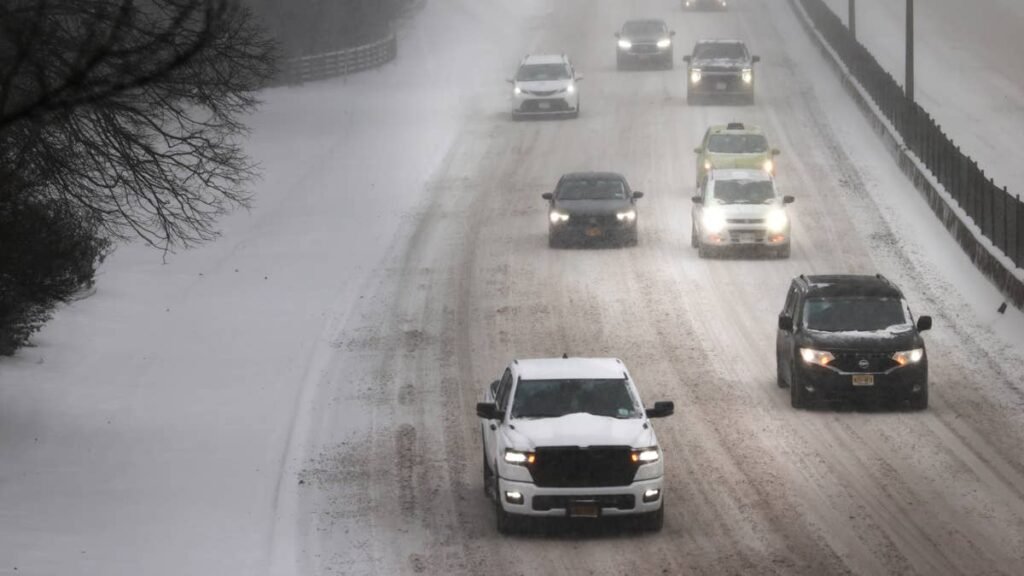
As we originally reported on this storm here, NWS Fairbanks reissued its winter weather advisory for the eastern Alaska Range at 12:19 p.m. AKDT Sunday, replacing the morning version with a lower snowfall floor, a stated elevation threshold, and a longer window of falling snow. The updated product calls for 4 to 8 inches above 2,000 feet along the Richardson Highway near Isabel Pass, with heavier amounts above pass level, and northerly winds gusting as high as 40 mph. It runs from midnight AKDT Monday to 4 a.m. AKDT Tuesday, which is 4 a.m. ET Monday to 8 a.m. ET Tuesday.
What Changed In The Reissue
The snowfall range went from 5 to 8 inches to 4 to 8 inches, and the geography behind that number changed with it. The morning version applied its totals to higher elevations north of Isabel Pass. The update applies them above 2,000 feet near the pass, which is a threshold rather than a compass direction and puts the accumulation squarely on the roadway rather than only on the terrain around it.
The zones are the same as before: eastern Alaska Range north of Trims Camp and eastern Alaska Range south of Trims Camp, covering the Richardson from Milepost 202 to Milepost 259, a continuous 57 miles taking in Trims Camp, Black Rapids and Donnelly Dome.
Where The Storm Stood At Midnight
The transition had not happened yet at road level when the advisory took effect. In the midnight AKDT Monday Alaska weather roundup, Delta Junction, at the north end of the corridor, reported rain at 43 degrees with visibility down to 7 miles and a southwest wind at 6 mph. Glennallen, at the south end, reported fog and rain at 45 degrees with visibility of 3 miles. Twenty-four hours earlier the same Delta Junction station was cloudy and dry at 46 degrees.
Why Wet Snow Is The Harder Problem
Dry snow at 20 degrees packs and sheds. Wet snow near freezing does neither. It lands on wet pavement, gets compressed by traffic into a slush layer, and then refreezes under it as the surface temperature falls, which produces a road that looks slushy and behaves like ice.
Tire compound is what covers the gap. Winter rubber stays pliable below roughly 45 degrees, where an all-season begins to stiffen, and on a thin slush layer the compound and the tread depth are doing all of the work. All-wheel drive is not helping here. It splits torque under acceleration and contributes nothing to braking or cornering grip. Cold pressure is worth a check too, since a tire loses roughly 1 to 2 psi for every 10-degree drop, and a set last set in summer is running soft now with nothing visibly wrong.
Before You Drive It
NWS closes the updated advisory with the same two instructions it opened with. Slow down and use caution while traveling, and check 511 Alaska or dial 511 for current road conditions. On a 57-mile stretch with services spaced this far apart and a forecast that now covers the afternoon as well as the morning, both are worth taking literally.