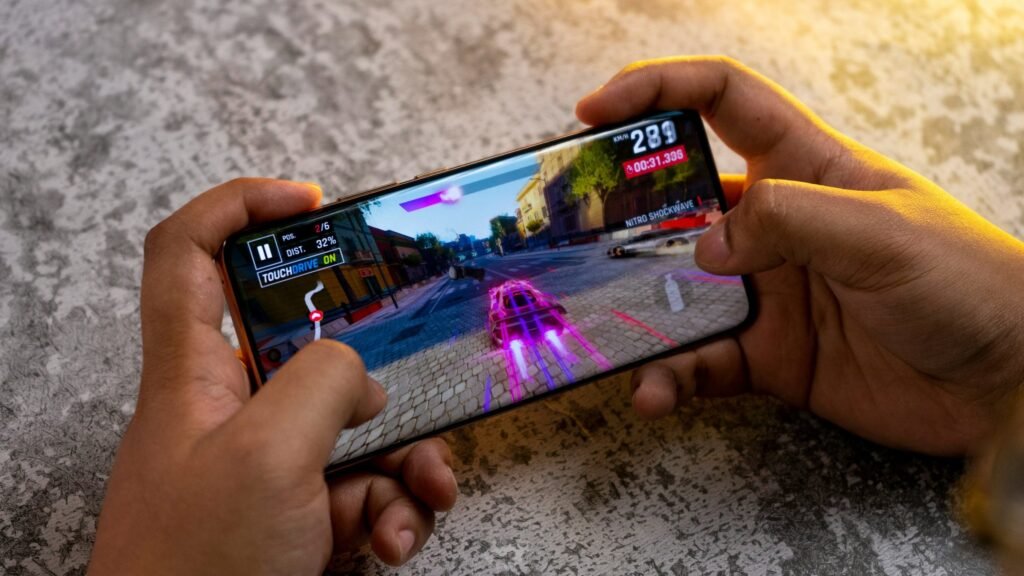

You know the exact feeling. You’re playing a mobile RPG, grinding for that one rare item with a 1% drop rate, and your inventory is still completely empty. It is incredibly easy to blame the game’s code. But the truth about how your phone calculates chance is a lot more complicated than a digital dice roll. Because smartphones are deterministic machines, they rely on complex random number generators to keep things fair. Whether it’s a standard gacha game or a provably fair iGaming platform like SpinBit, getting a highly predictable processor to do something genuinely random requires serious math.
The illusion of pseudo-randomness
Because a computer cannot simply “guess” a number, developers use what is called a Pseudo-Random Number Generator (PRNG). This is an algorithm that requires a starting point, known as a seed.
In older games, that seed was often tied to the system clock. If you pressed a button at the exact same millisecond across two different playthroughs, you would theoretically get the exact same result. Today, the math is substantially more robust. The core logic usually relies on a Linear Congruential Generator, which looks something like this:
$X_{n+1}=(aX_n+c)pmod{m}$
The game takes your seed value (Xn), crunches it through a massive multiplier, and adds a constant, and divides it to find the remainder. That remainder is your random event. And it happens in milliseconds. Whether you’re playing a high-end mobile MOBA or testing out early emulator builds in an unofficial capacity, the underlying processor is making thousands of these calculations every second just to figure out where an NPC should walk or what loot should drop.
Hardware entropy and true random generation
Software algorithms are great for basic mobile games, but PRNGs have a fatal flaw: if you know the seed and the algorithm, you can predict the outcome. For anything requiring serious security, mobile devices step up to True Random Number Generators (TRNGs).
Instead of relying on a math formula, TRNGs pull “entropy” from the physical world. Your smartphone’s processor actively measures microscopic physical phenomena—like thermal noise in the silicon or microscopic variations in the photoelectric effect—and translates that physical chaos into digital data.
Organizations like the National Institute of Standards and Technology (NIST) maintain incredibly strict standards for how this hardware operates. Modern flagship processors have secure enclaves built right in to handle these tasks, which is exactly why premium devices like the Samsung Galaxy Z Fold 8 can process heavy, secure cryptographic workloads directly on the device without breaking a sweat.
The shift to provably fair systems
The stakes change entirely when you move from single-player RPGs to competitive environments. Players need absolute mathematical proof that the game isn’t altering the odds behind the scenes. Enter the “provably fair” algorithm.
This system uses cryptographic hashing (usually SHA-256) to ensure transparency. Before a game even starts, the server generates a secret seed and shows you a scrambled hash of it. Your device then provides its own active client seed. The two seeds combine to create the final, randomized outcome.
This level of transparency is quickly becoming the baseline standard for secure mobile platforms. Because you provide half the equation and can verify the math after the round ends, the platform literally cannot change the outcome mid-game. The math simply wouldn’t match the hash. For developers, it solves the oldest problem in gaming: proving to the player that the house isn’t cheating. You get the hash, you check the math, and the results are undeniable.
What this means for your screen
We rarely think about the work happening beneath our glass screens. A policy built to ensure fairness is quietly pushing mobile software into a much more secure, transparent era. The next time you manage to land that ultra-rare 1% drop on your first try, you aren’t just getting lucky. You are sitting at the very end of a complex chain of hardware entropy, cryptographic hashing, and silicon-level thermal measurements.
That is a HUGE leap from the simple clock-based seeds of the past.
A quick note on responsible play: Mobile iGaming should always be treated strictly as entertainment, never as a reliable way to make money. It is highly recommended to set personal time and spending limits before you start playing and always take breaks during longer sessions. Never play with more than you can comfortably afford to lose, as real money can be lost. You must be of legal age in your jurisdiction to participate. If the experience stops being fun, step away immediately, and seek support if needed.
The post How Random Number Generators Actually Work in Your Phone’s Games appeared first on Android Headlines.