
Want more housing market stories from Lance Lambert’s ResiClub in your inbox? Subscribe to the ResiClub newsletter.
During the Pandemic Housing Boom, we saw red-hot housing demand quickly absorb much of the available slack in the housing market. Back in 2021, active housing inventory for sale, unsold completed new builds, and available lot supply all plunged to historic lows.
But ever since the Pandemic Housing Boom fizzled out in mid-2022, housing slack has slowly been building back up—especially in certain pockets of the Sun Belt (although, of course, there’s a lot of nuance, and Florida has recently given back some of that slack).
For evidence of increased slack, look no further than Zonda’s New Home Lot Supply Index, which measures lot supply based on the number of single-family vacant developed lots and the rate at which those lots are absorbed via housing starts. A higher index value indicates a greater supply of single-family vacant developed lots, while a lower index value indicates a tighter lot supply/new construction market.
That index reading for Q2 2026 climbed to 85.2—well above the all-time low of 35.8 set at the height of the Pandemic Housing Boom in Q2 2022, when builders were buying as much entitled land as they could find.
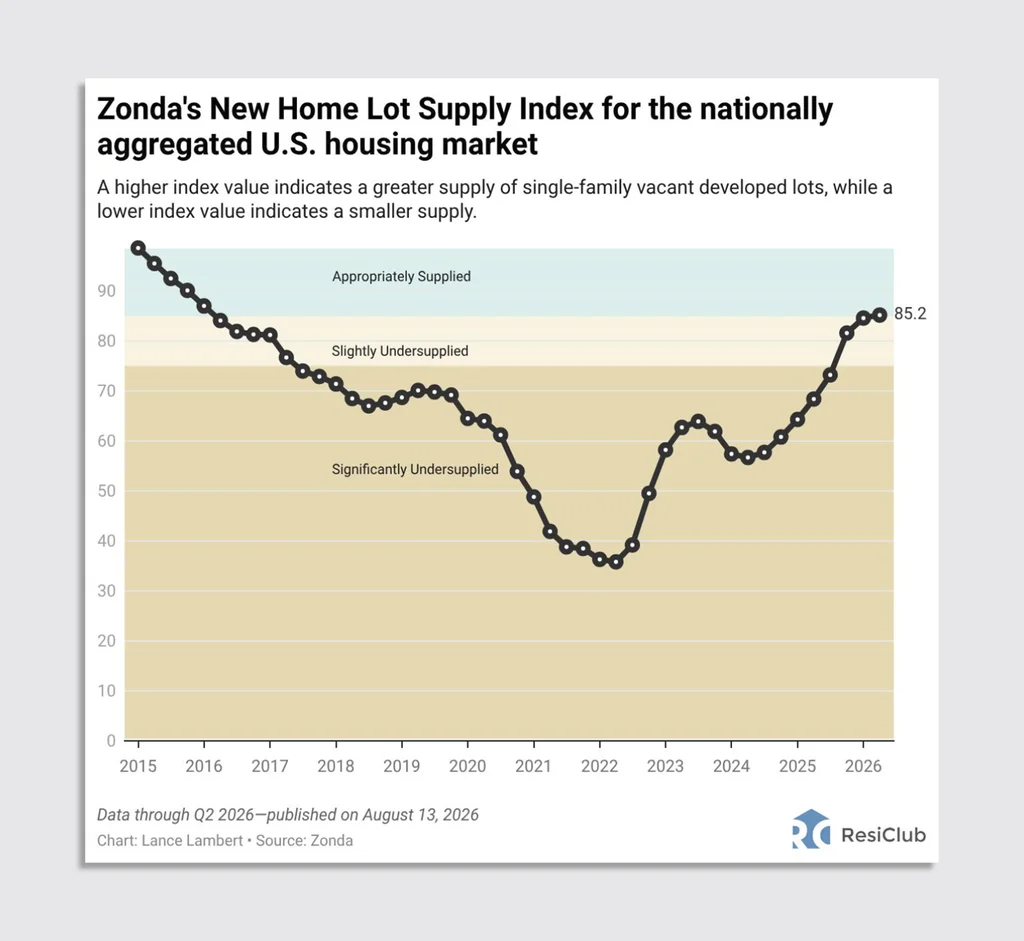
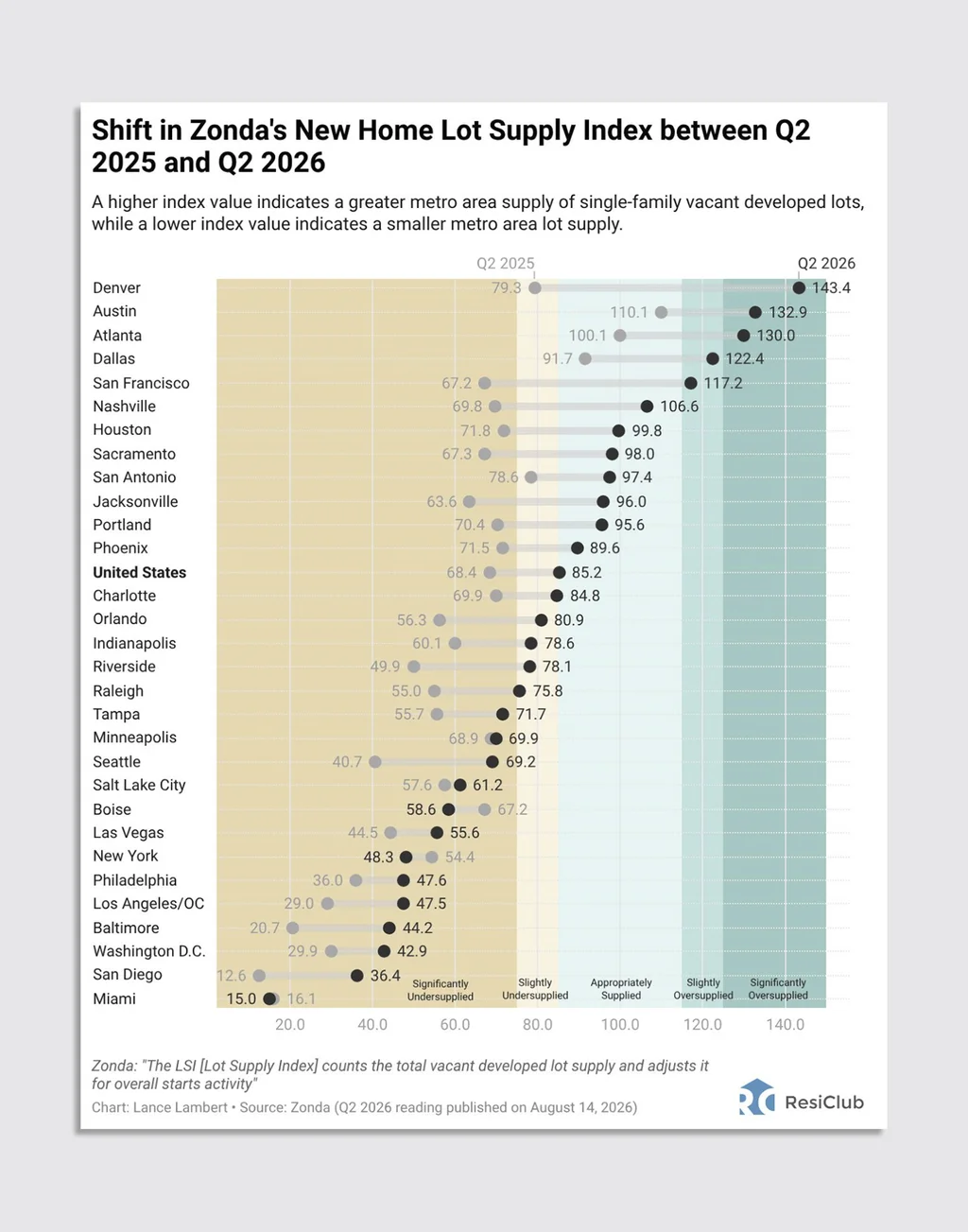
According to Zonda, homebuilder lot supply loosened/rose in 27 of the 30 major metro area housing markets tracked over the past 12 months.
Housing markets like Austin, Atlanta, Denver, Dallas, L.A., Seattle, and Jacksonville experienced some of the most significant loosening of lot supply.
That said, despite an uptick in available lots in some markets on a year-over-year basis (and the national aggregate rising into the “appropriately supplied” range), around half of major housing markets are still what Zonda considers “slightly undersupplied” or “significantly undersupplied.” The picture varies a lot across markets.
Zonda’s New Home Lot Supply Index has 5 groupings:
- “Significantly oversupplied” = 125 score or higher
- “Sightly oversupplied” = 115-125 score
- “Appropriately supplied” = 85-115 score
- “Slightly undersupplied” = 75-85 score
- “Significantly undersupplied” = 75 score or lower
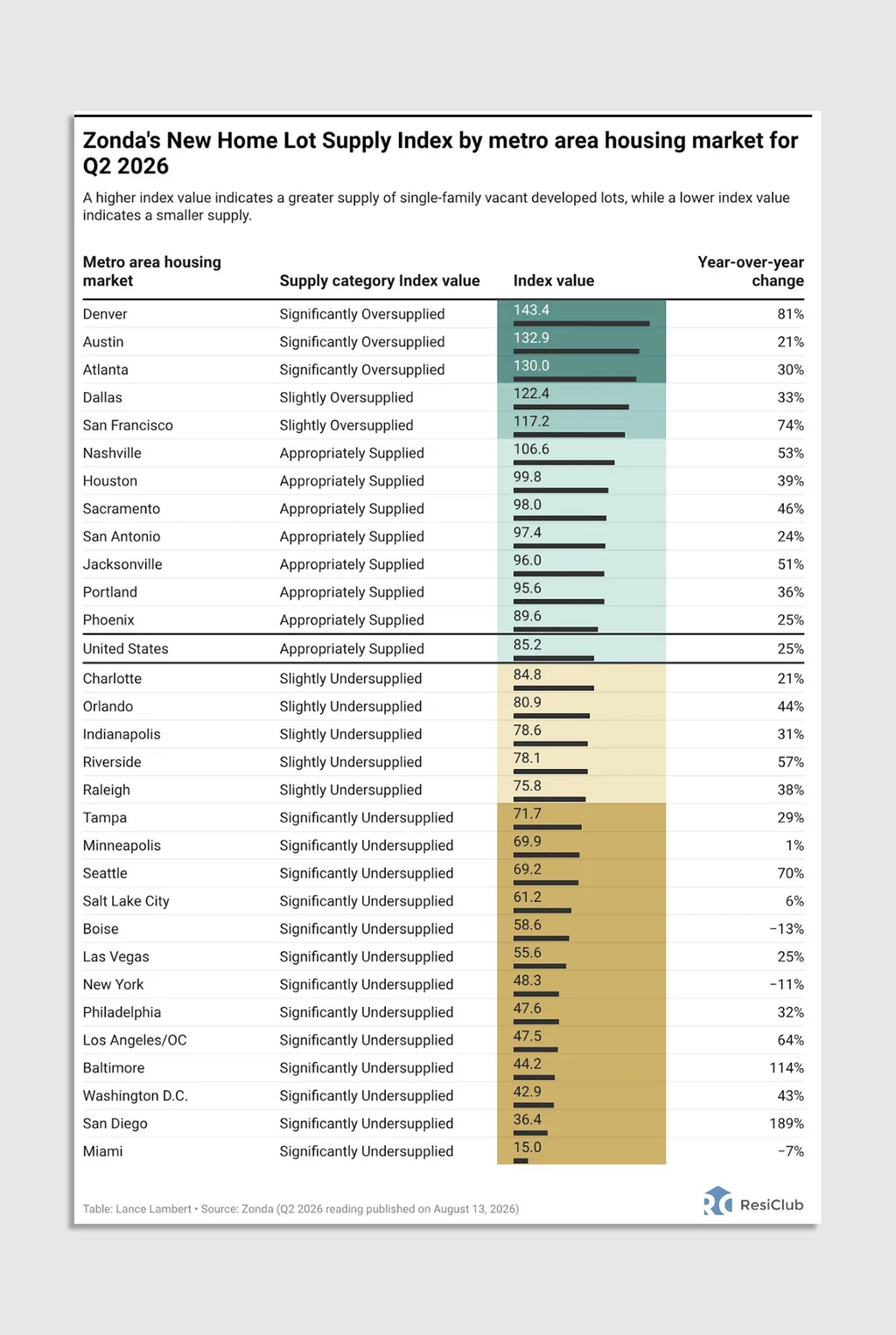
If you go back 18 months, just three major metro housing markets were “appropriately supplied” in terms of lot/land supply—Austin, Atlanta, and Dallas—and none were classified as “slightly oversupplied” or “significantly oversupplied.”
Fast-forward to the latest reading, and 12 of the 30 markets now fall into the “appropriately supplied” category or higher.
And core homebuilding markets like metro Denver, Austin, and Atlanta have shifted into the outright “significantly oversupplied” range.
Here’s what Ali Wolf, chief economist for Zonda and NewHomeSource, wrote on August 13, 2026:
“The national lot market has reached an important milestone . . . For the first time since 2016, the [national] market is considered ‘appropriately supplied.’ The shift reflects both improving lot availability and a moderation in housing starts as builders respond to a softer demand environment. While the national market has returned to balance, conditions still vary significantly from one market to another.”
“Builders continue to strike a careful balance between preparing for future demand and avoiding excess supply . . . Upcoming lot activity declined [a different analysis] in the second quarter as developers remained disciplined about bringing new lots through the pipeline. While activity slowed, the development pipeline remained active, highlighting a mindset of cautious optimism. Developers are exhibiting restraint today while still positioning for future opportunities.”
If Zonda had published data for more than 30 markets, my assumption—based on my own analysis—is that many pockets of Southwest Florida (including Cape Coral and Punta Gorda) would have been fairly close to the top.