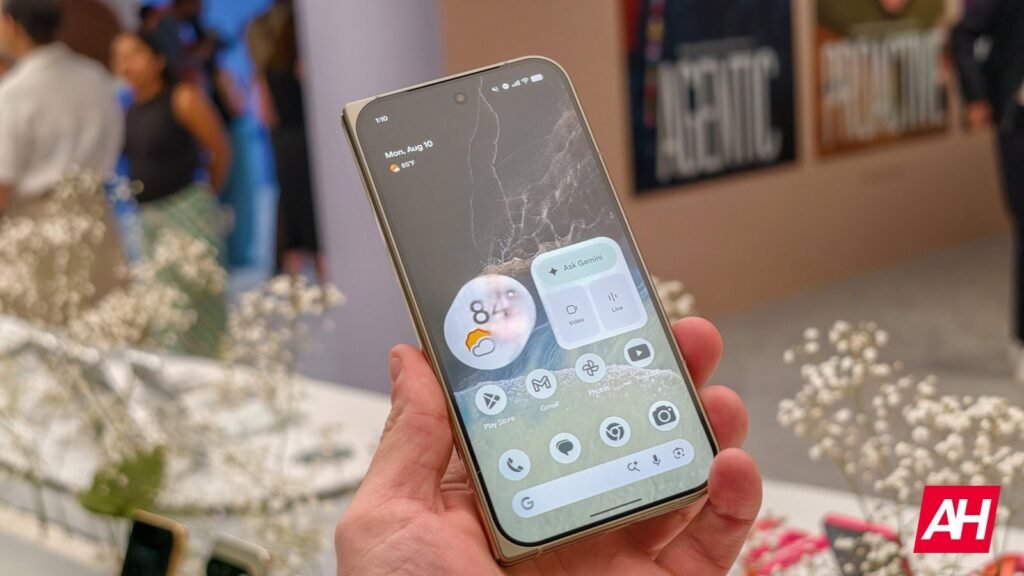

Google’s latest foldable, the Pixel 11 Pro Fold, is now out, and while the design is mostly the same as the last two years, it brings some really nice improvements this time around. It’s thinner, lighter, and has better cameras. But can it stand up to the Galaxy Z Fold 8?
Both the Galaxy Z Fold 8 and the Pixel 11 Pro Fold start at the same price, though Google does include more RAM at that price and bigger displays. I’ve spent the past month using the Galaxy Z Fold 8 and the past week or so with the Pixel 11 Pro Fold, and they’re quite different. But let’s compare them, so you don’t waste your money.

Google Pixel 11 Pro Fold vs Samsung Galaxy Z Fold 8: AI Smarts vs real features
Starting with the software, both phones get 7 years of updates. That’s not just security patches, but new OS updates as well. So they will both be updated well into 2033; that’s not too shabby. Technically, the Pixel 11 Pro Fold will get an additional month since it was released in August, and the Galaxy Z Fold 8 was released in July.
When it comes to Google, there’s always a lot more AI smarts here than with any other brand, and that’s the case again this year. Google has added the new HiLight feature on the Pixel 11 Pro Fold (as well as the Pixel 11 Pro and Pixel 11 Pro XL), which will indicate when you are using Gemini with the phone face down, or when one of five people are calling you. That’s it. I know, it’s a real gimmick, unfortunately. It’s not the RGB indicator we were hoping would return.
Google also has a lot of new Gemini Intelligence features, which are also available on the Galaxy Z Fold 8, like the ability to use Gemini to do some of your usual chores, like ordering groceries from Instacart. Gemini can do that in the background for you, on both devices.
Where Samsung really comes out on top is with its customization. Samsung offers more customization on the Galaxy Z Fold 8, and that’s before you even install Good Lock from the Samsung App Store, which takes it to the next level.
Samsung also wins on multitasking. Google is still pretty plain when it comes to multitasking on a foldable, unfortunately. But for Samsung, particularly on the Galaxy Z Fold 8, you can now use three apps side-by-side, thanks to the wider inner display. It’s still not quite on par with what OPPO is doing with Boundless View, but it is pretty darn close.
While I prefer Google’s software over Samsung’s, I’ll give Samsung the win here. They have many of the new AI features Google is using to entice users, plus more customization and better multitasking.
Winner: Samsung Galaxy Z Fold 8

Google Pixel 11 Pro Fold vs Samsung Galaxy Z Fold 8: Hardware
When it comes to hardware, these are two very different foldables. Samsung went with a passport-style foldable, which Google originally did with the Pixel Fold a few years ago and then ditched. Samsung is also much lighter and easier to use one-handed. But where Google excels here is that third camera. Google does indeed have a 5x telephoto camera on-board, even if it is pretty much crap. It’s a 10.8MP 5x telephoto that is pretty tiny, but still larger than what Samsung put on the Galaxy S26 Ultra and Galaxy Z Fold 8 Ultra.
The most important hardware aspect here, however, is how it feels in the hand. Despite the sharper corners, the Galaxy Z Fold 8 feels so much better in the hand. It’s one of the few devices that I truly just can’t put down, which is saying a lot. The weight also comes into play here; this is an extremely light foldable. It’s lighter than a lot of flagship slab phones, actually.
But there is something about the Google Pixel 11 Pro Fold’s design and colors that I love. Most importantly, Google’s phones don’t wobble when you set them down on a table. Samsung’s do, thanks to that vertical camera bar. Unfortunately, a case won’t fix this, or even really help all that much, unless you get a massive case like an OtterBox, then what’s the point of a “thin and light foldable”.

Google Pixel 11 Pro Fold

Samsung Galaxy Z Fold 8
| Google Pixel 11 Pro Fold | Samsung Galaxy Z Fold 8 | |
|---|---|---|
| Dimensions (unfolded/folded) | Unfolded: 155.2 x 150.4 x 5 mm; Folded: 155.2 x 76 x 10.1 mm | Unfolded: 161.4 x 123.9 x 4.5 mm; Folded: 81.9 x 123.9 x 9.7 mm |
| Weight | 239 grams | 201g |
| Cover Display | 6.5-inch LTPO OLED (120Hz Adaptive) | 5.5-inch LTPO OLED (120Hz Adaptive) |
| Resolution | 2342×1080 | 1972×1248 |
| Inner Display | 8-inch LTPO OLED (120Hz Adaptive | 7.6-inch LTPO OLED (120Hz Adaptive) |
| Resolution | 2152×2076 | 2448×1848 |
| Chipset | Google Tensor G6 | Qualcomm Snapdragon 8 Elite Gen 5 for Galaxy |
| RAM | 16GB | 12GB/16GB |
| Storage | 256GB/512GB/1TB | 256GB/512GB/1TB |
| Main camera | 48MP (f/1.7 aperture, 1/1.56-inch sensor size, OIS, multi-directional PDAF) | 50MP (f/1.8 aperture, 1/1.56-inch sensor size, OIS, multi-directional PDAF) |
| Ultra-wide camera | 10.5MP (f/2.2 aperture, 1/3.4-inch sensor size, 127-degree FoV) | 50MP (f/1.9 aperture, 1/2.51-inch sensor size, 120˚, OIS, dual-pixel PDAF) |
| (Periscope) telephoto camera | 10.8MP (f/3.1 aperture, 1/3.2-inch sensor size, 5x optical zoom, OIS, dual-pixel PDAF) | N/A |
| Selfie camera | 10MP | 10MP |
| Battery size | 4,750mAh | 4,800mAh |
| Charging | 30W wired, 25W wireless (Qi2.2 Magnetic), 5W reverse wireless | 45W wired, 120W wireless, 4.5W reverse wireless |
| Colors | Olive, Obsidian | Graphite, Cream, Lavender, Pistachio (Samsung.com exclusive) |
Winner: Samsung Galaxy Z Fold 8
Google Pixel 11 Pro Fold vs Samsung Galaxy Z Fold 8: Camera
When it comes to cameras, you’d immediately think that the Pixel would win, right? Because of that extra camera that’s on board. But think about it: a 10.8-megapixel 5x telephoto camera that is 1/3.2″ is not going to be all that helpful. It’s small and low resolution. However, that is where Google’s computational photography comes in, because Google’s cameras provide much better photos than the Samsung Galaxy Z Fold 8, surprisingly.
Samsung decided that, with the Fold 8, users wanted an ultrawide camera instead of a telephoto camera. I don’t know about the rest of you, but I use the telephoto way more than the ultrawide. I definitely would have liked to see a good telephoto on the Galaxy Z Fold 8. But knowing Samsung, it likely would have been the tiny 3x sensor on the Galaxy S26 Ultra and Galaxy Z Fold 8 Ultra, unfortunately. So maybe this was the better option.
I’m not a big fan of Samsung’s color science on the Galaxy cameras; I much prefer the colors that come out of Google’s cameras (but prefer OPPO and vivo’s colors even more). So for me, the winner here is the Pixel 11 Pro Fold, for the better-looking photos and the better camera versatility.
Winner: Google Pixel 11 Pro Fold

Which should you buy?
Which one should you buy? That question is pretty tricky right now. This isn’t as much of an “apples to apples” comparison as many of our comparisons, mostly because of the Galaxy Z Fold 8’s passport-style design.
The way I see it, if you’re a power user and watch a lot of video, the answer is the Galaxy Z Fold 8. But if you want the Pixel camera and software, then the Pixel 11 Pro Fold is the one to get. Don’t forget, Google also includes more RAM for the same price as Samsung, and that might become very important as more AI features are added.
My preference is the Galaxy Z Fold 8. I love this phone so much because it’s lightweight, it’s easy to use with one hand, and it’s great for watching videos. Something that I do a lot on foldables.
The post Google Pixel 11 Pro Fold vs Samsung Galaxy Z Fold 8: The Best Foldable Showdown of 2026 appeared first on Android Headlines.