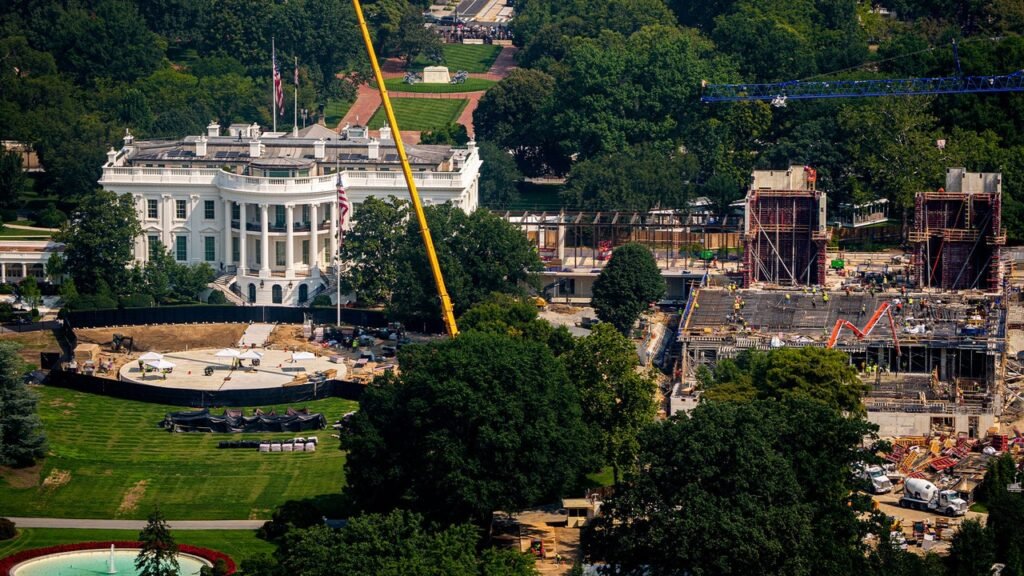
After Trump’s plan to build a lavish ballroom next to the White House hit a major roadblock, the president is asking the highest court in the land to give his construction the green light once again.
On Friday, the Trump administration sent an emergency filing to the Supreme Court claiming that a mandated freeze on the ballroom’s construction amounts to a national security threat. If the Supreme Court doesn’t intervene, August 21 is the last day that the project — very much underway in the chaos where the East Wing once stood –- can continue.
In the filing, U.S. Solicitor General D. John Sauer argued that construction is too far along to be halted now. “Respondent below conceded that at some point, construction will have gone beyond the point of judicial intervention,” Sauer wrote. “That line has long since been crossed.”
The Trump administration is asking the Supreme Court to allow construction to continue while the legal side of the controversial ordeal sorts itself out in the courts. Last year, Trump falsely claimed that the plan to install a massive ballroom wouldn’t involve any demolition, but he later quietly moved forward with bringing the building down outright. “It won’t interfere with the current building. . . . It’ll be near it, but not touching it and pays total respect to the existing building, which I’m the biggest fan of,” Trump said at the time.
Now, the administration is arguing the opposite, pointing to the massive scale of the construction project and its partial completion as grounds that the work should go on. In the new filing, Sauer highlights how “the concrete-and-steel superstructure rises to ‘70 feet above ground in places, with a footprint of nearly 50,000 square feet and extensive above-ground works throughout.’” The Trump administration argues that the work is more than halfway done, “with millions of pounds of steel procured, tens of thousands of cubic yards of concrete poured, and miles of conduit laid.”
The pitch vs. reality
Last year, the White House’s chief of staff soothed critics by claiming that the administration would work closely with historical preservation organizations on the plan to revamp the East Wing, originally erected in 1902. Instead of cooperating with preservation groups, Trump is now battling them in court. The National Trust for Historic Preservation sued to stop the project, arguing that only Congress can approve major alterations to the “People’s House” – a view that judges were sympathetic to in last week’s ruling.
“We are aware of no instance in American history in which a President unilaterally and using privately collected funds demolished substantial portions of the White House that Congress authorized to be built and American taxpayers paid for,” the two judges who halted construction wrote.
While Trump originally pitched the massive ballroom project on its appeal as a large event space for hosting parties, that story has undergone a transformation almost as dramatic as the East Wing’s own. As the project encountered legal resistance, the administration pivoted to claiming that the construction plan is actually key to national security, and the final build will introduce a hospital, drone-proof ceilings, missile-resistant steel, and “top secret military facilities” onto White House grounds. Because last week’s ruling only put the above-ground ballroom construction on hold, the administration’s last minute plans for a new underground bunker can continue so long as they’re below ground.
In a new statement, the National Trust criticized the Supreme Court filing and argued that the administration’s stated plan to install one million new pounds of rebar and 3,000 cubic yards of concrete in the next seven days is a yet another effort to end-run the law.
“The Administration has not only refused to listen, but is now actively attempting to outrun the courts by accelerating construction of the Ballroom,” The National Trust for Historic Preservation wrote in a press release. “…[Its] transparent efforts to evade the rule of law, frustrate judicial review, and limit the availability of meaningful relief in the courts must stop here.”