When sculptor Shirley Tse was invited by her former student Anna Hrund Másdóttir to produce an original exhibition at her cooperative gallery King and Bang in Reykjavik, her first thought was to invite her friend and former teacher, the film and video maker Dana Berman Duff, to collaborate with her.
Geography, landscape, desire and time are some of the interests these two artists shared. The result is an extraordinary manifestation of physical elements — breath, moon and tides — that bind us and the universe.
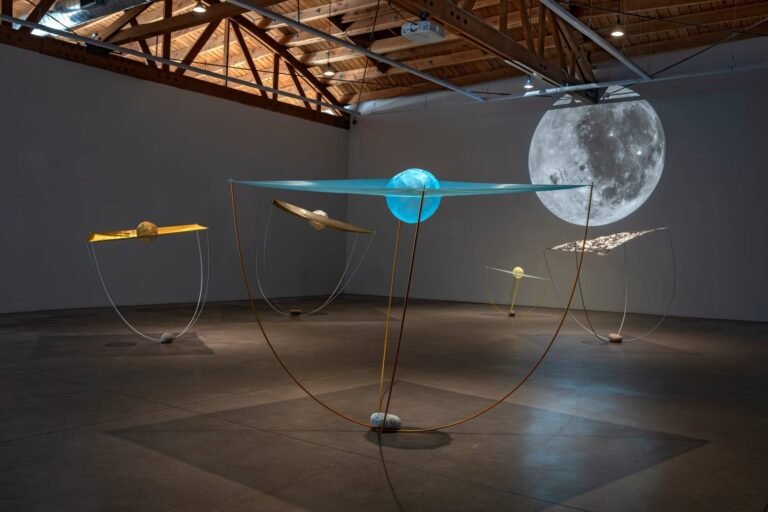
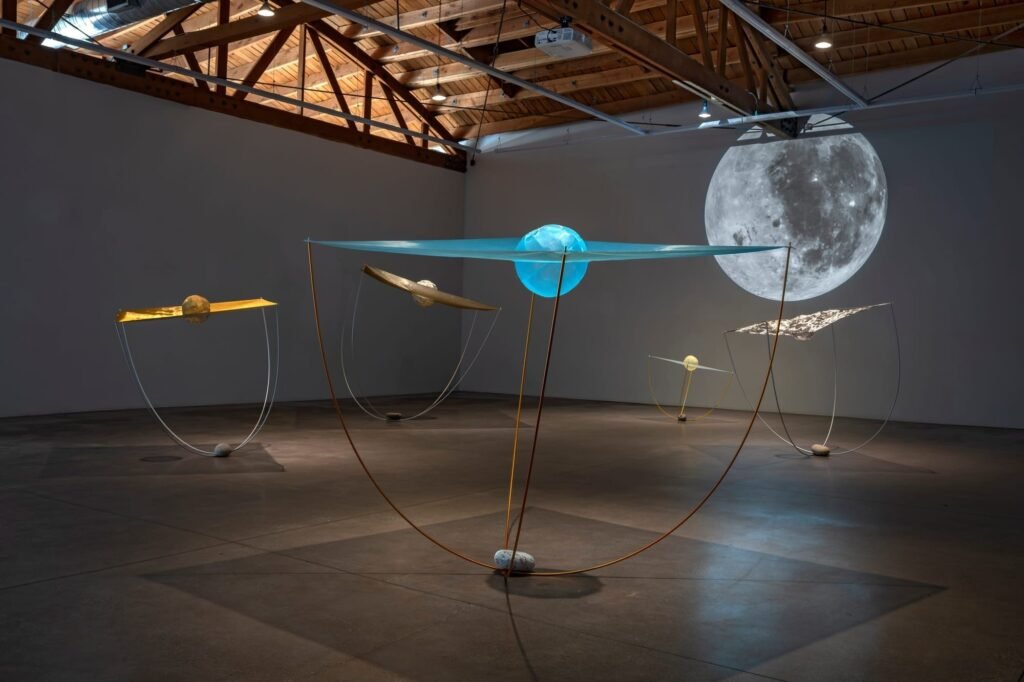
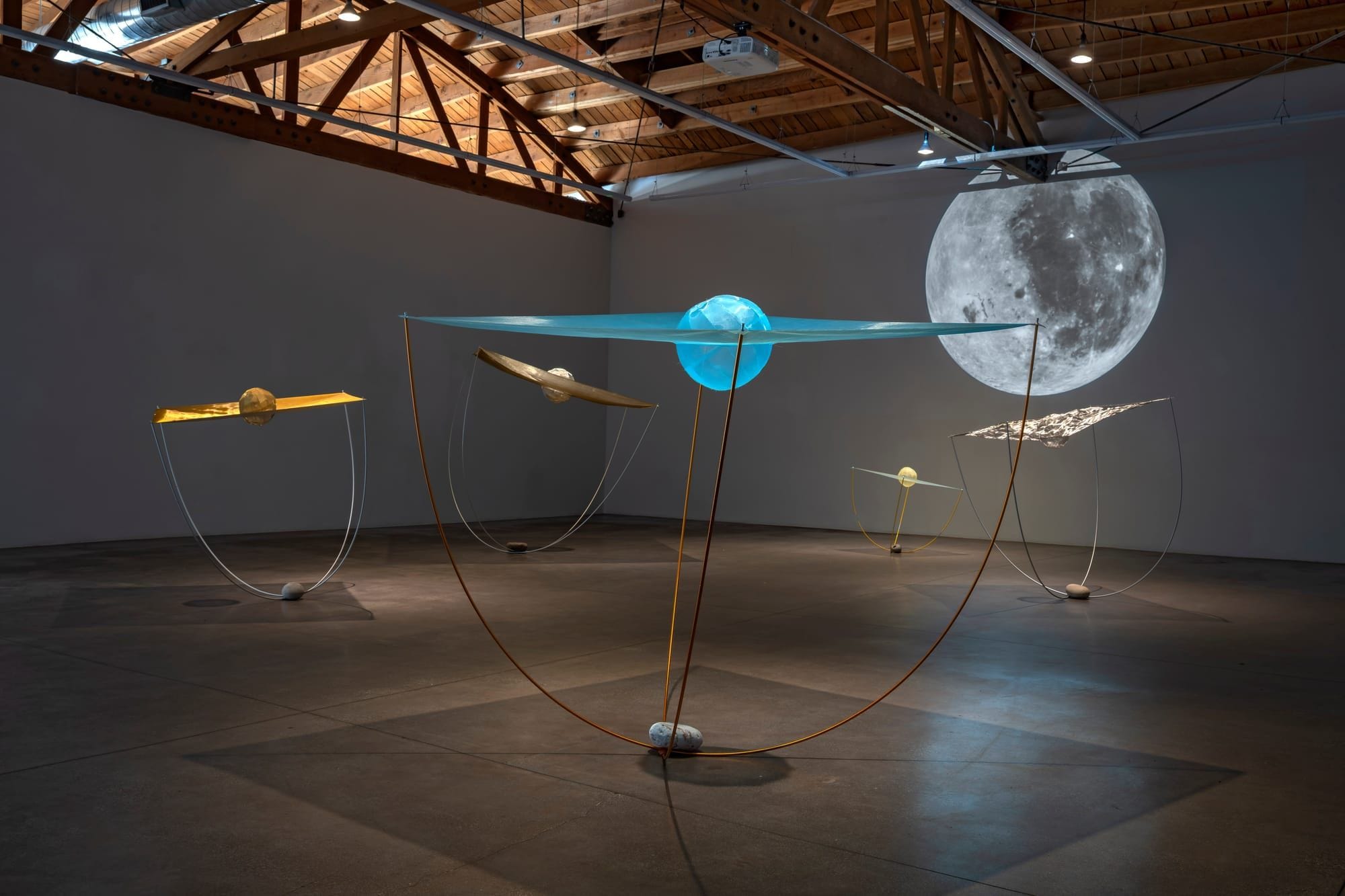
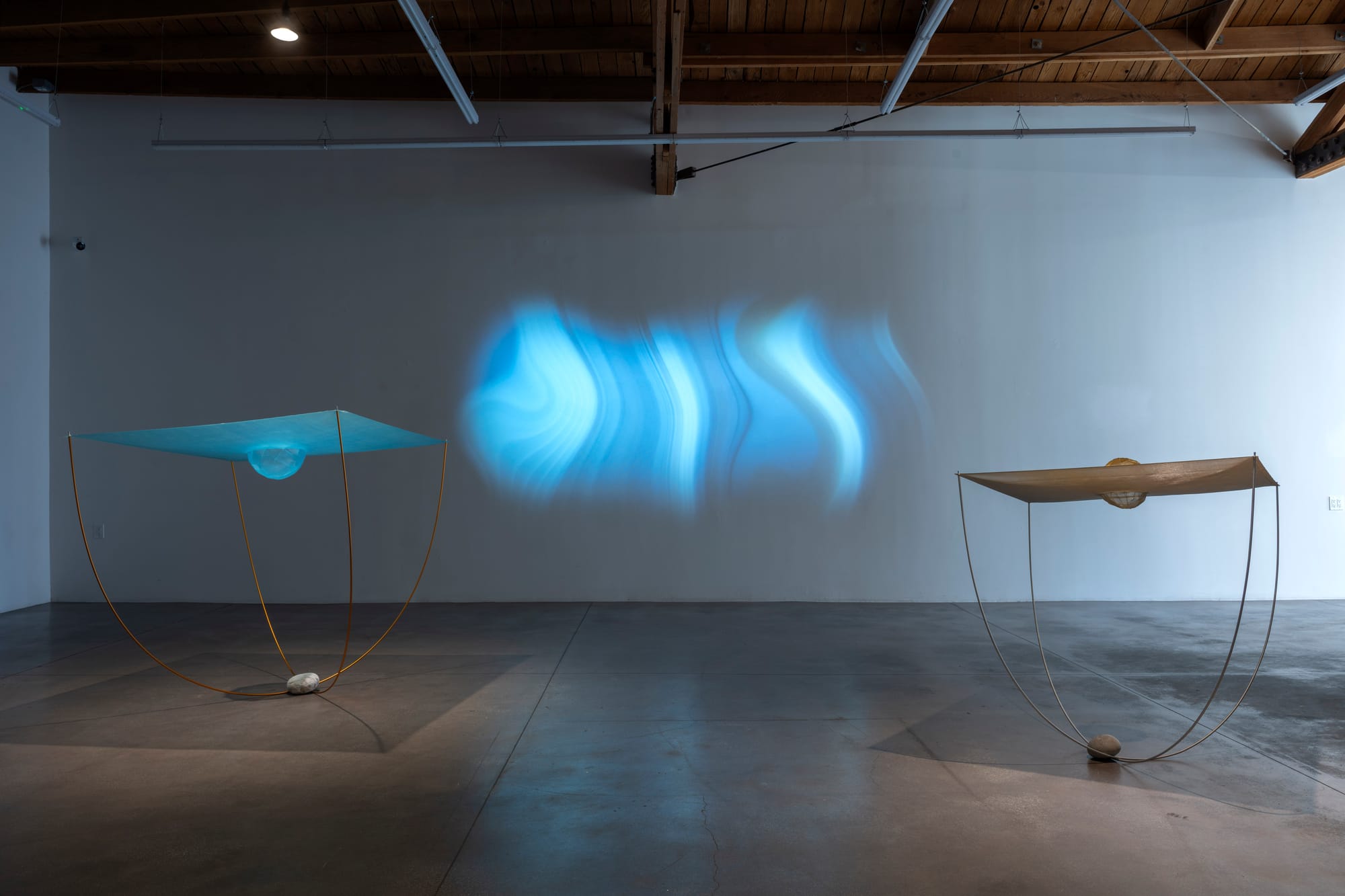
Working under the name “Relational,” Tse and Berman Duff’s exhibition The Universe Breathes Us was first staged at Kling and Bang in 2025, and again this summer at Shoshana Wayne Gallery in Los Angeles. Both iterations included a live choral performance of an original song by Berman Duff and her husband, the composer-musician Alan Duff Berman. Seeing it for the first time, I was struck by the deceptive simplicity of each of the elements and the subtly seamless ways that they animate each other. In Tse’s photograph “Orkney Moon” (2025), a soccer ball covered in rice paper rests in a green summer field on a Scottish island. Reborn as a moon, it migrates into a series of sculptures that fill the main gallery, contained by projections of Duff’s videos on opposite walls. In “The Other Side of the Moon Is Not Dark” (2025), a giant moon slowly rotates, and in “The Breathing Ocean (Portal)” (2026), the moon meets a video of the original Icelandic choir fracturing into a kind of northern lights.
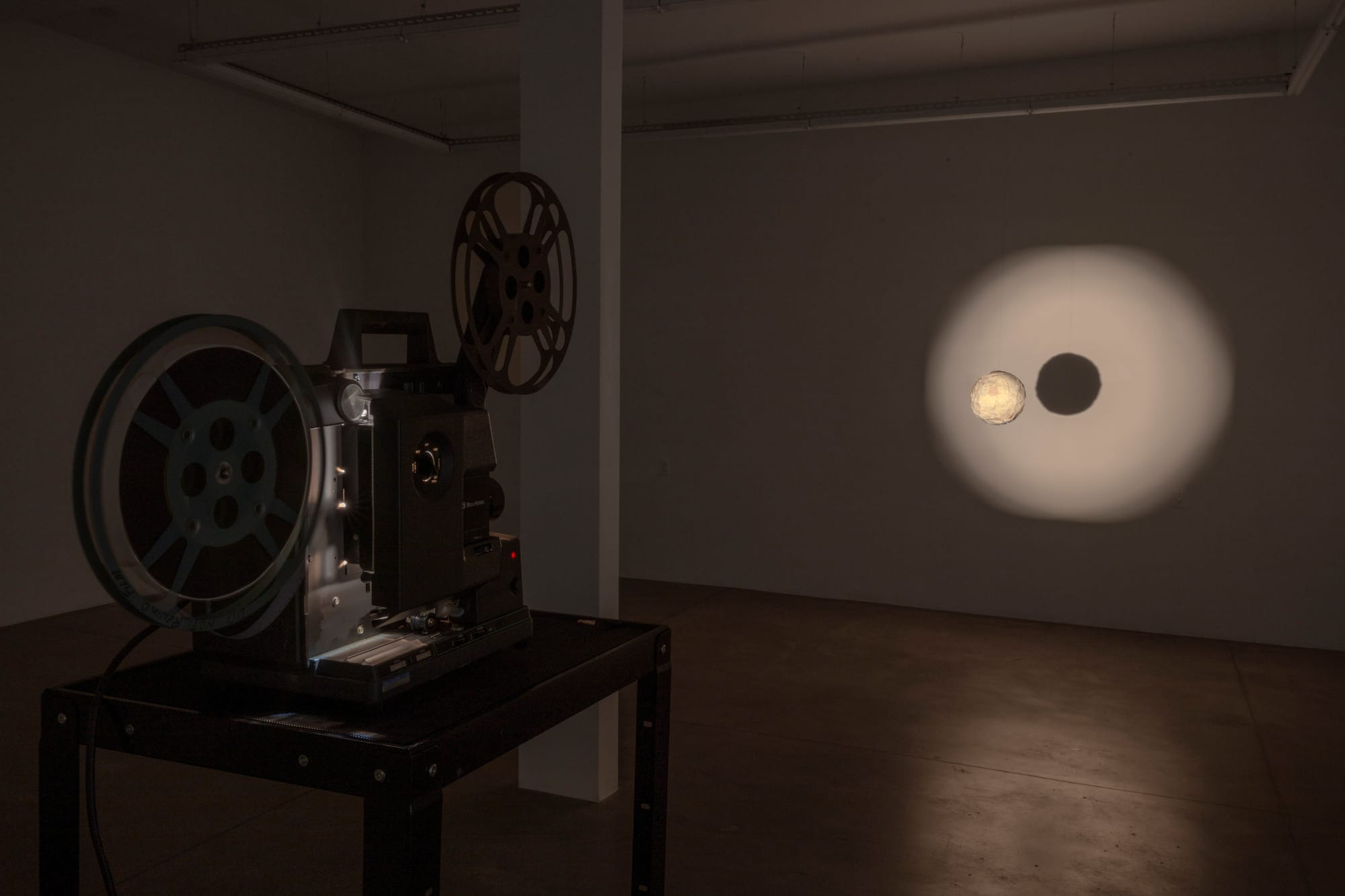
In an adjacent room, film and sculptural elements combine in the surprisingly moving installation Sun and Moon (2025). Suspended by thread from the gallery ceiling, Tse’s rice-paper moon casts changing shadows in the white light of Duff’s 16mm projector. The tail end of a big reel of film flaps incessantly.
I’ve followed and written about both Tse’s and Duff’s work for more than two decades. The Universe Breathes Us felt like a new and exciting departure. On August 4, we met at the gallery to talk about it. This conversation has been condensed and edited for clarity.
Chris Kraus: It’s such a beautiful show and there’s a lot of different things to talk about, but first, the title Relational — you joined up to form a collective?
Dana Berman Duff: Yes, we did.
CK: But it’s not a traditional collaboration — instead, you made your work in dialogue with each other’s. It’s a really interesting thing that happens maybe unconsciously when artists and writers work in proximity. How did the show come about?
Shirley Tse: If you watch the eight-minute Orkney Moon video in the hallway, you’ll get the context of our collaboration. I started researching tidal turbine power during a residency in Scotland two years ago. I’m really into sustainability in my recent practice and tidal power is a form of renewable energy. Initially, I thought this new work would be all about engineering — you know, the turbine blade, etcetera. But then I came across this sentence that completely changed my direction: “Tidal power is the only form of power we harness from the Moon.” Tides are caused by the gravitational pull of the Moon, together with the Earth and the Sun: in other words, relational force. In that moment, I remembered reading in the book Yoga Anatomy a quote that talks about breathing: The most basic fact of breathing is not my body sucking air into my lungs and releasing it. Rather, when I inhale, the weight of the atmosphere pushes air into my body. And that immediately breaks the subject-object relationship! I was invited to do a show in Reykjavik, and I didn’t want to do a solo show. I wanted to make this show a relational force with another artist that I admire so deeply. So I invited Dana to collaborate with me.
DBD: I just wanted to mention that it wasn’t a conventional collaboration — we each made our own pieces. It’s a relational collaboration. My pieces wouldn’t exist but for Shirley’s.
CK: Sorry to be technical, but just to clarify things here, what is a tidal turbine?
ST: Just like a wind turbine that turns blades to create energy for electricity, a tidal turbine is a form of renewable energy. You put a turbine through tidal currents, and the force of the tides pushes the turbine to generate energy.
CK: That’s amazing.
ST: Yeah! Instead of solar power or wind power, it’s lunar power! I thought that was so poetic and I had to make art about it.
DBD: Hence all these moons.
CK: The exhibition notebook contains a lot of emails you both wrote while you were conceiving the show. I was really struck by something you said, Dana, in an email to Shirley about how one reason you left sculpture behind was that you wanted to work with time as an element, and you could only do that in film and video.
DBD: Yes, but I started working with time long before moving to film. I was very influenced by both Buddhism and structuralist film. I realized that I was frustrated with making objects that were supposed to last forever. So I wanted to work with impermanence, though I didn’t think of it that way then, but I started making sculpture out of liquids and things that would fall apart or degrade — and all of these works no longer exist. Film was the medium where I could really use representation and control time and explore the experience of looking — that it’s very much like meditation. It’s like being present in the moment for what’s happening, yeah, like breathing.
CK: There’s this insane calculation in the notebook where you’re dividing the rotational speed of the moon by its — volume?
DBD: [Laughs] Essentially, it’s just a scale exercise. I took the size of the real moon, the diameter of the real moon, scaled it to the size of that projected moon on the wall, and I ended up with a certain ratio. Then I took 29.5 days, which is the time it takes for the moon to fully rotate, and multiplied that by the ratio to arrive at two hours and 40 minutes.
CK: So it’s kind of a math poem.
DBD: It is totally structuralist. For me, every choice needs to be based on some kind of structure, not on taste. And so I had to find a rational structure for this projection. And I was delighted that it turned out to be two hours and 40 minutes, which means that you can barely see it moving. It’s very like my other 16mm films. Barely moving.
CK: You could say that breath is the overall theme of the show. Would you agree?
ST: Yes. Breath. Breathing.
CK: Everything’s held in place by the breath and that quote from Yoga Anatomy that you put on the wall, that “breath enters us all by itself” — we just have to allow it. How did you think about this while you were building the show?
ST: Relational force, manifested by breath, is at the center of this exhibition. When you see a body moving, it’s easy to think that that movement comes from the body itself, but the movement actually comes from the relational differences, the differential, between two bodies. So there’s no A or B. It’s the dynamic that produces the illusion of A and B. This is very poetic, but I think it’s actually a critical stance as well. Our world is in a very chaotic moment right now. I believe that it is the individualist, isolationist mentality that got us into this mess in the first place. Our model of the relational, no-self, runs counter to the idea of the individual that’s isolated, separate, and always wants to assert power over other things.
CK: Yes, but I’m still curious how the Bobbing Moon sculptures that fill the main room came to be. The soccer ball moon from Orkney Moon has migrated onto suspended mesh squares that form rectangular fields. How did you arrive at these constructions?
ST: The sphere form comes from the Orkney Moon project. The photograph of the white ball on the grass in Scotland, the hanging paper sculpture in the Sun and Moon installation, and the video on the small monitor all share the same title, Orkney Moon. Because I wanted to show that this sphere is not just an object; it’s an event, in different forms.
Dana’s moon projection shows the moon from the sun’s, not the Earth’s, perspective. From there, you see the moon in 360 degrees, without any dark side. I thought seeing the moon from this perspective was so beautiful that I responded with the “Bobbing Moon” sculptures. Even though they don’t physically move, they suggest movement, resting in a delicate balance between their weight, tilting angles, and anchoring stones. My sculptures have always been fragile because I want them to reflect the fragility of our life-world.
During the opening, people knocked the sculptures off their balance. People were kind enough to help me reset the sculptures by holding onto them. However, I had to gently ask them, “Let go, let go!” Without letting go, you will never find your center.
DBD: Yes, and in this exhibition, we completely suspend “individual authorship”: All of the works are produced by Relational, even though many of them weren’t even touched by the other person’s hand. But because Shirley’s mind exists, my work exists here. It’s all completely the product of the interaction.
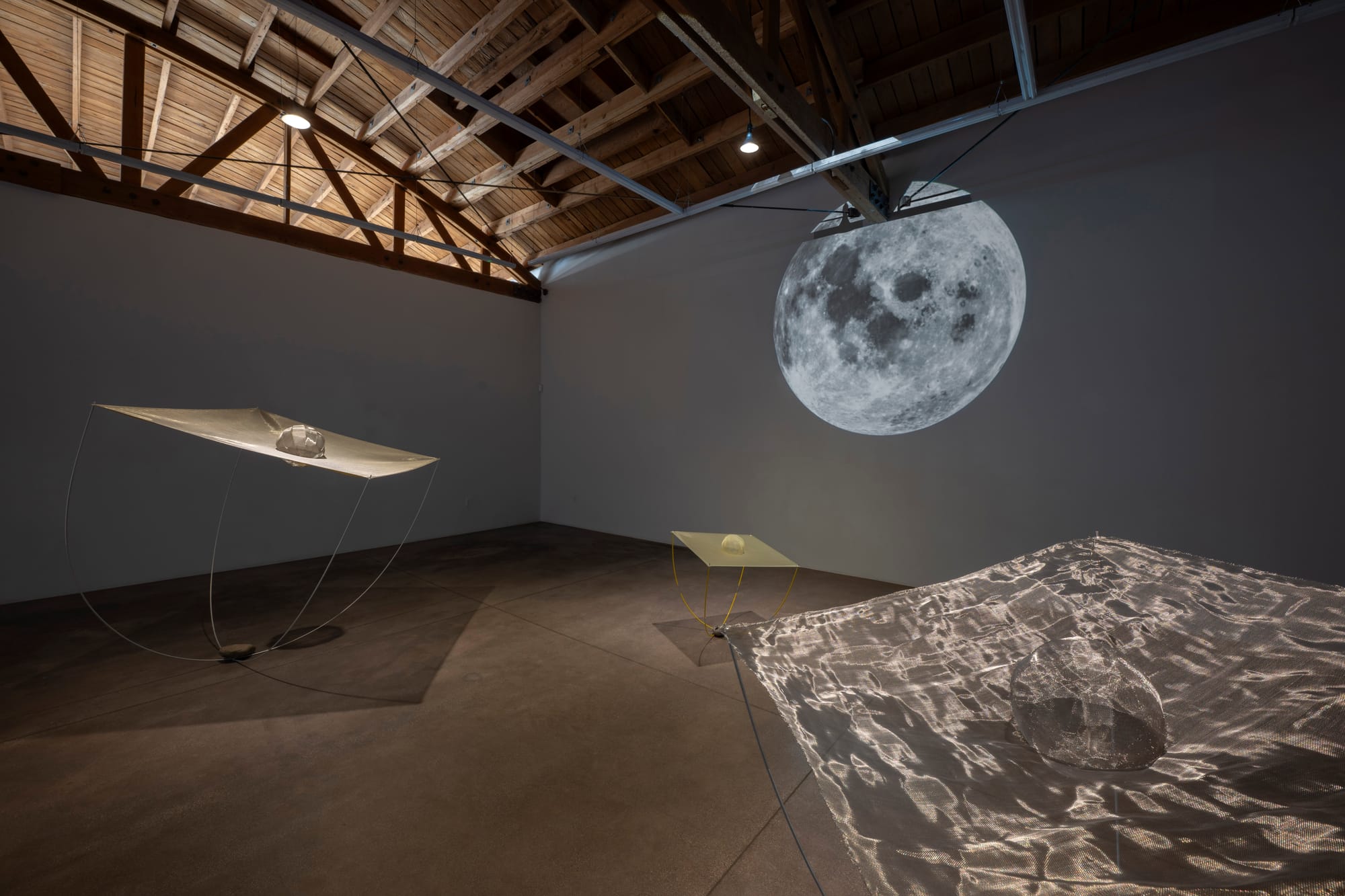
ST: Material and shape choices I used in the sculptures adhere to my current practice of not buying any more new materials. So all of this material was already in my studio, leftover from past projects. The tent poles make the sculptures collapsible- more sustainable in terms of transport and storage.
CK: Shirley, I think the use of sound in this exhibition is something new — but Dana, as a film and video maker, sound has always been an important element. How did you conceive the pervasive sound in this exhibition as a force?
DBD: Sound is a way I can work with time. I think of sound as another image space. When you hear something, you see something in your mind. As you walk through this installation, you hear breathing, and that would influence your body in this space.
CK: It’s like being inside a giant body.
DBD: But then there’s also, really at Shirley’s urging, gradually coming in is the sound of waves, of the ocean, so we can bring it back to the tidal idea, and then there’s a weird grinding noise of the underwater energy collection turbines. It’s not a pretty sound, but I thought it was ethical to include it. And then there’s a little musical piece composed by Alan that I wanted to add because it’s soothing and calming. And then it returns to the choir.
CK: Okay, the last question is, the sculpture in the other room is just so incredible. I just stood in the middle of it and it was so completely immersive and engaging and brilliant. The flapping of the 16-millimeter film, the football, the shadow that it cast. It’s like every idea in the notebook and the exhibition is contained in those simple objects. I mean, that’s a real coup. So can you talk about how you arrived at that?
DBD: I thought I should make the sun for Shirley’s moon.
Since I work in 16-millimeter film and I have these projectors and I wanted to invoke something that’s kind of apocalyptic and sad, that is, the disturbing sound of a 16-millimeter projector running out of film. Flap, flap, flap. And to most of us the sound is alarming and that’s the feeling I wanted to invoke: “Oh no! The film is over!”
ST: When I came up with Orkney Moon the “sculpture,” I thought it was the most beautiful thing I ever made, because I did not make it myself. I began without any plans, letting go of my ego and my prejudice. I observed what the children were doing and folded their interests into mine. And then Orkney Moon made itself! It was a solid three-dimensional thing in the beginning, but when I took the rice paper off of the football for my niece Sandra to “conserve” it, it became a drawing. When it was kicked by my nephew Tiger, it picked up chlorophyll and the soil. It was a drawing, not by me, but a drawing by the soil, the grass, and the action of kicking. I don’t want this “thing” to be just sitting there as an object in an exhibition, so it needs to be activated, as an event. My dear friend Jessica Bronson suggested making a book that tells the story or gives it context somehow and that inspired the idea of making the exhibition notebook. Perhaps this project exists both in physical space and literary space that gives people the feeling of containing the whole world.