In the event of an emergency, evacuating a building can be one of the most important safety measures. But depending on the kind of emergency—whether a fire or a tornado or an active shooting—taking the right evacuation route or finding shelter can be the difference between life and death.
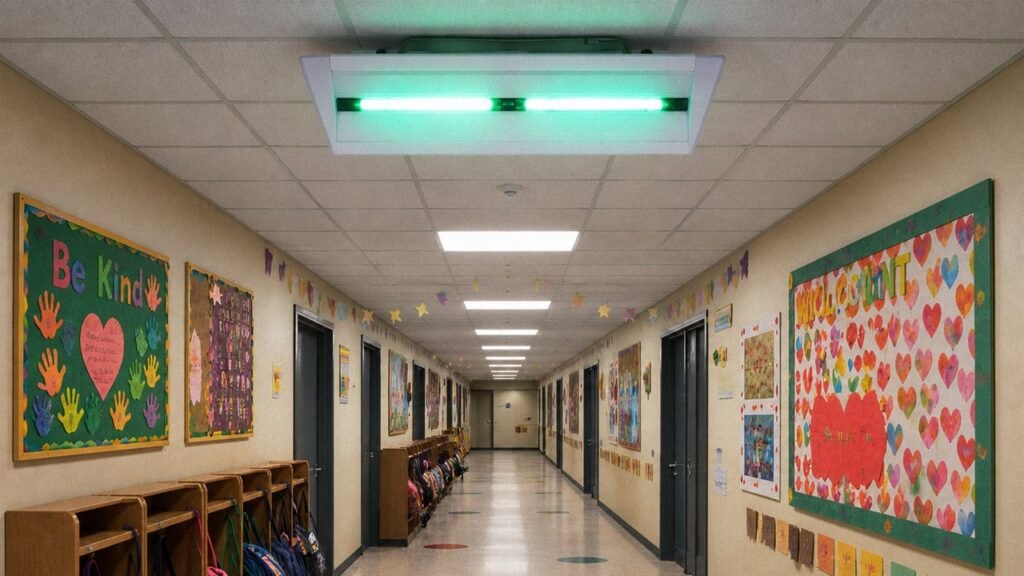
Go To Green is a new emergency evacuation system that’s designed to automatically direct people to go, or stay, in the safest place during an emergency. Designed primarily as a response to active shooter situations in schools, the system uses a simple system of colored lights to direct people to the safest evacuation route, and away from danger.
“Most children in the United States play red light, green light. So it just makes sense to use lights that we’re all preconditioned to pretty much from birth,” says Ernie Williams, founder of Go To Green.
The system consists of thin ceiling-mounted LED light arrays and various audio and motion sensors that activate at the sound of gunshots or during fires. Located in school hallways and inside and outside classroom doors, the lights turn green to show people where to move and red to show them where to avoid. Red and blue lights flash at the point nearest the emergency source, be it a fire or a shooter. It essentially turns buildings themselves into real-time evacuation tools, showing in a very visual way where to go during an emergency, and where not to.
Williams, a former Marine, spent 25 years in the military and says the idea for a more intuitive active-shooter security system and evacuation guide came from direct experience. “I spent a little bit of time getting shot at and understood the problem with indoor systems,” he says. “They can’t pick up an active shooter in real time.”
Williams says Go To Green’s sensors act independently to be able to pinpoint where a threat exists, even if it’s moving. “Let’s say a guy’s walking down the hallway and he shoots, the sensors change and the pathways may change,” he says.
The system is currently installed in 20 schools, mostly in Texas, where the company is based. None have been called into action for active shooter situations, but they have been activated during tornadoes, alerting students and staff to get indoors and avoid dangerous places within buildings. The company is backed by O’Leary Ventures, the investment arm of Shark Tank star Kevin O’Leary.
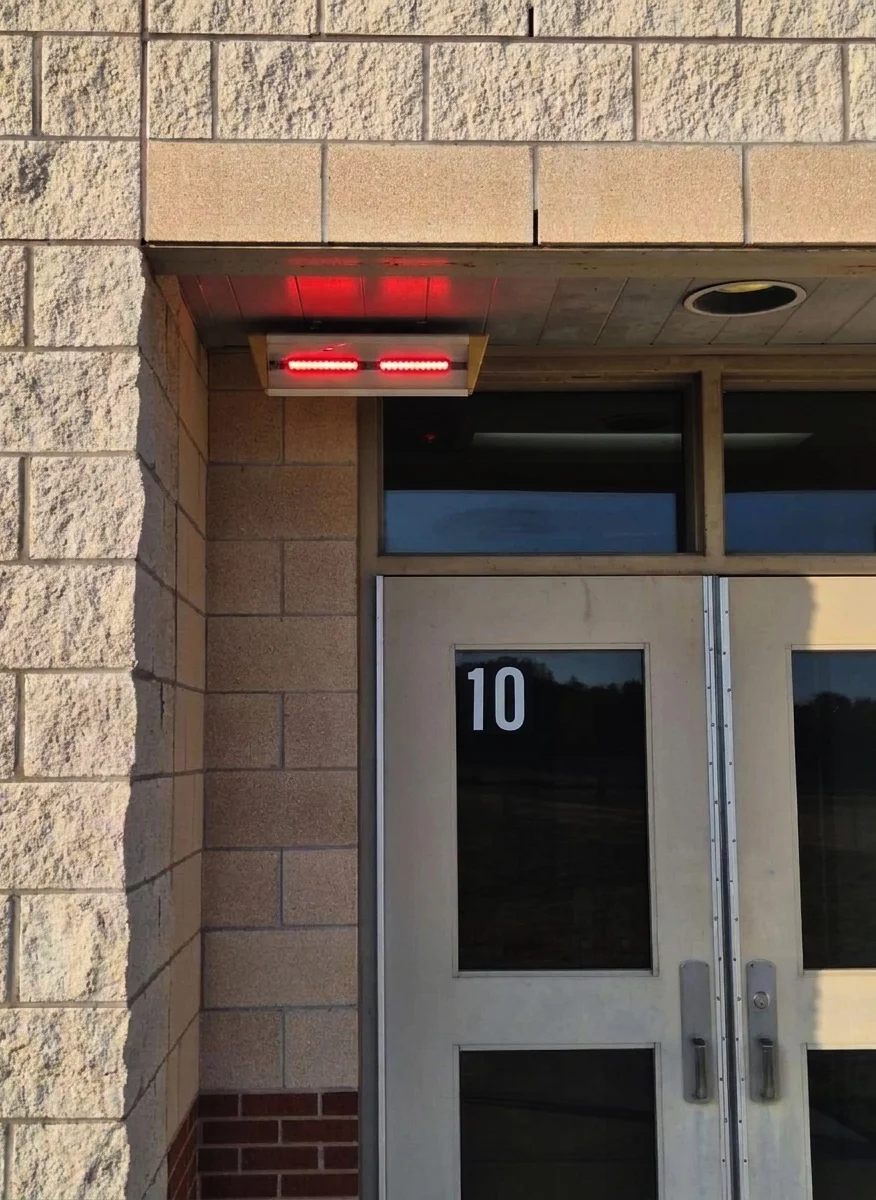
Primarily focused on active shooters, the security system is also designed to assist first responders, with exterior lights that flash blue and red to indicate the location of the threat, be it a fire or a person with a gun. “We can direct them using visual signals. We don’t have to get on the radios, we don’t have to get on the phone with them. They look up and see a visual and this automatically takes them to the threat,” Williams says.
Go To Green is one of many school security systems and tools that have come to market in recent years. Amanda Klinger, director of operations at the nonprofit security training organization The Educator’s School Safety Network, says products on the market vary widely in their efficacy. “We’ve really seen the industry explode in growth,” Klinger says. “There’s a lot of money to be made.”
After reviewing material on the Go To Green active-shooter security system, Klinger says it has the potential to be a valuable part of a school’s security system, but that security systems alone can only go so far. Training and threat prevention are also necessary to reduce the chances of very rare and extreme emergency events like active shooter situations. “The part that’s a little bit tough to swallow is, in a district where they opt for something like this, have they done appropriate training for their folks and for their students?” Klinger says. “Is this the icing on the cake, or is this the only thing that they’ve done?”
Klinger worries that school districts may dedicate limited resources to products and systems as seemingly simple solutions, without putting the same effort and resources into training and prevention. “The concern that we have with stuff like this, that does seem like a pretty good idea, that does seem to have a good amount of efficacy and utility, is does the school district then also have the political will to do some things on the other side of the coin?” Klinger says. “Because this is something that is only response. There is not a deterrent effect.”
Williams sees the Go To Green system as a way to reduce the harm that can come from shootings or other kinds of emergencies by making it easier for people to avoid threats, and for first responders to react more efficiently. “We’re trying to change the paradigm of what we focus on during a shooting,” he says. “We need to focus on the potential victims, and let the professionals focus on the shooter.”