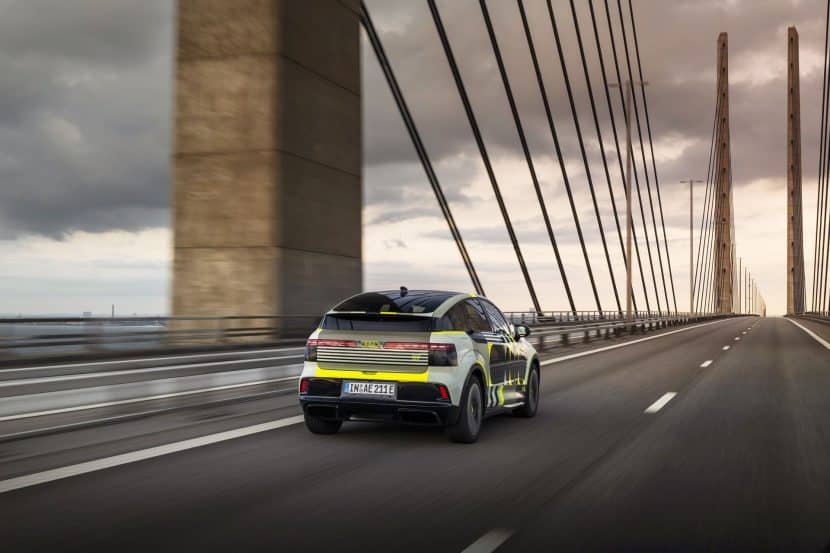
Audi has confirmed the A2 e-tron will return this fall with a preliminary WLTP energy consumption of 12.8 kWh per 100 km, making it the most efficient Audi ever built, and setting up a direct fight with the BMW i1 before BMW’s small electric hatch has even been revealed.
Audi is leaning hard on the A2 name’s efficiency pedigree. CEO Gernot Döllner name-checked the original three-liter A2 directly, and the numbers back up the callback: a 0.24 Cd figure Audi says is the best in its compact lineup. The company’s reasoning is straightforward: at 100 km/h and above, drag accounts for more than half of a car’s total energy demand, so every tenth off the Cd matters more than it would at city speeds.
A Design Optimized For Efficiency

Audi gets there with a rounded front end, a flowing roofline, and a sharply cut-off rear rather than a conventional fastback shape, plus detail work like air curtains that redirect airflow around the front flanks and gap reducers and gap breathers that calm turbulence around the wheel arches. An active cool-air intake stays shut in normal driving to keep drag down, only opening during charging, hard acceleration, or hot weather when the battery and electronics need the airflow. Audi says all of it together is worth up to 0.9 kWh/100 km.
The drivetrain gets silicon carbide power electronics, thinner motor laminations, a switch from star to delta stator winding, and a 10.2:1 final drive, changes Audi claims add up to 10 percent efficiency over the outgoing setup. The 61-kWh LFP pack charges at up to 89.6 percent efficiency on a wallbox and supports both vehicle-to-load and vehicle-to-home discharge, the latter starting in Germany, Austria, and Switzerland.
Cell-To-Pack Construction

The battery itself is built cell-to-pack, meaning the LFP cells are bonded straight into the housing instead of grouped into modules first, which is how Audi packs more energy into a compact footprint without growing the pack. LFP skips rare earth elements entirely and, according to Audi, ages slowly enough that owners can charge to 100 percent routinely without accelerating wear, unlike battery chemistries that call for keeping day-to-day charging capped well below full.
The cells also hold a flatter voltage curve as state of charge drops, so power delivery stays more consistent late in a charge cycle rather than tapering off. Audi credits a chemistry-specific state-of-charge and state-of-health algorithm for a lot of the real-world gain here too, arguing that efficiency isn’t just a hardware number but a function of how well the software reads the battery’s actual condition over time.
An Interesting Market Moving Ahead

Mercedes already has the CLA fighting for this exact buyer, and BMW’s answer, the i1, is still working its way through development. The i1 has an internal code NB0, built on a variant of the Neue Klasse 800-volt architecture, and notably switching back to rear-wheel drive after two decades of the 1 Series running front-drive. That’s a meaningful departure for BMW’s cheapest EV, and one aimed squarely at restoring some of the driving character the front-driven 1 Series traded away for cost and packaging. But it also means BMW is arriving to this segment later. The i1 isn’t rumored to land until 2028. [Photos: Audi AG]


First published by https://www.bmwblog.com