Editors’ Vox is a blog from AGU’s Publications Department.
Air-sea gas exchange regulates climate and ocean biogeochemistry. A new article in Reviews of Geophysics brings together theories, laboratory experiments, field observations, and models to explain how bubbles contribute to this exchange, why their effects differ among gases, and what scientists still need to learn. Here, we asked the lead author about some of the key concepts and challenges explored in the review article, and future directions for research.
What is air-sea gas exchange, and why is it important?
Air-sea gas exchange is the movement of gases between the atmosphere and the ocean. Carbon dioxide enters and leaves the ocean through this process, and the global ocean takes up a quarter of human-emitted CO2 through this exchange. The same process regulates the air-sea exchange of oxygen and many other climatically and biologically important gases. Gas exchange is therefore central to understanding climate, marine ecosystems, and the global carbon cycle. However, the ocean surface is not a simple, flat boundary. Wind, waves, turbulence, temperature differences, surface films, rain, and bubbles all influence how rapidly gases cross it.
In simple terms, what is bubble-mediated gas transfer?
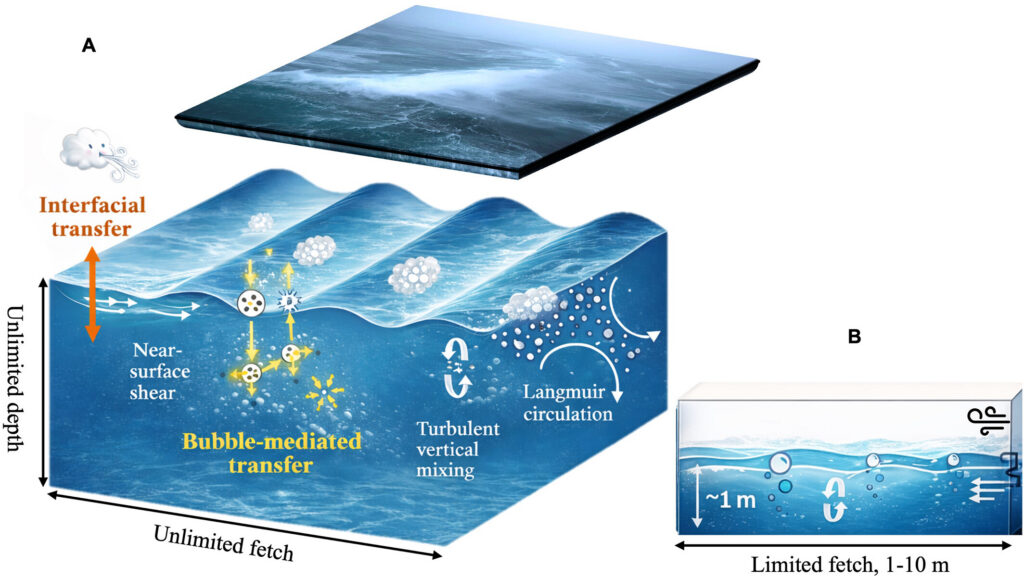
When waves break, they trap air beneath the sea surface and create clouds of bubbles. Gas can then move between the air inside each bubble and the surrounding seawater. This creates an additional exchange pathway beyond transfer directly across the ocean surface.
A bubble is not simply a piece of the atmosphere placed underwater. Water pressure and surface tension compress the gas inside it, while the bubble’s size, depth, and lifetime continually change. Some bubbles dissolve completely; others rise and burst at the surface. During this journey, gases can enter or leave the surrounding water. The combined effect of millions of short-lived bubbles can substantially influence gas exchange, particularly during strong winds and energetic wave breaking.
How does bubble-mediated transfer differ from interfacial transfer?
Interfacial transfer occurs directly across the boundary between air and water. It is controlled mainly by wind-driven turbulence close to the surface and by how rapidly a gas moves through the thin layers of air and water on either side.
Bubble-mediated transfer has three distinctive properties. First, it is directly linked with the wave breaking, which has a nonlinear dependence on the wind speed. Second, it depends on gas solubility. A highly soluble gas can approach equilibrium within a bubble quickly, whereas a poorly soluble gas may continue to transfer throughout the bubble’s lifetime. Third, submerged bubbles are compressed, so the gas inside them is slightly over-pressured. This can favor gas entering the ocean over gas leaving it. Consequently, bubbles may change not only the rate of exchange but also the apparent equilibrium between the ocean and atmosphere.
How do scientists study the effects of bubbles?
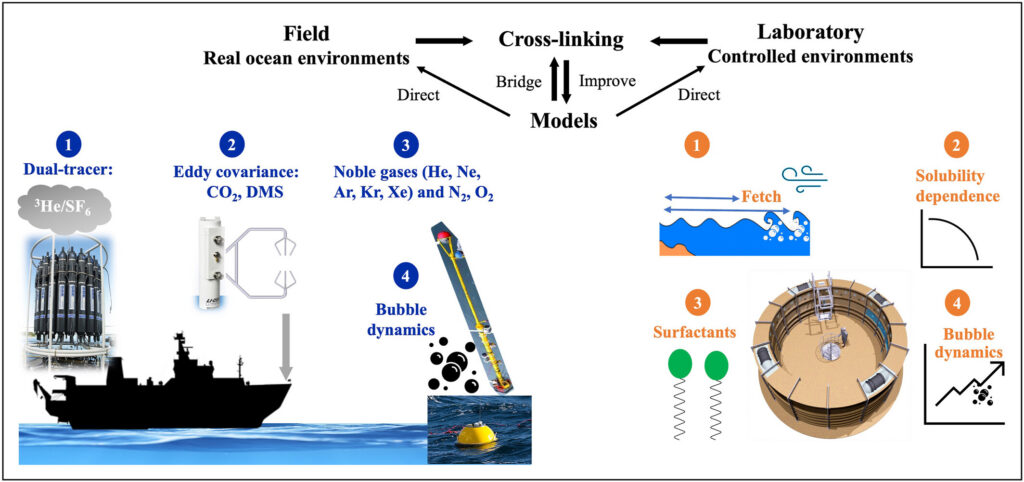
No single method can fully describe bubble-mediated gas exchange due to its complex properties, so researchers combine several approaches. Laboratory wind-wave tanks allow controlled experiments in which wind, waves, bubble populations, and gas solubilities can be varied. Field techniques include measuring the saturation states of inert gases and directly measuring turbulent gas fluxes above the sea using the eddy covariance technique. Different gases act as complementary tracers because their solubilities and molecular properties differ. Noble gases, oxygen, carbon dioxide, and dimethyl sulfide can therefore reveal different parts of the exchange process. Finally, physical models resolve the bubble dynamics and combine with gas exchange processes, providing independent constraint and a testbed for bubble-mediated gas exchange. To provide the bubble dynamic information, researchers use acoustic and optical instruments to measure bubbles and wave breaking.
Why is bubble-mediated transfer difficult to quantify?
First, the underlying processes are highly complex. Accurate simulation requires understanding and representing the full sequence from wave development and breaking to air entrainment, bubble-size distributions, bubble cloud movement, and gas exchange between individual bubbles and seawater. Uncertainty at any stage can propagate into the final transfer estimate.
Second, observations are difficult. Bubble-mediated exchange is more significant under high winds and intense wave breaking, when field measurements are most challenging and remain scarce. Measuring bubbles very close to an active sea surface is especially difficult and such measurements are crucial to validating models. Traditional linear wind-wave tanks also have limited breaking capacity, fetch, and water depth, making it difficult to reproduce open-ocean conditions.
Third, bubble-mediated and interfacial transfer occur simultaneously and their separation is difficult. Interpretation of measurements and the scaling from one gas to another is difficult, complicated by the dependence of the bubble contribution on solubility.
What are the most important remaining research questions?
Three questions are especially important. First, we need to understand what happens to bubbles in the uppermost meter of the real ocean: how much air is injected (bubble volume), how bubble sizes are distributed, and how bubble clouds are influenced by upper ocean water movement.
Second, we need to determine how bubble-mediated transfer changes across gases with different solubilities. This is essential for transferring knowledge from commonly studied gases to climate-relevant gases such as CO2 and O2.
Third, we need to explain why laboratory experiments and field observations often produce different estimates of the bubble contribution. Progress will require coordinated measurements of near-surface bubble properties and the exchange of several gases with contrasting solubilities across laboratory and ocean environments. These observations should ultimately be used to develop physically based parameterizations for ocean biogeochemical and Earth system models.
—Yuanxu Dong (yuanxu.dong@lmd.ipsl.de,  0000-0002-1468-1623), completed this work while affiliated with GEOMAR Helmholtz Centre for Ocean Research Kiel and Heidelberg University. He is now at LMD-IPSL, École Normale Supérieure-PSL, École polytechnique, Institut Polytechnique de Paris, Sorbonne Université, CNRS, Paris France
Editor’s Note: It is the policy of AGU Publications to invite the authors of articles published in Reviews of Geophysics to write a summary for Eos Editors’ Vox.

Citation: Dong, Y. (2026), How bubbles reshape air-sea gas exchange, Eos, 107, https://doi.org/10.1029/2026EO265028. Published on 5 August 2026.
This article does not represent the opinion of AGU, Eos, or any of its affiliates. It is solely the opinion of the author(s).
Text © 2026. The authors. CC BY-NC-ND 3.0
Except where otherwise noted, images are subject to copyright. Any reuse without express permission from the copyright owner is prohibited.