Editors’ Highlights are summaries of recent papers by AGU’s journal editors.
Source: Paleoceanography and Paleoclimatology
Archaea, a major branch of the tree of life that was first recognized in 1977, are single-celled microorganisms that inhabit an extraordinary range of environments, from the open ocean and lakes to soils, hot springs, and even the human microbiome. Intriguingly, these microbes possess the ability to adjust the molecular composition of their membrane lipids in response to environmental temperature variations. In the marine realm, free-floating (“planktic”) species of archaea alter the relative abundance of membrane lipids containing different numbers of cyclopentane rings as the surrounding seawater warms or cools during growth—with warmer conditions favoring lipids with greater cyclization.
In 2002, Schouten and colleagues calibrated this relationship into a “paleothermometer” (or paleoclimate proxy for temperature) and named it TEX86—the TetraEther indeX based on membrane lipids containing 86 carbon atoms. Since its calibration against sea-surface temperature using marine sediments from across the world’s oceans, TEX86 has been used to reconstruct ocean temperatures across ~190 million years of Earth history, from the age of the dinosaurs to today, serving as a critical resource for paleoceanography and paleoclimatology.
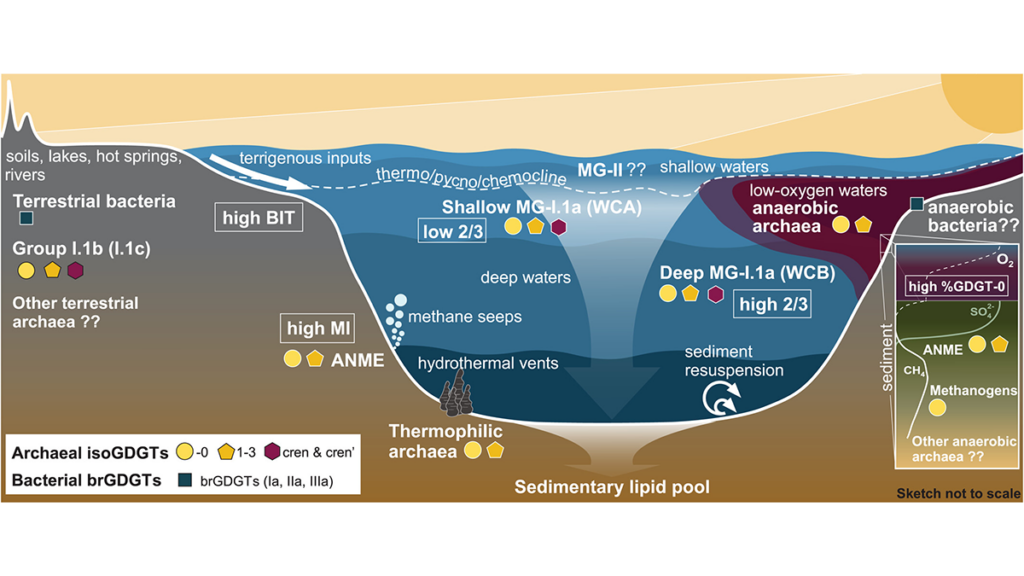
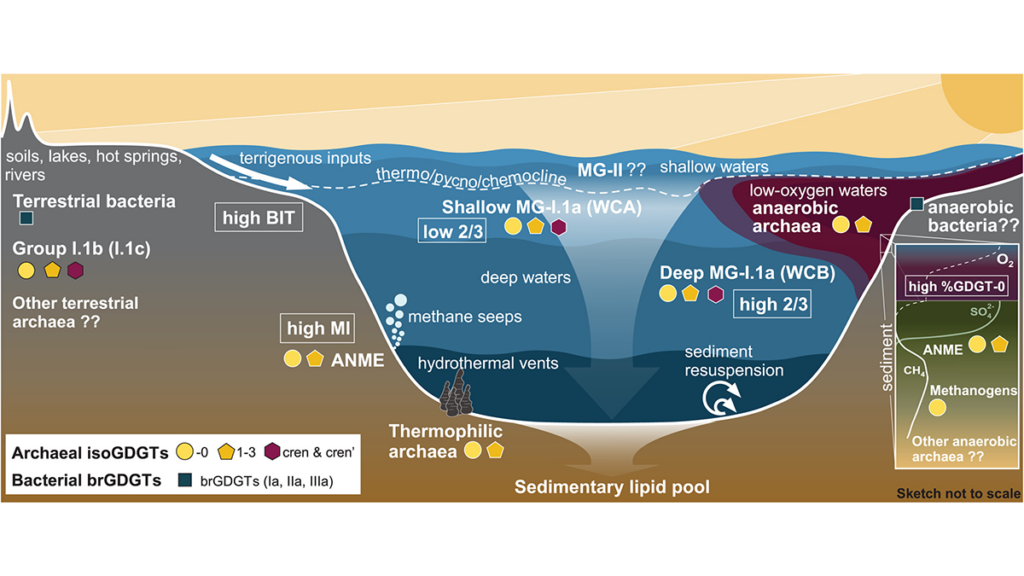
In this community-driven (and comprehensively detailed) review paper, Elling et al. [2026] characterize and synthesize our current understanding of TEX86, including its origin primarily from a class of ammonia-oxidizing archaea (Nitrososphaeria), the mechanistic basis of the paleotemperature signal, and the challenges that complicate its interpretation—from production depth and seasonality to non-temperature influences on membrane composition, including nutrient availability and archaeal community composition. Importantly, the review highlights that the form of the relationship between TEX86 and temperatures above 30°C is yet uncertain—with different calibrations yielding markedly different estimates—limiting our ability to estimate ocean warming under past greenhouse climates. To overcome these challenges, the authors advocate for expanded laboratory culture and mesocosm experiments and, ultimately, the development of more realistic proxy-system models that better represent the processes governing TEX86. By charting both the remarkable progress and the remaining uncertainties of TEX86, this review provides a roadmap for the next generation of molecular paleoclimate reconstructions.
Citation: Elling, F. J., Inglis, G. N., Davtian, N., Hurley, S. J., Naafs, B. D. A., O’Connor, L. K., et al. (2026). Archaeal tetraether lipids as tracers for past marine environmental change. Paleoceanography and Paleoclimatology,41, e2025PA005373. https://doi.org/10.1029/2025PA005373
—Kaustubh Thirumalai, Editor, Paleoceanography and Paleoclimatology
Text © 2026. The authors. CC BY-NC-ND 3.0
Except where otherwise noted, images are subject to copyright. Any reuse without express permission from the copyright owner is prohibited.