When I was thinking about having kids, my algorithm spoon-fed me all the pregnancy content the internet had to offer (for better or for worse). When my son was born, boom: There were all the tummy time tips and sleep consultants ready to offer advice. But apparently now that I’m “of a certain age,” my algo has decided it’s time for me to start thinking about osteoporosis. Because lately, I keep getting served videos of women marching in place at the stove while they make dinner and literally stomping around the block in order to increase their bone density. So, I had to ask some experts: Does stomping help bone density?
Osteoporosis isn’t just a condition mentioned in drug commercials during daytime TV. Around 10 million Americans have osteoporosis and another 44 million have low bone density, according to the Bone Health & Osteoporosis Foundation. It occurs when your bones’ mineral density and overall mass decrease, making bones weaker and more prone to fractures. In some cases, those breaks can happen simply from bending over, coughing, or lifting an object.
Women over 50 are at higher risk of developing osteoporosis — nearly 1 in 5 women will be diagnosed compared to 1 in 20 men. The key to preventing it is to promote healthy bone density, obviously, which is mainly done through weight-bearing exercises like walking or dancing, and lifting weights. But if you spend time on social media, stomping seems to be the prevention method du jour.
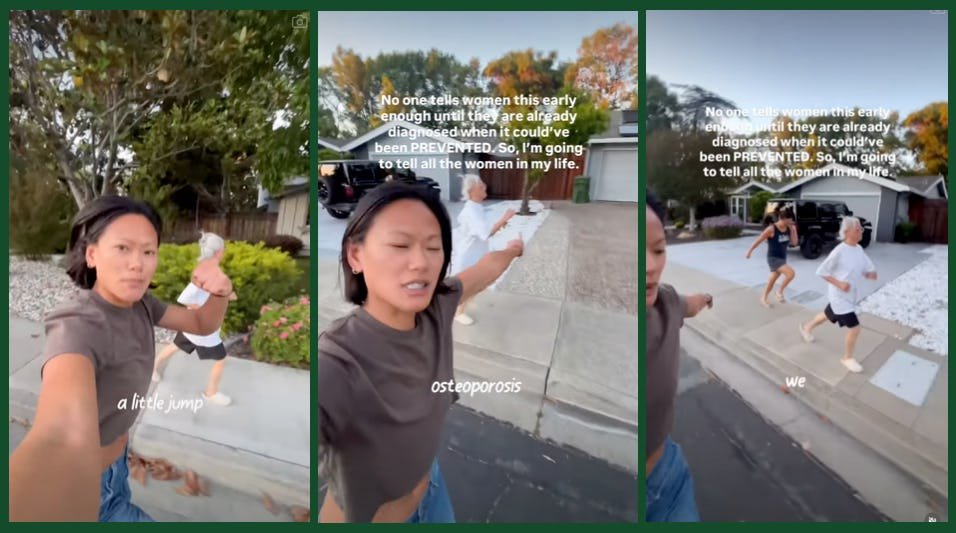
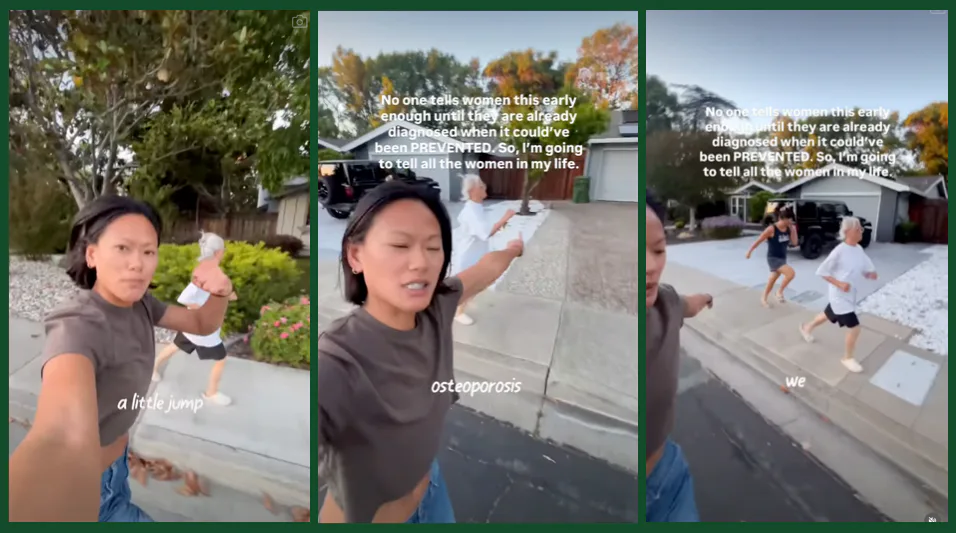
Dr. Laura Kuan’s (@drlaurakuan on Instagram) post is one of many that made its way into my feed recently. In her video, she and her mom appear to be on an evening stroll, the pair stomping their way around the neighborhood and even adding in a small jump here and there, all in the name of staving off osteoporosis.
“Through resistance training and exercises that impact the bones, we can drastically slow down and even stop (the earlier you start, the better) bone and muscle loss,” she wrote in the caption. “When you do, you are sending physical signals to your muscles and bones to build MORE. That signal does not come from walking, swimming, biking, cardio. That signal only comes from something that challenges the muscles and bones enough. So once an exercise becomes too easy, you must incrementally increase challenge to continue building up bone and muscles.”
Kuan’s mom is 72 and has osteoporosis, her caption goes on to explain. “We just found out her osteoporosis medication did not work, and now she’s high risk for fractures. I’m hoping this is the wake-up call she needed to start taking training seriously. Cuz she’s too important to me to watch her struggle and suffer.”
Why would stomping around improve your bone density? Activities that put stress on your bones, like walking or weight lifting, stimulate extra deposits of calcium and cue your cells to build more bone to handle that stress. “The result is stronger, denser bones,” Harvard Health says.
It’s true — there are some studies that show jumping increased bone density in premenopausal women. While walking, jogging, and dancing are all considered safe weight-bearing exercises, Dr. Alexandra Reese, a rheumatologist at Cleveland Clinic, says she wouldn’t recommend going straight to jumping and stomping… especially if you don’t know what your bones can handle.
“Unfortunately there’s not really anything that cues you into the diagnosis of osteoporosis besides fractures,” she says. “These videos have good intent and I think they’re kind of touching on weight-bearing exercising, but I think [stomping] could be a little more damaging to the joints and the bones if somebody does truly have osteoporosis.”
The most common fractures in people with osteoporosis include wrist, hip, spinal, and ankle fractures, Reese explains, and that’s usually how they find out they have osteoporosis in the first place. So, taking to the streets to forcefully stomp around on concrete may not be wise if you’re trying to prevent breaks, she advises.
The CDC recommends all women undergo a DEXA scan to evaluate their bone density at age 65, or between 50 and 64 if they have certain risk factors, like a family member who has broken a hip. But preventive measures need to start well before age 50, experts say. For Reese, the ideal time to make weight training, resistance training, and bodyweight exercises part of your routine is in your 20s, though it’s especially important during menopause, when bone loss really accelerates.
“Our highest bone density is going to be when we’re 30. So make sure any time in your 30s, 40s, 50s, that you’re continuing with a weight-bearing strengthening program, exercising with weights two to three times a week,” says Colleen Scordato, PT, DPT of Orlando Health Outpatient Rehabilitation.
Including balance exercises into your wellness routine is crucial to preventing falls and fractures too, both Scordato and Reese point out. “Make sure that you’re incorporating balance with your exercise to include tandem stance — which is standing with one foot in front of the other — or single-leg stance or single-leg stance with eyes closed. Certain yoga poses, like the warrior pose, are also good ways to practice your balance. For weight training, use free weights instead of machines because those free weights are going to have a component of balance within them,” Scordato says.
Whether you get your activity in through jogging, lifting, pilates, pickleball, or just dancing around the house, it’s important to talk to your doctor before starting any high-impact activities — especially if you know your bone density is low, says Reese.
“Make sure you talk with either your primary care doctor or your rheumatologist if you already have a diagnosis of osteoporosis; then you can just see what exercises are safe for you.”