
Earlier this year, Amazon overtook Walmart as the world’s biggest retailer by sales. The online marketplace’s claim to fame is selling everything under the sun—but such a massive catalog has its drawbacks. Amazon sells products by plenty of trusted brands, but to find them, shoppers have to wade through oceans of slop.
That includes “pseudo-brands,” such as online-only retailers typically named with a string of all-caps letters that look more like high-security passwords than brand names. (A cursory Amazon search for a tank top, for example, returns offerings from alphabet-soup-style brands like MAGCOMSEN, UOUA, and ANRABESS.)
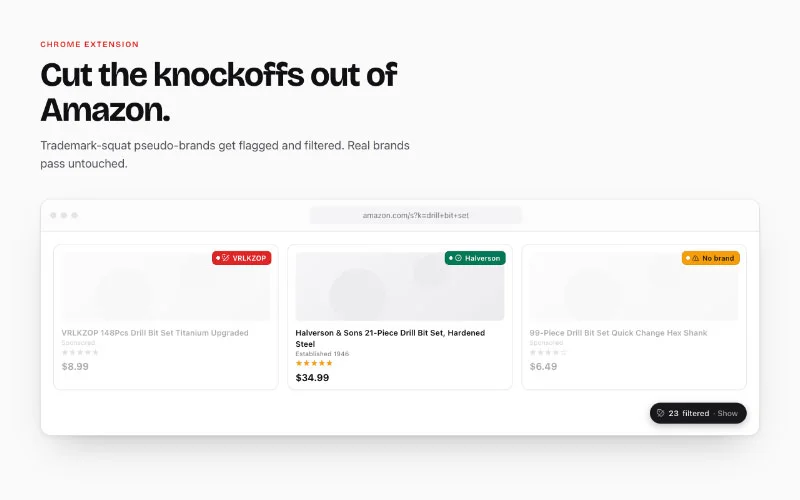
That’s where a new tool called Knockoff comes in. The web extension from the developer Josh Pigford automatically sorts through brands on Amazon to filter out the sketchy options, and highlights the retailers that consumers can count on for quality service and products.
How Knockoff filters out the slop
Pigford was inspired to create Knockoff by his own experience shopping for a grass trimmer, when his died while he was doing yard work over the weekend.
“I did the usual search on Amazon for replacement parts and the tools needed for that and I had the hardest time just finding well-made tools,” Pigford tells Fast Company over email. “Everything I was finding were those nonsensical brandnames with almost no selling history.”
“I think the first time I ever noticed how insane some of these brands were was when I shopping for a dog bed maybe two years ago and the top products were made by WNPETHOME and EHEYCIGA,” he adds. “So, I decided to build Knockoff to hide all of that and focus on what I think most people would at least subjectively call more ‘trustworthy’ brands.”
As Knockoff puts it on its website, the browser extension filters out knockoff retailers “so what’s left is brands with a reputation to lose.” It works by checking search results against a curated list of more than 5,000 established brands, then scoring unknown names based on their likelihood of being a pseudo-brand. Users can also help refine the tool by reporting any misclassifications, adding a human touch to the automatic filter.
Knockoff isn’t a one-size-fits-all tool. The filter is customizable, including three levels of extremity (Relaxed, Standard, and Strict), the ability to personally block or trust certain brands, and options for how blocked retailers should appear in your search results (with a warning label, faded out, or entirely absent).
Knockoff is available as an extension on Chrome and Firefox and works across all Amazon storefronts.
‘He deslopped Amazon’: Social media celebrates Knockoff
Pigford initially shared Knockoff on social media as a personal project, asking social media if he should release it to the public. The answer was a resounding yes, leading to Knockoff’s release in the Chrome Web Store a day later.
Knockoff immediately went viral, with Pigford’s announcement post garnering 10.5 million views on X.
“Holy crap, it’s beautiful,” one user marveled, sharing a screenshot of how Knockoff cleaned up his search results. “He deslopped Amazon.”
Another user said the tool was undoing Amazon’s “enshittification,” a welcome reprieve from an all-too-widespread trend.
Pigford says the online response “has been almost universally positive.”
“I’ve been called a savior, legend, hero and god hundreds of times, which is obviously absolutely absurd, but very kind regardless,” he says. “I’ve still got a lot of work to do around accuracy, but excited to see where this goes!”
What makes Knockoff such an instant hit? Pigford thinks the era of AI slop may be to blame, with online shoppers finding relief in a guarantee of something curated by humans.
“I believe it’s resonated so much as buyers are just overwhelmed with the firehose of life. AI has played a big part in consumers feeling duped and having a hard time discerning what’s real,” Pigford explains. “Having something that helps, even just a little bit, with regained control just feels good.”