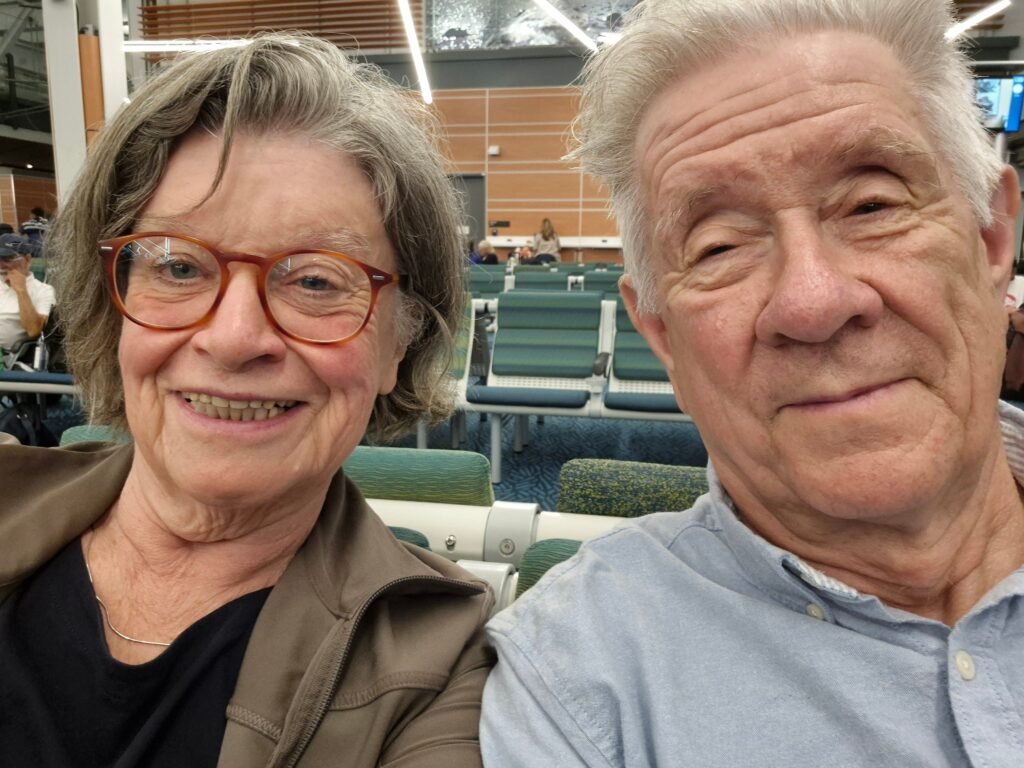
Barry Rueger
- We left Canada so my 80-year-old wife could get a master’s at the University of Cambridge.
- My visa limited my work opportunities, our budget is tight, and I’ve taken on all household chores.
- I feel out of place here, but I know this is a temporary hardship for my wife’s dream.
Just before her 80th birthday, my wife, Susan, was accepted into a master’s program at the University of Cambridge in the United Kingdom.
This would not be her first degree, but earning one from such a prestigious academic institution is a once-in-a-lifetime opportunity.
Pursuing this dream has been daunting. Not only does completing a master’s in only nine months seem nearly impossible, but we’ve also temporarily relocated from our home in British Columbia.
Although Susan was born in the UK, she’s considered an international student — tuition and fees for this degree are tens of thousands of dollars.
Still, my role is to support her as she embarks on this great challenge.
Our income has been reduced and I’ve taken on all of the household responsibilities
Barry Rueger
Susan and I have both always worked, often seven days a week.
After decades of managing not-for-profit organizations, I’d moved into freelance writing, and we’d been operating a successful dog-walking business. Susan has also taught piano to eager students around Vancouver for many years.
However, my wife is now focused on her studies. And as I’m in the UK on a tourist visa, my options for working are extremely limited, and I can’t get a job locally.
We have pensions and some retirement savings, but this has been a bigger challenge than expected, especially amid relocation costs and tuition bills.
Unable to do much work during our time in the UK, my plans were to read lots of books and finish the memoir I’ve been writing for several years. What happened has been much more mundane: I have become a bit of a stay-at-home husband.
I cook, I clean, I shop for groceries. I do laundry and am careful not to place Susan’s more delicate garments in the dryer. I take out the garbage and recycling, I pick up and return books at the University library, and I keep track of meetings, appointments, and doctor visits in my calendar.
We’d always shared these jobs and responsibilities, but now they’re almost entirely my domain while she focuses on her studies.
I’m also the in-house proofreader and editor, and Susan’s person to bounce ideas off of. When her workload seems most overwhelming, I’m the person who shuts up and just listens.
My entire life revolves around Susan’s schedule and requirements, and my own goals and needs have become secondary.
I often feel I don’t belong in Cambridge, though a new hobby has helped
Karl Hendon/Getty Images
It didn’t take long for me to learn that I have no real place in Cambridge. This feeling began at the college gym nearest our home for the year, a beige-painted apartment in student housing.
Susan’s keycard opens the door for her. My “partner” card doesn’t, so I can only work out when she does. More frustrating was realizing that not only would my card not open the door to get me into the gym, but also it wouldn’t unlock the door to let me exit. If there were no one else in the gym, I’d be trapped.
Furthermore, Cambridge is a town famously devoted to students and faculty. Because I don’t fit in either of those boxes, I’m excluded from all sorts of facilities and events, including free concerts and lectures I see advertised that happen inside colleges that I’m not allowed to enter.
Worse for me was realizing that because I wasn’t part of the University, I also rarely fit into conversations. When I meet someone locally, their ice-breaker question is always “What are you studying?”
“Um, nothing. I’m Susan’s husband.” turned out to be a very fast way to end a conversation. I’ve adapted that to, “Oh, I’m Susan’s plus-one…”, with a laugh, followed quickly by, “… and I’m working on a memoir.” That literary pretense is often enough to establish my legitimacy with Susan’s classmates.
After three or four months, I realized that this lack of a place to be, or a role to play, was making me terribly unhappy. Susan was entirely consumed by her studies, and I couldn’t in good conscience expect her to fix this.
So, on my 70th birthday, I came up with a solution of my own: taking up flying.
Barry Rueger
I began taking lessons nearby, and although the hobby is satisfying, it also reinforces the box I’m living in.
Gliding lessons have to fit around Susan’s life, and because we don’t have a car in Cambridge, I need to find people who can give me a ride to the airfield, which is 45 minutes from our student home.
Because it takes me away from Susan and takes up a large part of my depleted income, gliding also makes me feel guilty.
As much as I love soaring through the skies over the green English countryside, I keep being reminded that we’re here for Susan, not for me.
And even among the pilots, I find myself surrounded by retirees from the University and students from its gliding club. Once again, I don’t quite fit into either group.
Ultimately, these temporary discomforts are worth dealing with to see my wife’s dreams come true
CHUNYIP WONG/Getty Images
Susan and I have always supported each other’s passions — that’s what has made our marriage successful — but this new arrangement has been a challenge.
However, it is temporary. In a few months’ time, when we return home to Canada after Susan has completed her degree, I’ll be able to continue my writing work, and Susan will return to teaching.
Our budget won’t feel as strapped, and we’ll be back with our friends and community in Canada. We’ll probably return to our more balanced division of labor, taking turns who shops for groceries and cooks dinner.
And hopefully I’ll finally finish — and publish — my memoir.
Part of the memoir I’m writing looks closely at my mother’s life as the wife of my father. A bit like me during this time, she didn’t have a job and had less money than she really needed. She was stuck at home as a housewife, cooking, cleaning, and raising us kids.
My mom worked tirelessly to make sure that we were happy and secure. Like her, I’m going to great lengths to support someone I love, giving up part of my own life to make Susan’s dream come true.
If there’s one lesson that I’ll take home from Cambridge, it is that this is often the greatest gift that you can give a loved one.