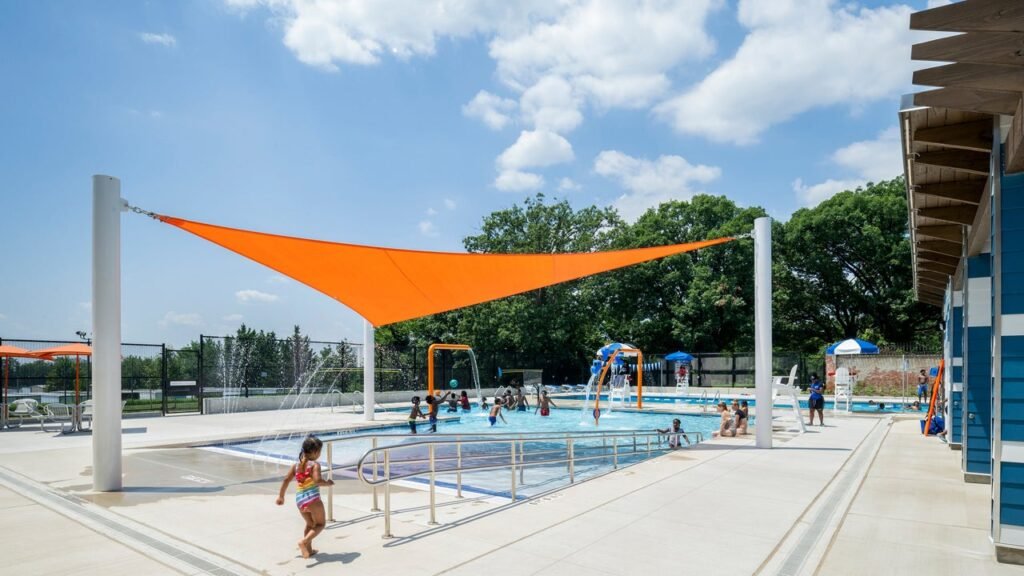
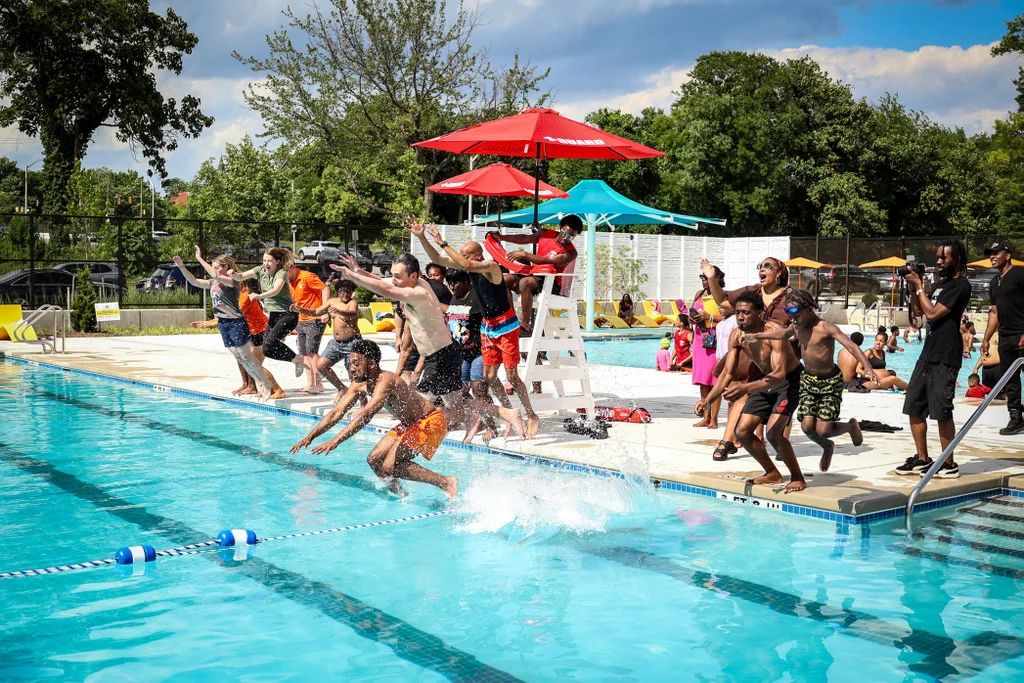
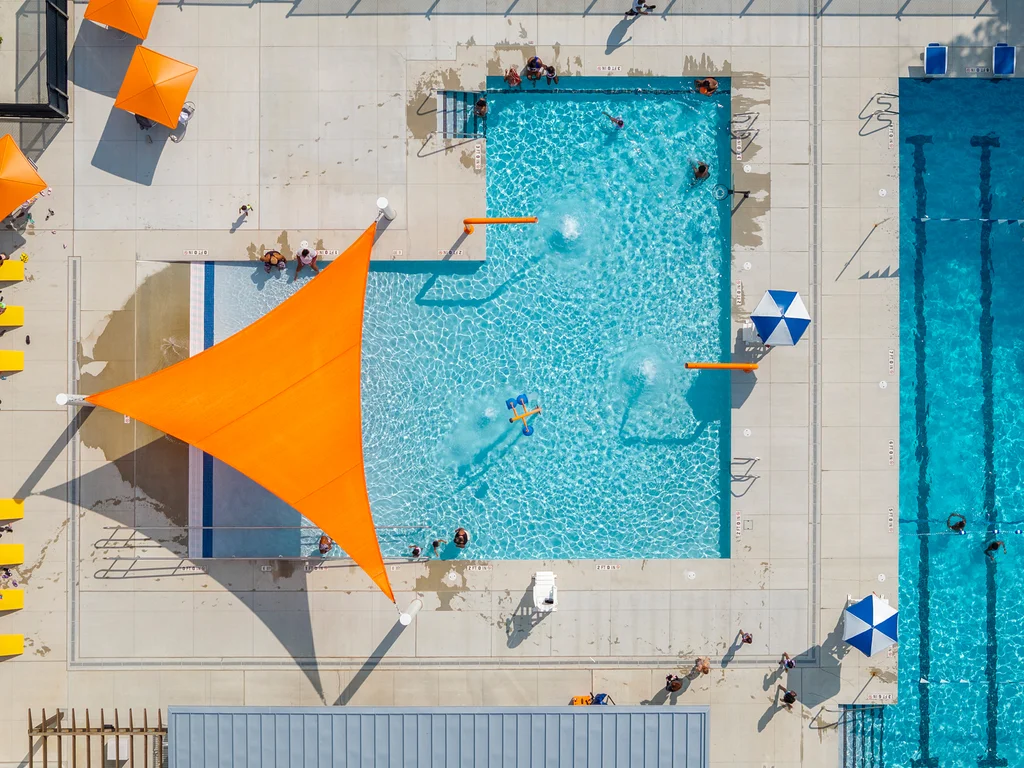
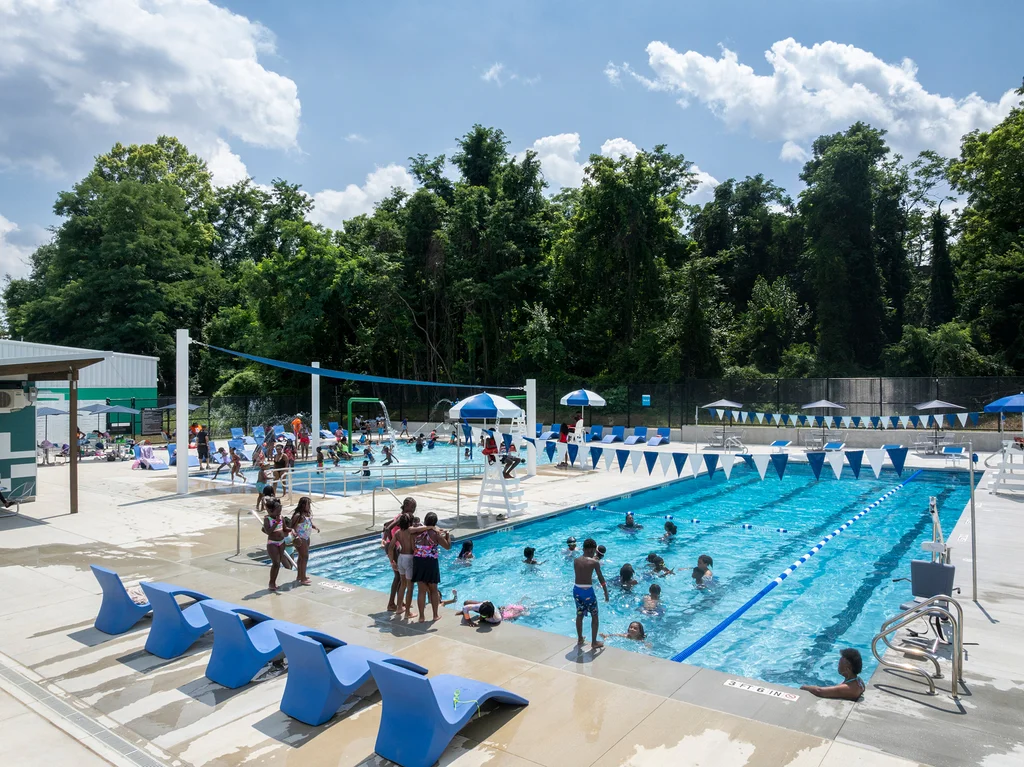
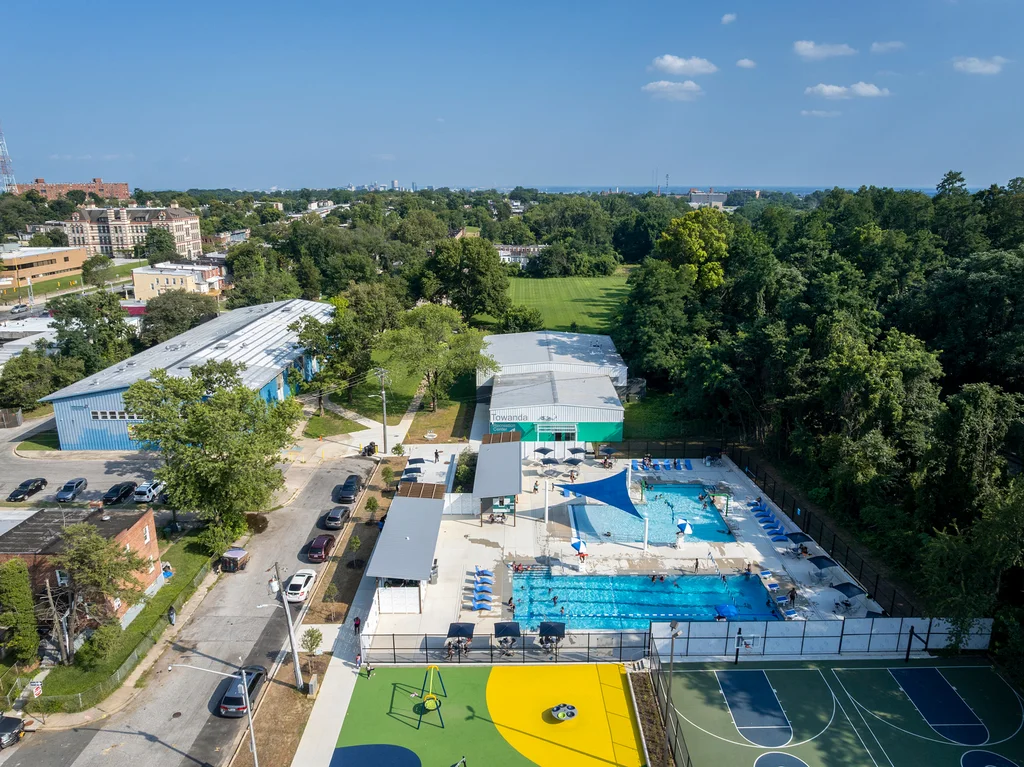
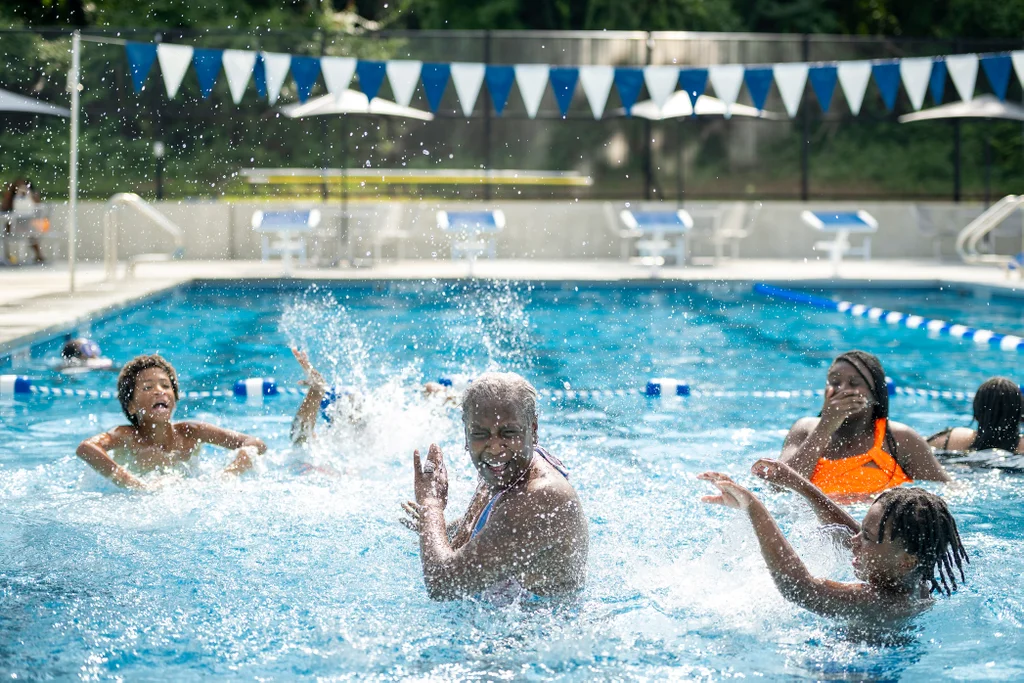
In mid June, Baltimore celebrated the opening of a newly renovated public pool. Located in Poppleton, a neighborhood in West Baltimore, the Greater Model Aquatics Center features a zero-entry wading pool (it gently slopes from the deck into the water, like a natural shoreline), a six-lane lap pool, and an expansive deck furnished with bright yellow lounge chairs, shade umbrellas, and a splash pad. A new rec building with public restrooms is also part of the complex.

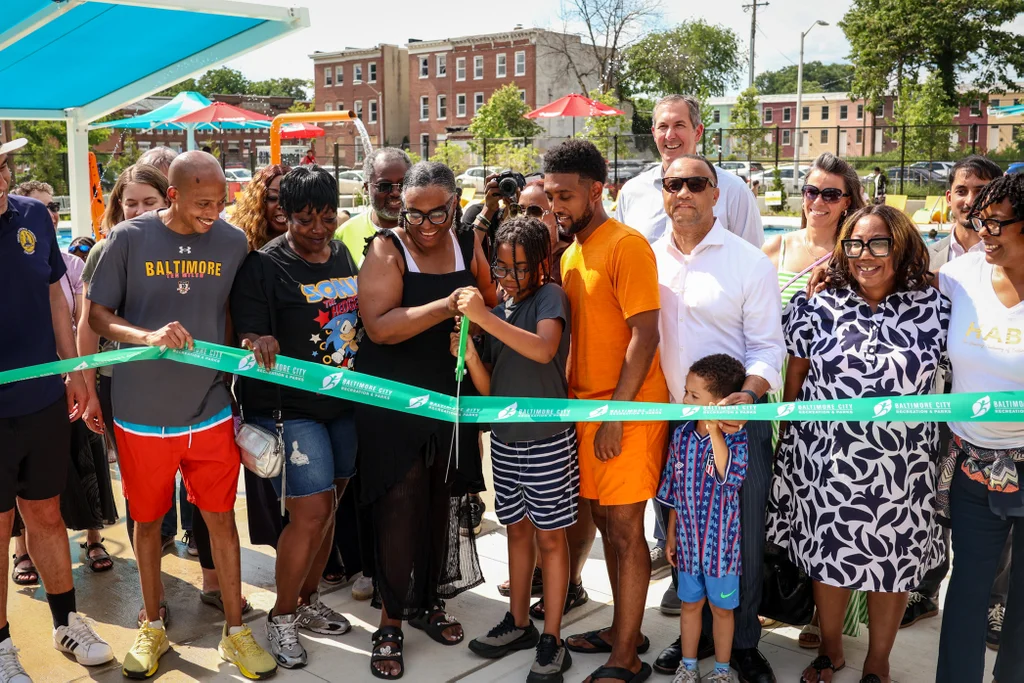
During the ribbon cutting, which took place on an 87-degree day, the sounds of play could be heard behind remarks from city officials. “These young people—hear these babies enjoying themselves in the water today—this is what it’s all about: our future generations enjoying this space, understanding that they stand on the shoulders of those who came before, who have fought to make this happen,” said John T. Bullock, the city council representative for the neighborhood.
Greater Model had been closed since 2019, when the city was forced to shutter the facility because of disrepair and deferred maintenance—a common problem afflicting aging public pools across the country. Baltimore, whose network of neighborhood public pools was built up during the 20th century, is demonstrating how to get many of these facilities back online and with modern features that help these public spaces better serve their communities.
With the help of the architecture firm CannonDesign, the Parks and Recreation Department is overhauling five aquatics centers using a kit-of-parts approach oriented around accessibility and multi-generational use. The idea is that well-functioning public pools for all are key to healthier cities from the perspectives of climate adaptation, social cohesion, and more. The collaboration shows how cities across the country could reinvest in this critical public infrastructure.
“So many individuals in this community depended heavily on pools,” says Reginald Moore, the director of Baltimore City Recreation and Parks (BCRP). “Yes, it is a place for them to cool off during Code Red days, but it’s also a place where families go to connect.”
The investment in these facilities comes at a time when cities have been pivoting to splash pads, which typically have lower construction costs and don’t require lifeguards, to address the need for public cooling. “We’ve seen a lot of cities remove their pools or close them and replace them with a splash pad,” says Monica Pascatore, the architect at CannonDesign who led the project. “I would challenge them to think about the difference between splash and immersion. The physiological relief of immersion on the body is very different than splash. And it doesn’t offer the opportunity to learn to swim, which is an equity issue where it’s really important to fill that gap.”
Designing a better neighborhood pool
Beginning in the early 20th century, Baltimore built small neighborhood pools to help alleviate crowding at its larger aquatics centers. These were simple swim centers with a single pool and a capacity for 30 to 40 people. Today, the city operates five large aquatics centers and 12 smaller neighborhood pools.
The city’s pools were segregated until 1956. Because of white flight in the 1950s—a problem that affected many cities—Baltimore’s population dropped, lowering the tax base that funded the municipal budget. Unlike Baltimore County, which transitioned its public pools to private after integration, the city maintained its public pools and expanded the network when it could. The five pools CannonDesign renovated were constructed in the 1970s.
Still, maintenance was a challenge. The city dedicated what money it had to larger central facilities and the neighborhood spaces suffered. By 2020, when CannonDesign began working on the project, these facilities had reached the end of their lifespan and were closed and sitting empty, becoming another symbol of vacancy in the city. After receiving funding to renovate the pools, the city decided to take a kit-of-parts approach to the redesign. This helps ensure consistent high quality spaces for the public, greater swim equity, and designs that can respond to their immediate community. Additionally, consistency across the facilities makes long-term maintenance more sustainable.
CannonDesign and BCRP wanted the facilities, which cost between $5 and $8 million to renovate, to be as accessible to as many people as possible. Instead of a single pool at each facility, they determined that two bodies of water would ensure that the various constituents who come to swim aren’t competing with each other for space. More effective use of the sites enabled them to build two pools. For example, the architects shrunk the size of the locker rooms in order to allocate more room for recreation.
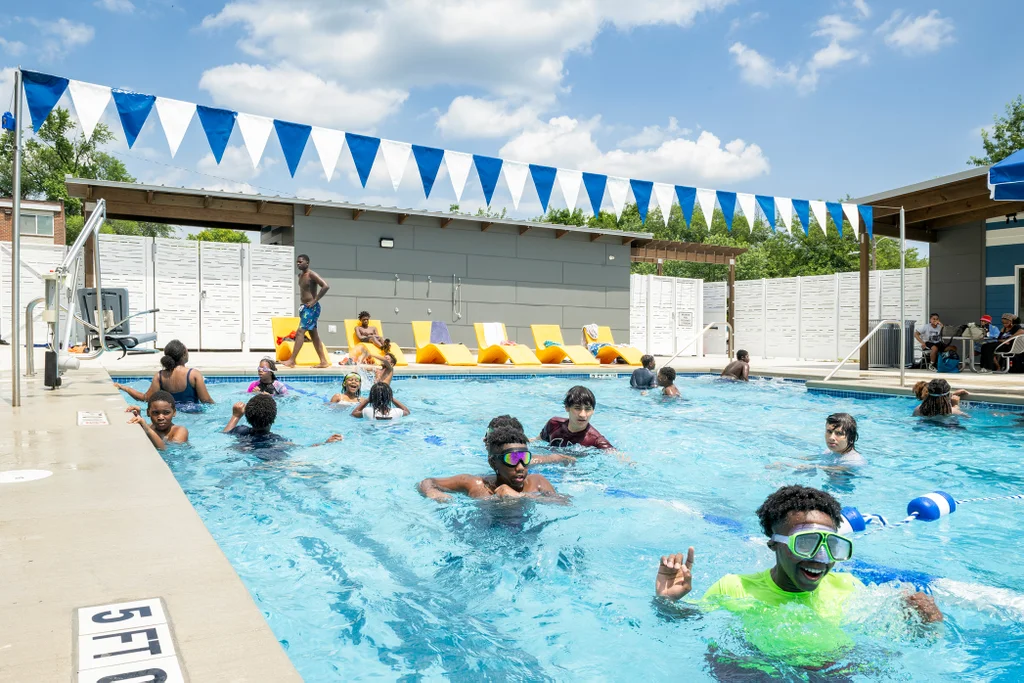
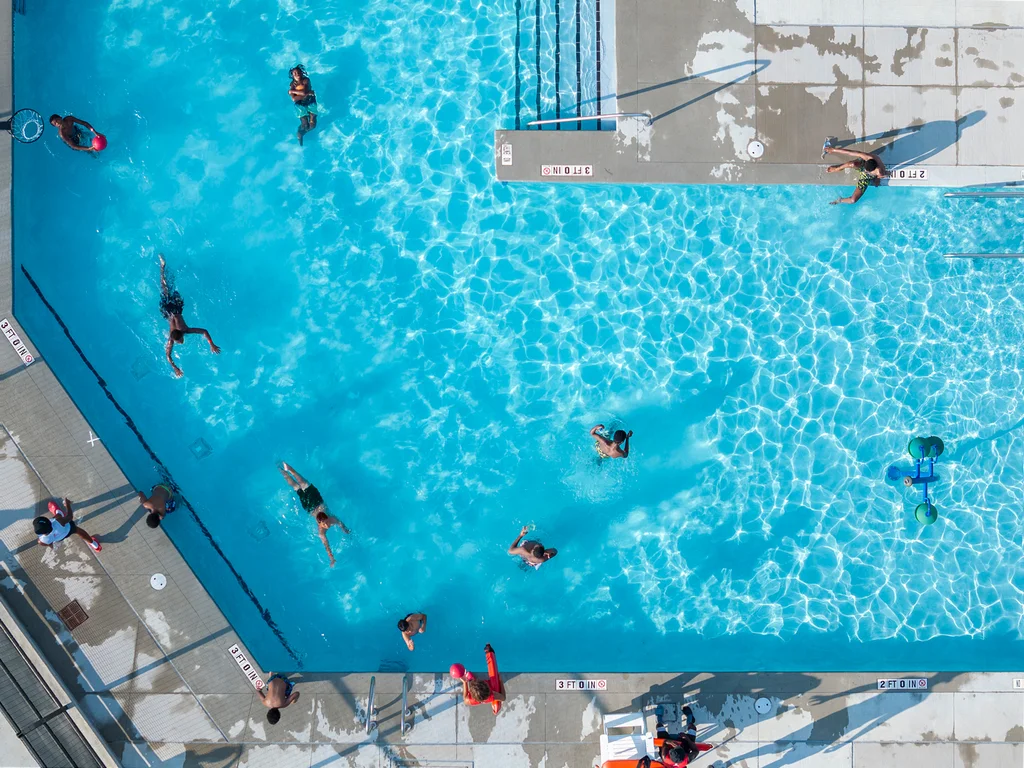
The shallow pool with zero-entry is tailored for young children and their caretakers, seniors and those with limited mobility, or anyone else who prefers the shallow end. The larger pool can be cordoned off for lane swimmers while leaving room for those who just want to play around. Then, CannonDesign integrated special features like massive pipes and sprinklers that drop water into the pools from above.
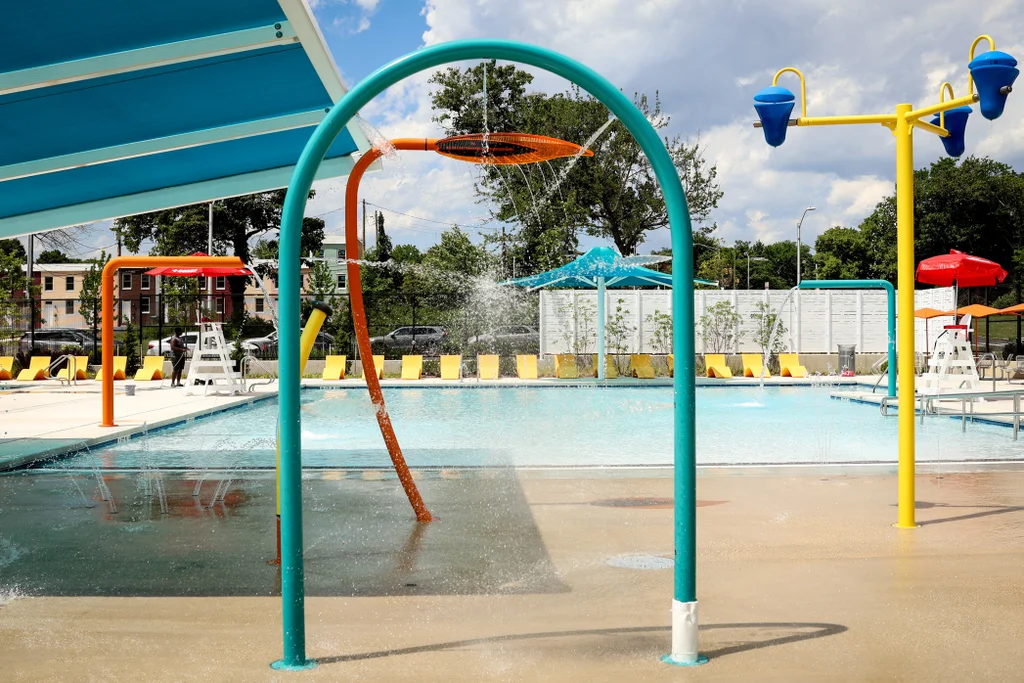
“People like to experience water in different ways,” Pascatore says. “We took the approach of thinking of these as a retreat, a respite, a place for people looking for reprieve from the heat.”
This approach also guards against the deferred maintenance issue in the future. “Having aging pool systems, every mechanical system is completely different—different pumps, different motors—and it’s like you beat your head up against the wall,” Moore says. “How do we maintain this system when I may have to go get a pump from California?”
Improving swim equity for all
The Greater Model Aquatics Center builds on lessons learned from the previous three pools that opened (they are the Walter P. Carter, Towanda, and Coldstream facilities).
To make room for the two pools, CannonDesign shrunk the footprint of the locker areas. The assumption was people would come to the pool from home ready to swim since the facilities are local. It turned out that visitors needed more space to store things, so they expanded the locker facilities. Additionally, the design team learned that the community has a higher population of people with autism, so it integrated a small greenspace in one corner of the center to provide sensory comfort for visitors.
Initially, BCRP sought to avoid landscaping within the facilities because of maintenance (scooping leaves out of the water is laborious and clogs filters, plus it’s extra work for an already stretched-thin staff). However, residents asked for more greenery. BCRP struck up a partnership with a gardening group near the Walter P. Carter pool and is working with them to introduce landscaping.
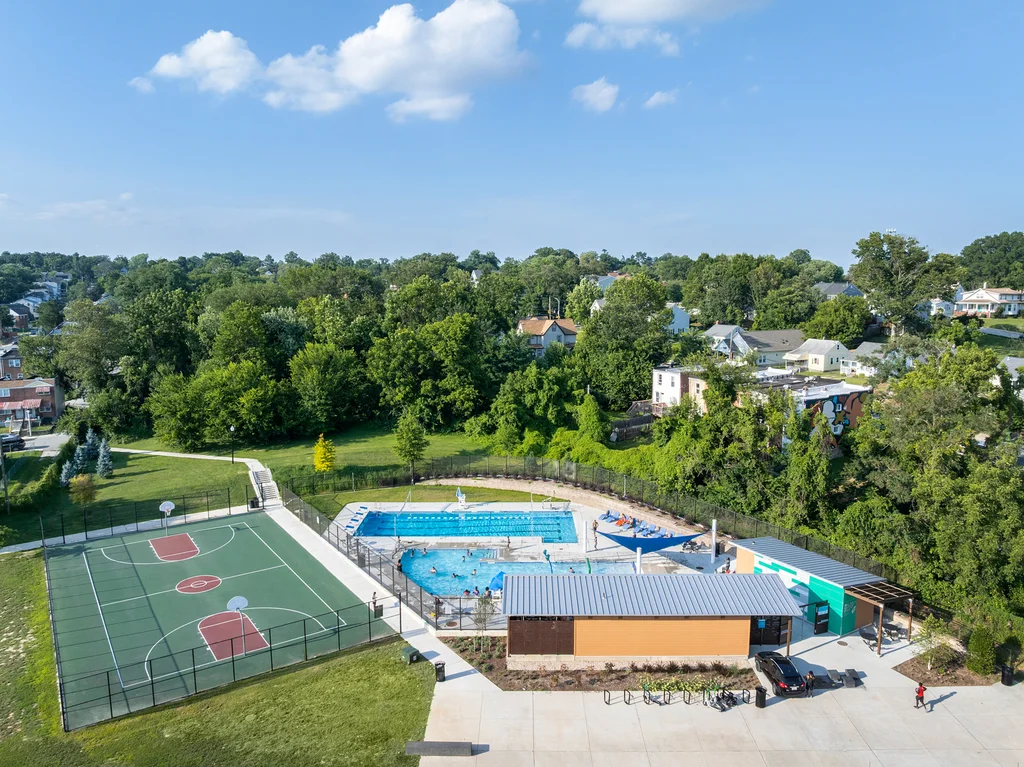
The final aquatics center that CannonDesign is redeveloping, the City Springs Park location in East Baltimore, was on a small site that wasn’t able to accommodate two pools. However, BCRP was able to swap locations with a community garden on the opposite end of the park in order to provide the same level of service as the other pools.
“We’ve learned that each community is different,” Pascatore says. “Even though the components of the pools are the same and they adapt to each site, what each community brings to it is unique and different.”
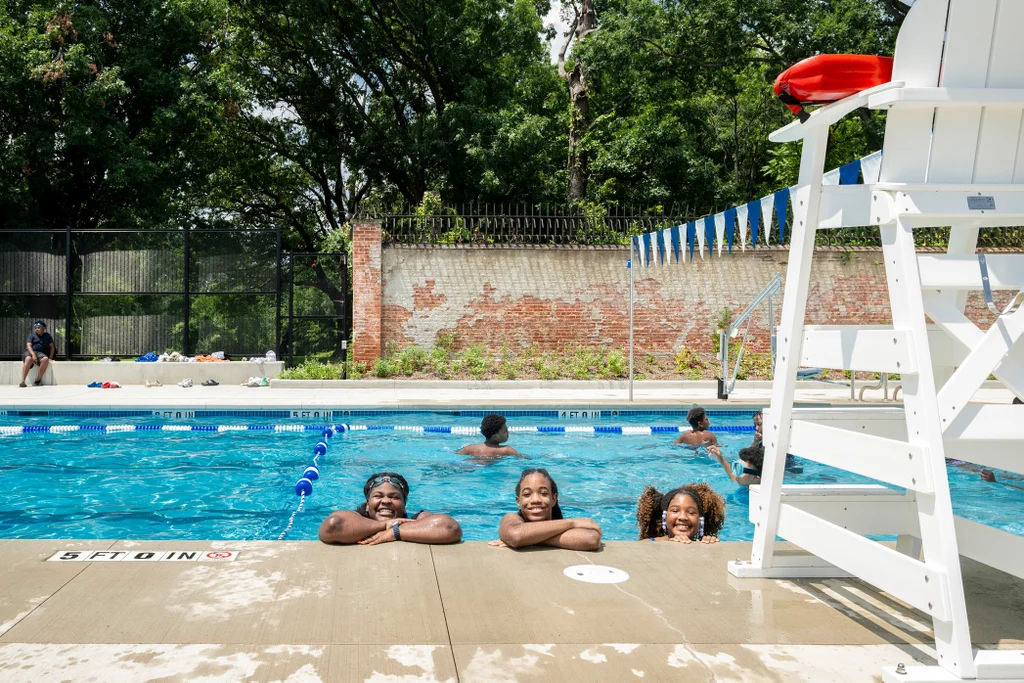
Part of the mission of the pools is also to address the racial disparity in drowning deaths: the drowning rate for Black people under 30 is 1.5 times that of white people in the same age group. Access to swim lessons helps this. In the United States, there are roughly 309,000 public pools and over 10 million private ones. “It’s bigger than just replacing pools,” Moore says. “It’s also about giving kids an opportunity to learn to swim.”
He’s particularly concerned about making up for the time when communities didn’t have easy access to pools. “We have to reeducate the community on the importance of the pool,” he says. “In the many years without having a pool, how many of those kids that are now in the community have never been taught how to swim? So we have a lot of catching up to do because that pool has been down for so long.”
One component of a healthier city
Public recreation centers, like the renovated neighborhood pools, are a component of what Mayor Brandon Scott is calling the “Baltimore Renaissance,” an equity-focused approach to city revitalization. Reducing gun violence is a critical element within the framework.
Mayor Scott is using a public health–based approach to achieve this goal. The thinking is: invest in community resources, affordable housing, and youth outreach, and crime will go down. To this end, the city launched a program called the Rec Rollout, a $120 million investment in parks and public spaces, in 2022. This included rehabilitating and building new basketball courts, playgrounds, and swimming pools. Early signs show it’s working. Between 2021 and 2025, the city’s homicide rate dropped 60%.
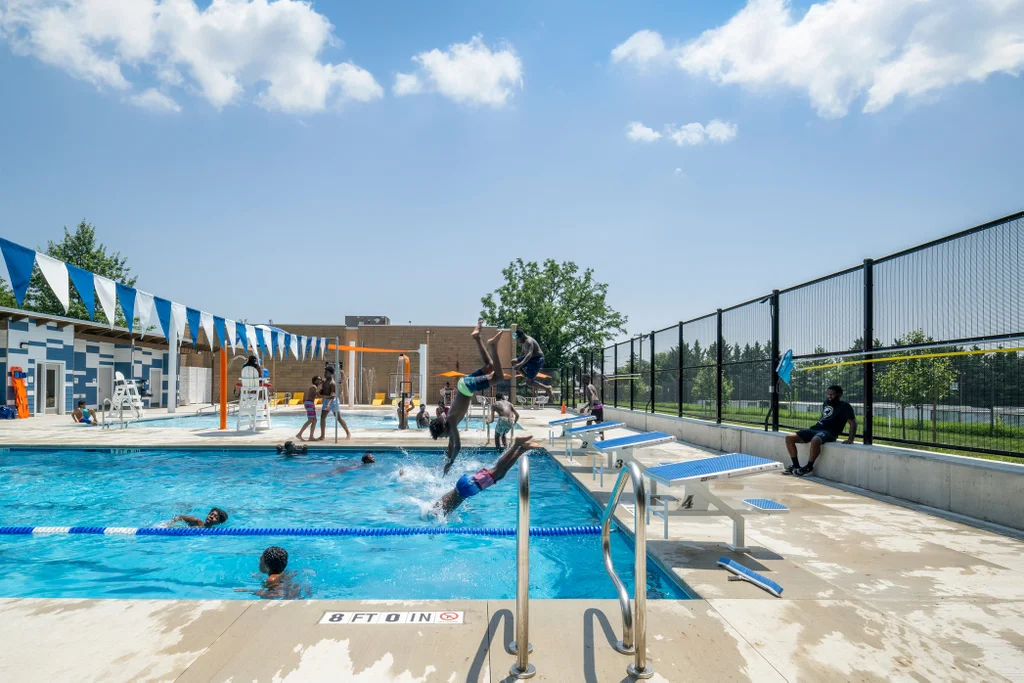
“Rec spaces are safe spaces,” Moore says. “It’s a place where our young people should go and connect and be kids.” He notes that while the parks and recreation department has opened youth-centered spaces like eSports and gaming labs, STEAM centers, and teen lounges, the aquatics centers offer a place to hang out without expectation of doing an activity.
“Sometimes teens just want to come to a space, get out the heat, connect with friends, charge their phone, and not necessarily always come into a programmed space.”
BCRP also uses its paid lifeguard program as a positive incentive to help youth stay out of trouble. It provides free training, pays for certification, and offers a bonus for high attendance and not receiving any disciplinary action. A few years ago, the city struggled with a lifeguard shortage, and had to limit pool hours as a result, but, according to Moore, they no longer have a shortage as of this year.
Some of the positive effects are harder to measure, but are still felt. CannonDesign began working on the renovations during COVID, when the importance of outdoor recreation space became extra apparent. “The mental health benefits associated with being able to go outside and be with their friends outside in nature is so critical,” Pascatore says. “It’s probably more important today than ever before.”
Since the renovations, BCRP has seen attendance at the pools, which have over twice the capacity of their predecessors, increase 30 to 40%. Larger spaces and more lifeguards are part of the reason for this, Director Moore says. He hopes the momentum keeps growing, and that more funds become available to renovate more pools. “The last part of my dream is that I would like to see Baltimore City have inner city swim teams,” he says.