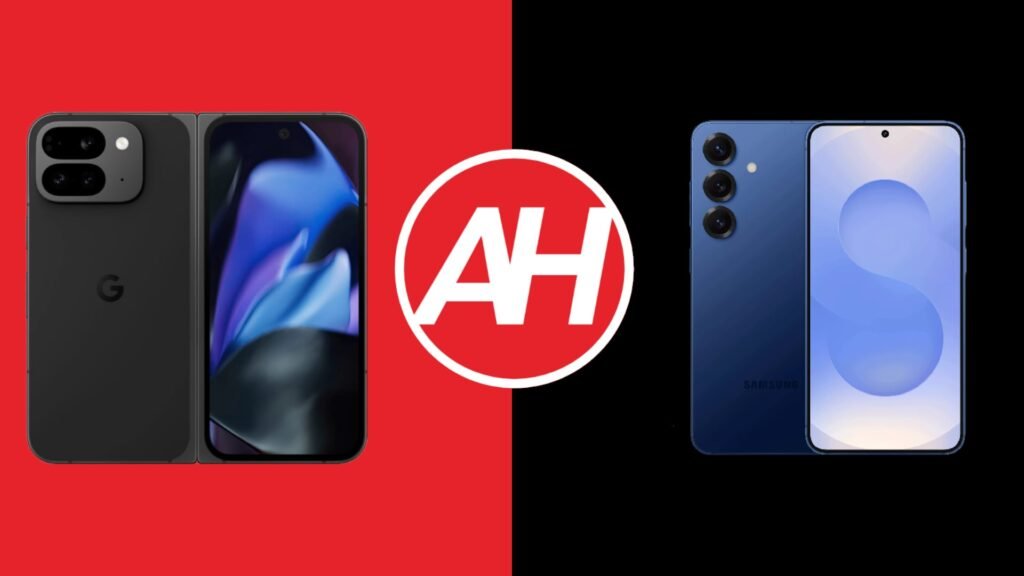

This time around we’ll be comparing two very different smartphones. One is a large-format foldable, and the other is a regular and compact smartphone. They’re the two opposites. They also differ quite a bit in the design department, and even in the internals section. It’s a Google Pixel 9 Pro Fold vs Samsung Galaxy S25 comparison. These phones are not the latest and greatest anymore, but they used to be.
As we usually do, we’ll first list the specs of both smartphones, and then we’ll compare them across a number of categories. We’ll compare their designs, displays, performance, battery life, cameras, and audio output. There’s plenty to talk about here, mainly because of the differences between them. Let’s get to it.
Specs

Google Pixel 9 Pro Fold

Samsung Galaxy S25
| Google Pixel 9 Pro Fold | Samsung Galaxy S25 | |
|---|---|---|
| Dimensions (unfolded/folded) | 155.2 x 150.2 x 5.1 mm / 155.2 x 77.1 x 10.5 mm | 146.9 x 70.5 x 7.2 mm |
| Weight | 257 grams | 162 grams |
| Main display | 8-inch Foldable LTPO OLED (120Hz) | 6.2-inch Dynamic LTPO AMOLED 2X (1-120Hz) |
| Cover display | 6.3-inch OLED (120Hz) | N/A |
| Resolution | 2152 x 2076 / 2424 x 1080 | 2340 x 1080 |
| Chipset | Google Tensor G4 | Qualcomm Snapdragon 8 Elite for Galaxy |
| RAM | 16GB (LPDDR5X) | 12GB (LPDDR5X) |
| Storage | 256/512GB | 128GB/256GB/512GB (UFS 4.0) |
| Main camera | 48MP (f/1.7 aperture, 1/2.0-inch sensor size, dual pixel PDAF, OIS) | 50MP (wide, f/1.8 aperture, 1/1.56-inch sensor size, 1.0um pixel size, dual pixel PDAF, OIS) |
| Ultra-wide camera | 10.5MP (f/2.2 aperture, 1/3.4-inch sensor size, 127-degre FoV, PDAF) | 12MP (f/2.2 aperture, 1/2.55-inch sensor size, 120-degree FoV, 1.4um pixel size) |
| (Periscope) telephoto camera | 10.8MP (f/3.1 aperture, 1/3.2-inch sensor size, dual pixel PDAF, OIS, 5x optical zoom) | 10MP (f/2.4 aperture, 1/3.94-inch sensor size, 1.0um pixel size, PDAF, OIS, 3x optical zoom) |
| Selfie camera | 10MP (f/2.2 aperture, 1/3.94-inch sensor size, PDAF) x2 | 12MP (f/2.2 aperture, 1/3.2-inch sensor size, 1.12um pixel size) |
| Battery size | 4,650mAh | 4,000mAh |
| Charging | 21W wired, 7.5W wireless, bypass charging (charger not included) | 25W wired, 15W wireless (Qi2 Ready), 4.5W reverse wireless (charger not included) |
| Colors | Obsidian, Porcelain | Icy Blue, Mint, Navy, Silver Shadow, Pink Gold, Coral Red, Blue Black |
Google Pixel 9 Pro Fold vs Samsung Galaxy S25: Design
The moment you lay your eyes on the two phones, you’ll notice the design differences. In addition to one of them being a foldable and the other not, they also do look different in general. They both do have a centered display camera hole up top on their displays. Well, that goes for the Pixel 9 Pro Fold’s cover display; the main display includes a camera hole in the top-right corner.
Both phones have frames made out of aluminum, and those frames are flat. The Pixel 9 Pro Fold includes a power/lock button on the right side, above the volume up and down keys. Its power/lock key also doubles as a fingerprint scanner. The Galaxy S25, on the flip side, has a power/lock key below the volume up and down buttons. The back side is flat on both smartphones.
You’ll notice that they have notably different camera setups. The Pixel 9 Pro Fold has a squarish camera island, with two pill-shaped cutouts on the inside that are horizontally aligned. The Galaxy S25, on the other hand, has three vertically aligned cameras, each of which protrudes from the backplate on its own; there’s no dedicated camera island.
The Pixel 9 Pro Fold is IPX8 certified for water resistance. The Galaxy S25, on the flip side, is IP68 certified for water and dust resistance, so it does have the advantage in that department. The Pixel 9 Pro Fold weighs a lot more than the Galaxy S25, while it’s also taller, wider, and thicker when folded. It is a lot wider when unfolded and also thinner. Holding and using these two phones is an entirely different experience, and they’re aimed at completely different types of consumers.
Google Pixel 9 Pro Fold vs Samsung Galaxy S25: Display
The Google Pixel 9 Pro Fold has an 89-inch foldable LTPO OLED display. That panel has an adaptive refresh rate of up to 120Hz, while it also supports HDR10+ content. The peak brightness here is 2,700 nits, while the screen-to-body ratio is 89%. The resolution here is 2152 x 2076 pixels. The cover display measures 6.3 inches, and it’s an OLED panel with a 120Hz refresh rate. HDR content is supported, while the Gorilla Glass Victus 2 protects the display. The resolution here is 2424 x 1080 pixels, while the display aspect ratio is 20:9. The peak brightness this display offers is 2,700 nits.

The Samsung Galaxy S25, on the other hand, has a 6.2-inch Dynamic LTPO AMOLED 2X display. That panel is flat, and it supports an adaptive refresh rate of up to 120Hz. HDR10+ content is supported, while the peak brightness goes up to 2,600 nits. The screen-to-body ratio is around 91%. The resolution on offer here is 2340 x 1080, while the display aspect ratio is 19.5:9. Corning’s Gorilla Glass Victus 2 protects this panel.
All three of these displays are quite good, actually. They are all sharp enough, vivid, and have very good viewing angles. They also offer a high refresh rate, and they’re bright enough for any occasion, although nowhere near the brightest. Neither display offers high-frequency PWM dimming, though, if that’s something you care about. For the vast majority of people, all of these will be more than satisfactory.
Google Pixel 9 Pro Fold vs Samsung Galaxy S25: Performance
The Google Tensor G4 is a 4nm processor from Google, and it fuels the Pixel 9 Pro Fold. That chip is backed by 16GB of LPDDR5X RAM inside this phone, while Google also uses UFS 3.1 flash storage here. Do note that the storage is not expandable, while you can choose between 256GB and 512GB variants.
The Samsung Galaxy S25, on the other hand, is fueled by the Snapdragon 8 Elite for Galaxy chip. That is a 3nm processor from Qualcomm, which is slightly overclocked. It is paired with 12GB of LPDDR5X RAM inside this phone. The 128GB storage option comes with UFS 3.1 flash storage, while the other two models include UFS 4.0 flash storage. The storage is not expandable, though.
Both phones offer really good performance. The Galaxy S25 technically has more powerful internals, and it’s definitely the better phone to use for gaming. However, during day-to-day use, they both offer good performance. The Pixel 9 Pro Fold can also run games, but its chip is not exactly made for gaming. So if you’re planning to play demanding games often, the Galaxy S25 is the better option, even though neither is made with gaming in mind.
Google Pixel 9 Pro Fold vs Samsung Galaxy S25: Battery
There is a 4,500mAh battery included inside the Google Pixel 9 Pro Fold. The Samsung Galaxy S25, on the other hand, has a 4,000mAh battery on the inside. Neither of these two phones offers great battery life, unfortunately. While their battery life may be enough for some people, if you’re even a borderline power user or simply use your phones quite a bit during the day, there’s a good chance you’ll have to recharge them.
What is surprising here is that the Galaxy S25 did slightly better for us in terms of battery life. The difference is only about half an hour of screen-on-time between the two phones, usually, but the smaller phone did a better job. Do note that using the camera, especially for video recording, and playing games on the two phones are the two most notable offenders in terms of battery life.
The Google Pixel 9 Pro Fold supports 21W wired, 7.5W wireless, and bypass charging. The Samsung Galaxy S25, on the other hand, supports 25W wired, 15W wireless (Qi2 Ready), and 4.5W reverse wireless charging. The Pixel 9 Pro Fold can be fully charged in about an hour and 35 minutes, while it takes the Galaxy S25 around an hour and 20 minutes to get there. Neither phone comes with a charger in the box, though, so keep that in mind.
Google Pixel 9 Pro Fold vs Samsung Galaxy S25: Cameras
The Google Pixel 9 Pro Fold has three cameras on the back. A 48-megapixel main camera offers an f/1.7 aperture and a 1/2.0-inch sensor size, along with dual pixel PDAF and OIS. The second camera is a 10.5-megapixel ultrawide unit with an f/2.2 aperture and a 1/3.4-inch sensor size. There is also a 10.8-megapixel periscope telephoto unit with an f/3.1 aperture, 1/3.2-inch sensor size, dual pixel PDAF, OIS, and 5x optical zoom.

The Samsung Galaxy S25, on the other hand, has three cameras as well. It includes a 50-megapixel main camera with an f/1.8 aperture, 1/1.56-inch sensor size, dual pixel PDAF, and OIS. The second camera is a 12-megapixel ultrawide unit with an f/2.2 aperture, 1/2.55-inch sensor size, and a 120-degree FoV. The last camera is a 10-megapixel telephoto unit with an f/2.4 aperture, 1/3.94-inch sensor size, PDAF, OIS, and 3x optical zoom.
Both of these phones do a solid job with photos, but they’re nowhere near the best ones out there. Their camera hardware is kind of outdated at this point. The Pixel 9 Pro Fold tends to take more contrasty shots, while the Galaxy S25 loves to crank up saturation more often than not. The Pixel 9 Pro Fold usually does a better job in low light, especially with its main and telephoto cameras.
Audio
Both phones do include stereo speakers. The ones on the Pixel 9 Pro Fold are louder in comparison. The difference is not big, but it’s there. The sound output quality is good from both phones.
There is no audio jack on either phone. You can connect your wired headphones to their Type-C ports, though. Alternatively, the Pixel 9 Pro Fold supports Bluetooth 5.3, while the Galaxy S25 supports Bluetooth 5.4 for wireless audio connectivity.
The post Phone Comparisons: Google Pixel 9 Pro Fold vs Samsung Galaxy S25 appeared first on Android Headlines.