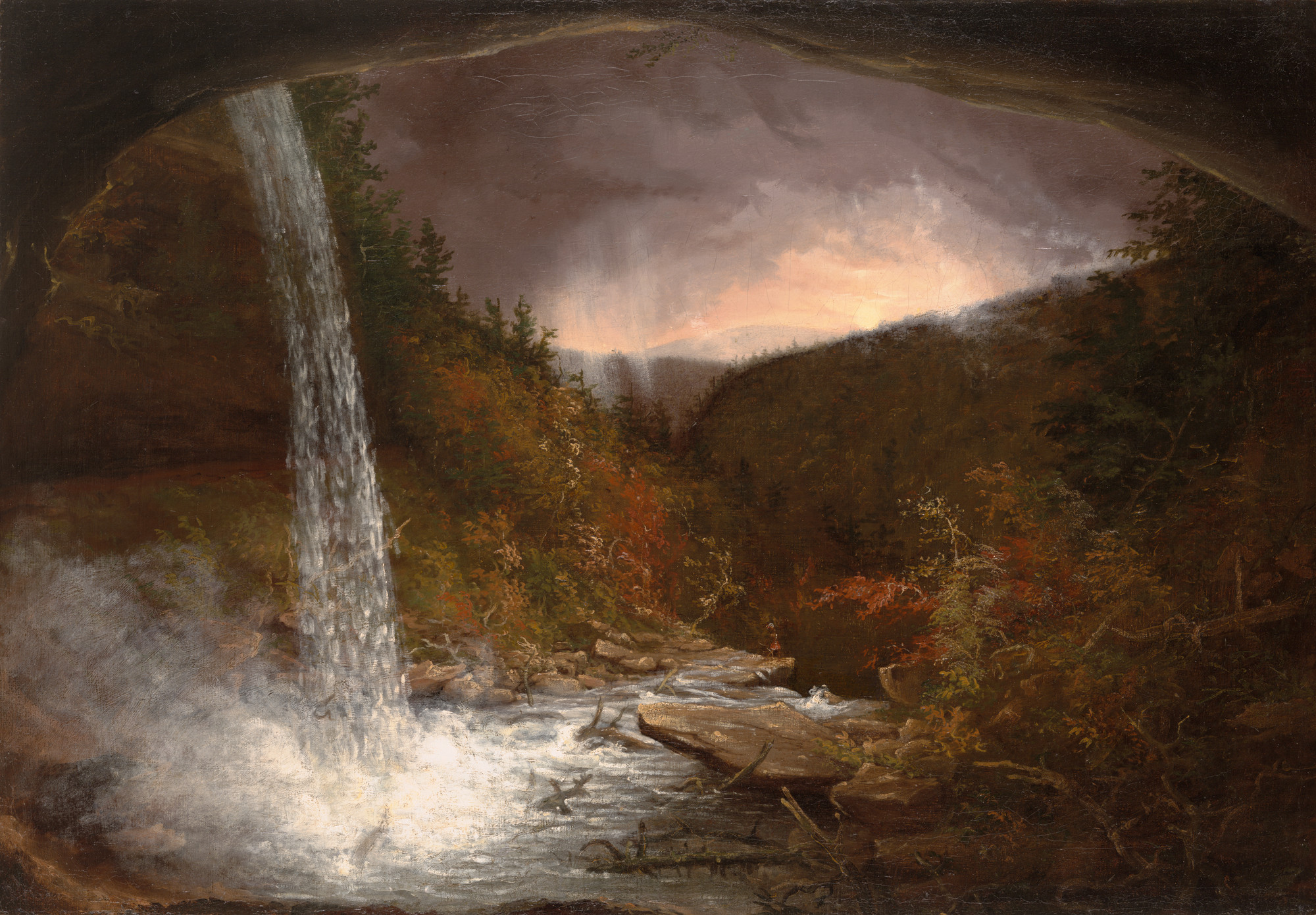
By the standards of geological epochs, Kaaterskill Falls in Upstate New York is positively youthful. Generated by melting glacial runoff eroding the sandstone and shale at the foot of the Catskills’ South Mountain during the middle Pleistocene — a spritely 130,000 years ago — Kaaterskill is a spectacular two-stage waterfall that seems to almost bounce down its 260-foot (~79-meter) height. Two centuries ago, that cascading waterfall would inspire a 25-year-old engraver born in Lancashire, England, who wanted to forge a new American aesthetics. Thomas Cole’s “Kaaterskill Falls” of 1826, on view at the Wadsworth Atheneum Museum of Art in Hartford, Connecticut, heralded that new movement.
Painted at his nearby Cedar Grove studio, “Kaaterskill Falls” turned the portraiture that had marked late colonial and early Republican American art in the mode of Gilbert Stuart and Rembrandt Peale to the wall. Where that work was staid, decorous, classical, and European, this adopted American made a declaration of independence from the art academies of London and Paris. Seemingly painted from the perspective of the rock-shelter behind the falls itself, the work depicts powerful water flowing into the creek below, framed by autumnal leaves of Eastern Hemlocks, Northern Red Oaks, Sugar Maples, and American Beeches rendered in green, red, orange, and brown. Through the mist and haze of the water droplets, the sun drops into a bleeding dusk, nightfall moving in with the black clouds. “The passion caused by the great and sublime in nature, when those causes operate most powerfully, is astonishment,” wrote the Anglo-Irish philosopher Edmund Burke in A Philosophical Enquiry into the Origin of our Ideas of the Sublime and Beautiful from 1757. A clarion call to the emerging Romantic movement, Burke’s claims about sublimity were first truly embodied in the American landscape, the only patrimony the young Republic had yet to offer.
Cole would become the doyen of the Hudson River School, the United States’ first genuine artistic movement — regarded as such for their eventual headquarters at the Tenth Street Studio Building in Greenwich Village at a time when the odor of the brackish harbor and the sounds of seagulls permeated a cityscape that hadn’t yet risen to heights rivaling the mountains 100 miles (~161 kilometers) north. “It was not that the jagged precipices were lofty, that the encircling woods were the dimmest shade, or that the waters were profoundly deep,” wrote Cole in his “Essay on American Scenery” in 1836, “but that over all, rocks, woods, and water, brooded the spirit of repose, and the silent energy of nature stirred the soul to its inmost depths.”
For Cole, and particularly his student Frederic Edwin Church, along with other foundational associated artists — including Asher Brown Durand and Sarah Cole (the founder’s sister) in the first generation, and Albert Bierstadt, John Frederick Kensett, Susie Barstow, and Mary Blood Mellen in the second — the American character couldn’t be summarized in a portrait, but only in landscape. The mountains and beaches, forests and rivers were the nation’s very scripture. Artists like Cole, Church, and Durand were technical masters, able to render with almost supernatural verisimilitude what Cole describes as the “crystal-like ether” of the atmosphere or the “liquid gold” of sunlight dappled on a stream in the Adirondacks or Berkshires.
That the Hudson River School, with their clear artistic nationalism, was a self-regarded avant-garde may strike contemporary viewers as surprising, as their work’s content can seem inescapably, even worryingly, retrograde. For late-19th-century Americans, French Impressionism — which had its own domestic currents — made the Hudson River School passé. When the second generation of the Hudson River School moved their plein air compositions out from the Catskills to the Western territories, and then into South America, there was a sense that their definition of “American” was less ecumenical than colonial. According to Evan Robert Neely in Political Economy, Race, and the Image of Nature in the United States, 1825-1875 (2024), the “ideology of propertarianism” in the Hudson River School’s compositions is “inextricable from colonial conquest.” But even if those are the political reasons for relative disinterest among subsequent art historians and critics, the general public may simply have gotten bored with all of those mountains and waterfalls as compared to the shock of Modernism.
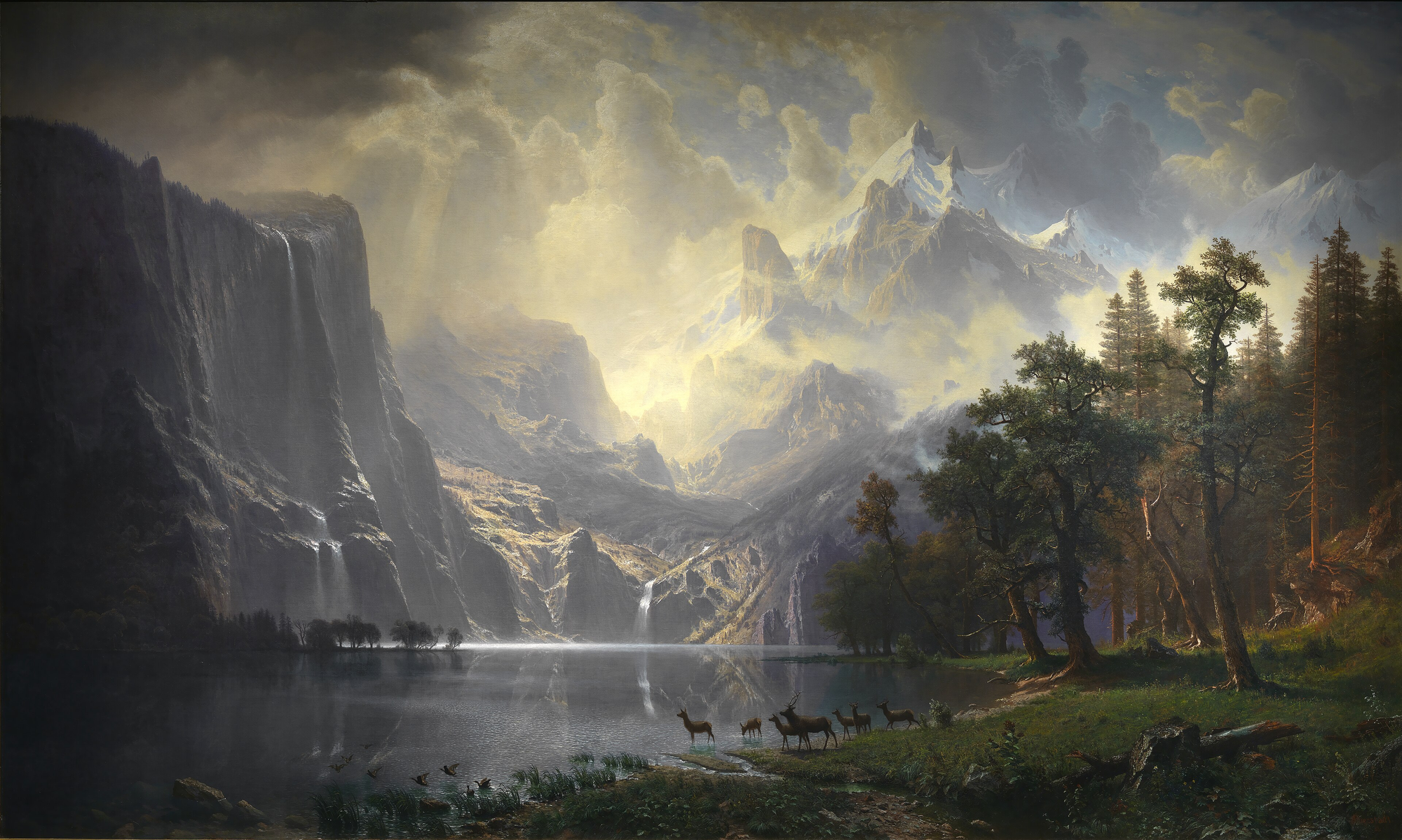
As the ominous fireworks of the 250th anniversary of the United States land — ask not for whom the bottle rocket pops — it’s worth revisiting the Hudson River School to consider whether this nation’s first genuine movement doesn’t express more of the emancipatory than might be presumed. One only need encounter the grandeur of Bierstadt’s 1868 “Among the Sierra Nevada, California” at the Smithsonian American Art Museum to feel that the genuinely utopian impulse behind the national parks — the first of which, Yellowstone, was established four years later — was already in the air. Such works are missives from artists during the infancy of the Industrial Revolution, the artistic corollary of the literary American Renaissance. Think only of that supreme secular mystic and all-American eccentric Henry David Thoreau’s imploration in 1864’s The Maine Woods that we must “Talk of mysteries! — Think of our life in nature, — daily to be shown matter, to come in contact with it, — rocks, trees, wind on our cheeks! The solid earth! the actual world! the common sense! Contact! Contact! Who are we? Where are we?”
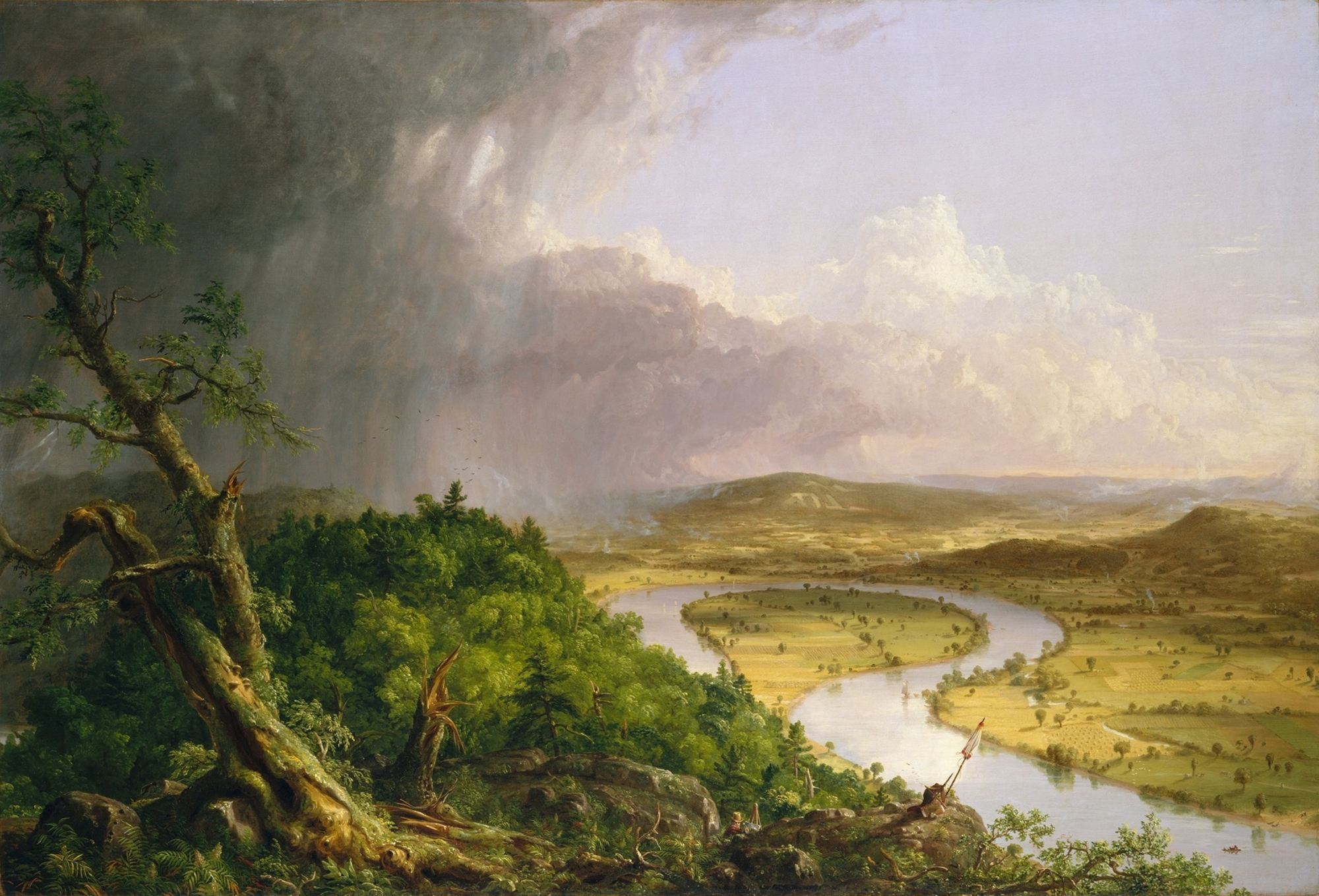
Cole’s 1836 “The Oxbow,” now at the Metropolitan Museum of Art, answered Thoreau’s question, in a fashion, before he even asked it. The painting depicts Mount Holyoke in Northampton, Massachusetts, following a thunderstorm — a representative and ambivalent masterpiece. It was made at the exact moment that railroad tracks and telegraph lines began to cross the country; the Erie Canal drove a deep gash through Upstate New York; and dark, Satanic Mills from Lowell’s Merrimack Manufacturing Company of 1823 to Cleveland’s Cuyahoga Steam Furnace Company of 1837 belched smog. But there is no sign of industry — or of people, save for the artist himself, hidden in the foreground with his easel and umbrella — in the painting. This is an environmental work that engages with the anticipatory grief that industrialization creates, that it continues to create. From the perspective of the mount, the painting looks down on the lush river valley, a green-robed island (or perhaps peninsula) dotted with trees, while sun breaks out on the right-hand of the canvas. Dark thunderclouds roll out to the left, but it’s only the title of the piece that indicates that this is after the storm. As the viewer, it’s perfectly possible that the clouds are actually rolling in.
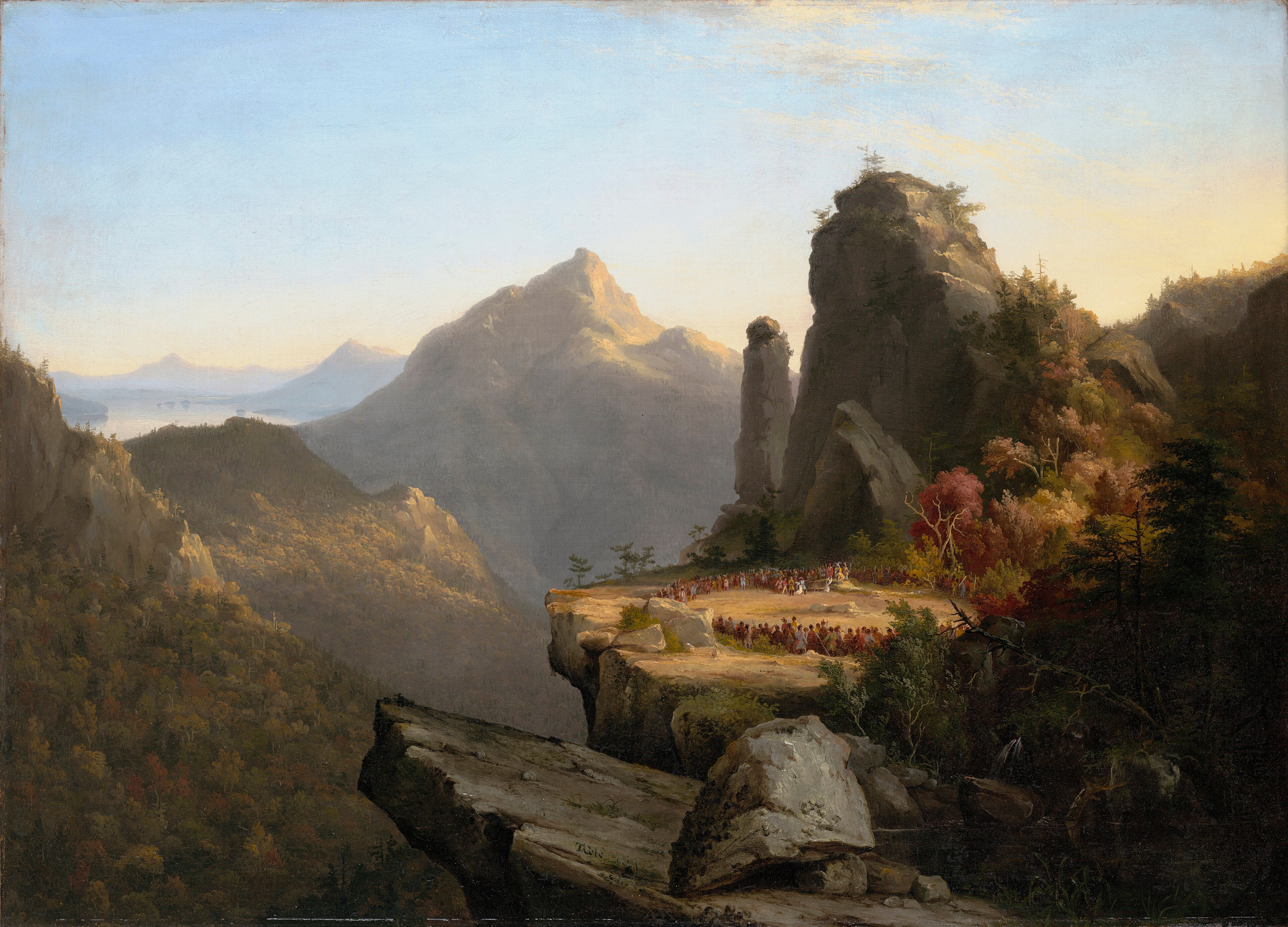
An example of Cole’s studied ambivalence — of his irony, really — is the 1827 “Scene from ‘Last of the Mohicans,’” held at the Wadsworth and based on James Fenimore Cooper’s 1826 popular novel of that title. In Cole’s rendering, a circle of Iroquois people gathers on a rocky outcrop over a dramatic, mountainous northeastern vista as the sun slowly begins to redden in the west. “I am on the hill-top,” reflects one of Cooper’s characters, “and must go down into the valley …. There will no longer be any of the blood of the Sagamores, for my boy is the last of the Mohicans.”
Inheritors of the racist discourse that marked Indigenous people for annihilation through increasingly noble pretensions, men like Cooper and Cole couldn’t help but make them mere props in their own psychodramas. And yet Cole’s painting more generally evidences an anxiety about entropy, about the destruction of nature brought about by those twin specters of industrialization and settler-colonialism. The most famous of Cole’s series, now held by the New York Historical, is his monumental Course of Empire pentad, accomplished between 1833 and 1836. On five large canvases — “The Consummation of Empire” being more than six feet (1.8 meters) long — Cole depicts the rise and fall of a fictitious civilization that appears broadly Greco-Roman with Celtic and Native elements, from the elemental to the arcadian, before destruction and desolation set in. This pessimistic understanding of civilizational entropy reflects American Republican fears about their future mirroring the history of Imperial Rome, but also sounds a broader warning about the degradations wrought upon the environment.
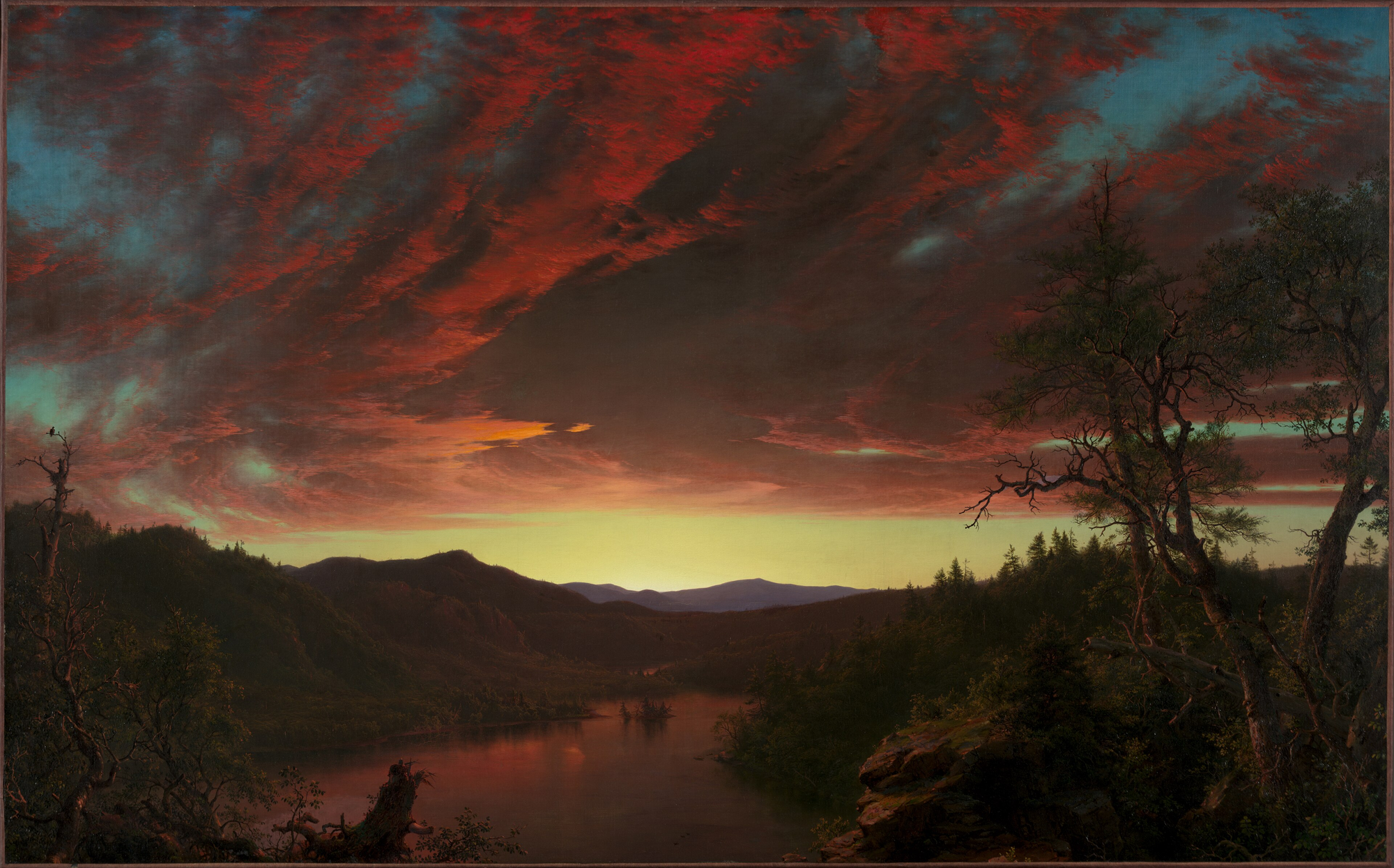
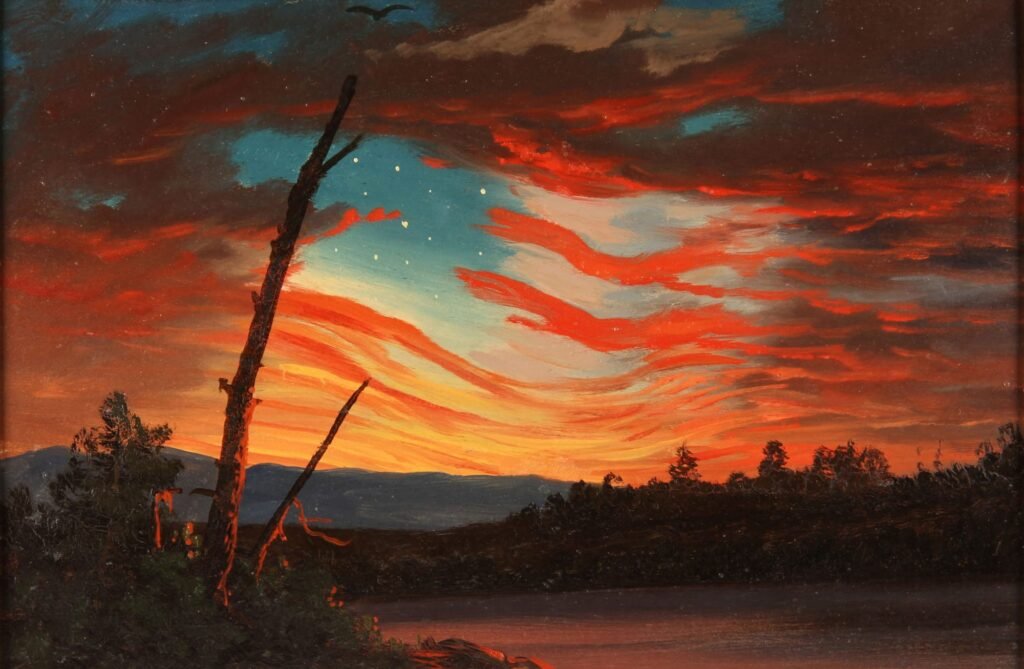
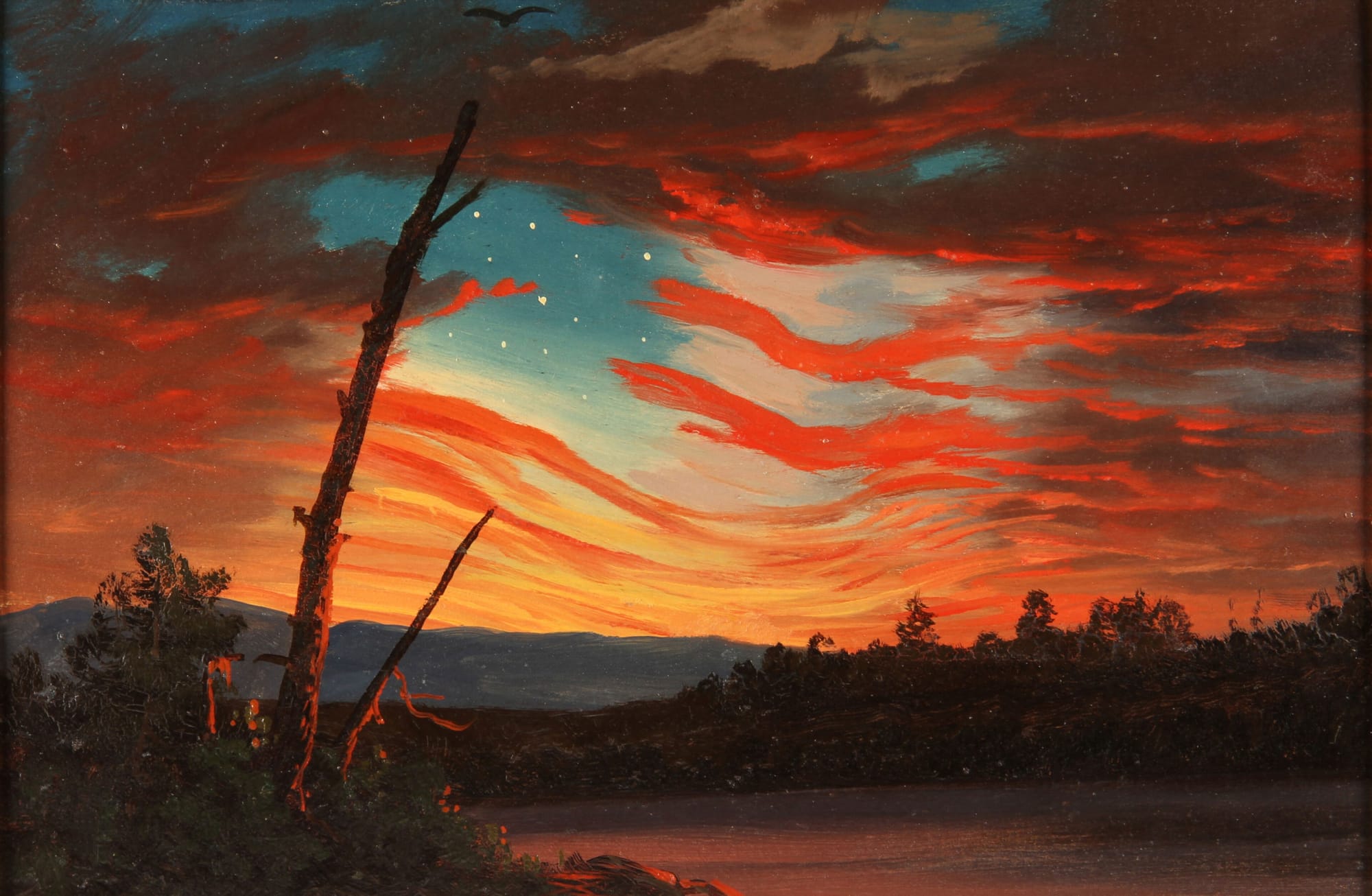
The Hudson River School is frequently thought of as plucky and patriotic, but true to the dictates of Romanticism and Burke’s contention that “terror is in all cases … the ruling principle of the sublime,” members of the movement were often fantastic illustrators of sunsets, of dusk’s melancholy extinctions. Church’s “Our Banner in the Sky” from 1861, now held by the Smithsonian, is at first glance jingoistic pablum that depicts a sunset of lurid reds and celestial blues over the low-slung hills of some rural hamlet that just so happens to perfectly mimic the appearance of the star-spangled banner waving in the sky. It’s not incidental that this is a sunset — perhaps a different kind of heavenly message. It suggests a studied ambiguity, not least because, while the image is certainly kitschy, it’s also profoundly disquieting. A far more technically proficient sunset of Church’s, “Twilight in the Wilderness,” painted one year earlier and now held by the Cleveland Museum of Art, is a testament to the painter’s facility with depicting clouds: the reds and scattered blues rolling over a pristine valley as an orange sun sets, conveying a sense of gentle finality, of the end of all things.
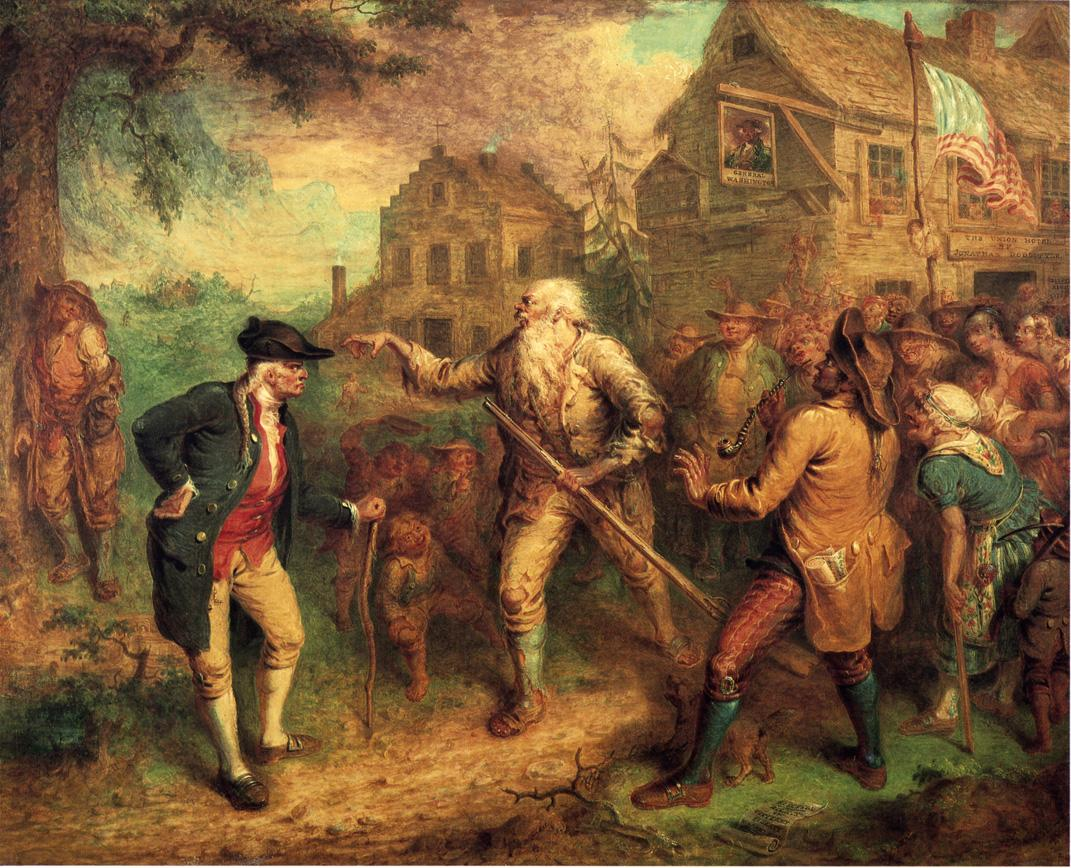
Unlike his compatriots, John Quidor, a minor representative of the school, painted the human form readily, as in his 1849 “The Return of Rip van Winkle,” now held by the National Gallery of Art and based on the eponymous tale of 1819 by Washington Irving, a writer who embodied the nationalistic goals of the Hudson River School. Drawing from that deep reservoir of Dutch myth that once permeated New York, Irving tells the tale of the slightly foolish colonial Knickerbocker who is bewitched by the ghosts of Henry Hudson’s explorers to fall comatose beneath the frigid leaves of the Catskills, not far from the Kaaterskill Falls, through the entirety of the Revolution. Upon waking, he is disturbed to find that the bunting of the Union Jack has been replaced with that of the stars and stripes, that the tavern’s placard, which once depicted King George III, now presents some other George. Nearly everything is shabbier, more run-down, and threadbare, even if there appears to be an unaccountable pride among the children of Rip’s contemporaries. “His mind now misgave him; he began to doubt whether both he and the world around him were not bewitched,” writes Irving.
Living through revolutions is no easy experience. The Hudson River School understood this well, as tanneries and waterwheels began operating beneath their beloved falls, setting the United States’ one singular inheritance, nature, on its inexorable path of exploitation. A few hours’ drive from Kaaterskill Falls, the bitcoin mining corporation TeraWulf has proposed a water-thirsty data center to sit on the banks of Lake Cayuga, depriving the nearby town of Lansing of its precious water and despoiling nature to generate AI slop untouched by human hands. On June 4, the New York State legislature passed a moratorium on all such data centers; the bill awaits the signature of Governor Kathy Hochul, an AI enthusiast.
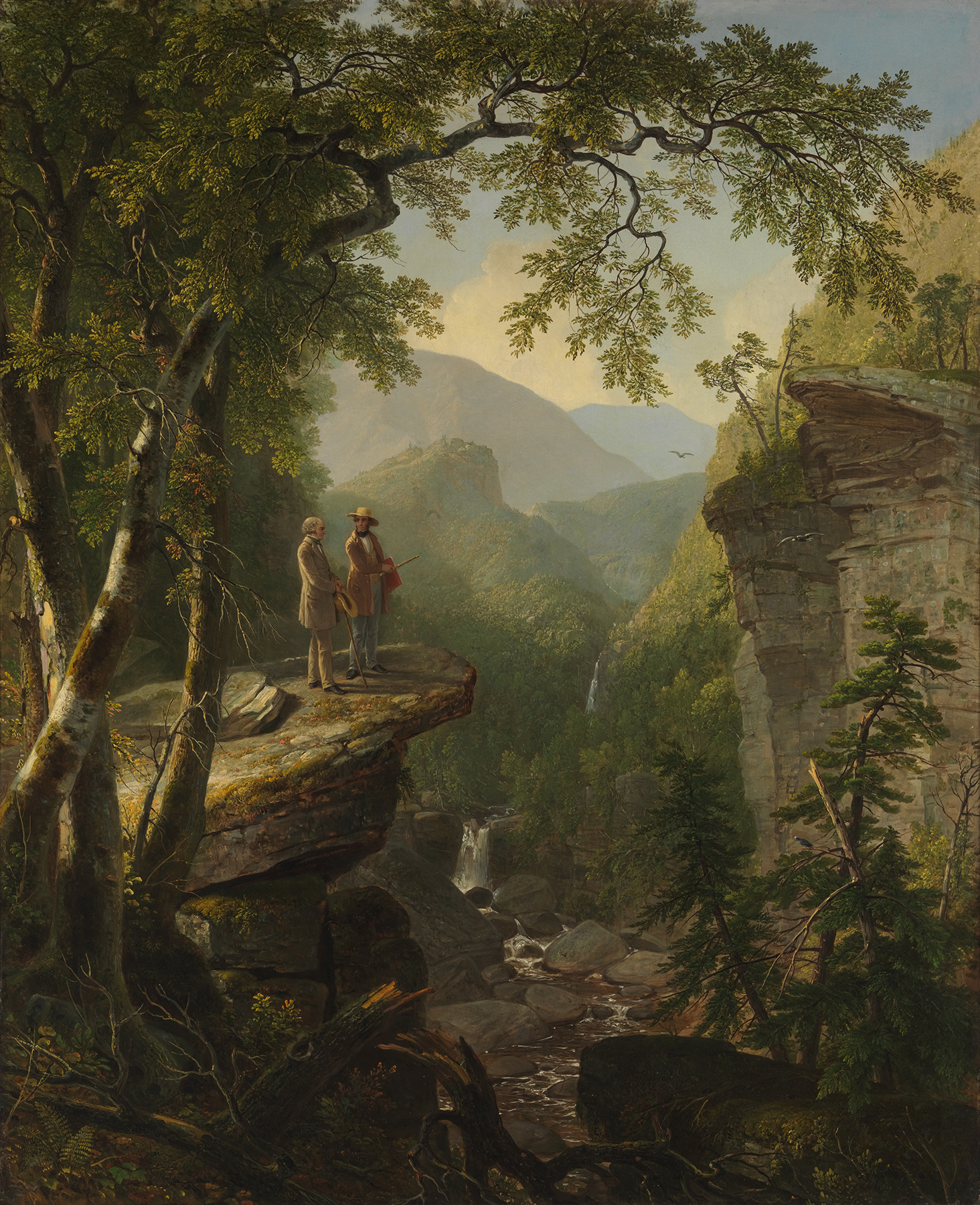
And so we return to Kaaterskill Falls, where Cole first eschewed his own sense of Protestant fallenness to embrace transcendent, immanent, pantheistic nature. Durand captured that quality of Cole’s in his study “Kindred Spirits” from 1849, on view at the Crystal Bridges Museum of American Art in Bentonville, Arkansas. Recalling a version of the German painter Caspar David Friedrich’s 1818 “Wanderer above the Sea of Fog,” while excising all of that maudlin Sturm und Drang, Durand’s painting places the rare human figures within a pleasant but nonetheless dramatic Catskills vista. Here is Cole himself, as indicated by an easel under his arm and brush in hand, standing next to a stately frocked gentleman who is the now largely forgotten Fireside Poet William Cullen Bryant. “For whom are those glorious chambers wrought, /In the cold and cloudless night?” asks Bryant in an 1836 poem about the waterfall. The answer, of course, is that they’re not wrought for anybody — they simply are, and that’s their paradoxical significance. Nature embodies a meaning beyond meaning, not to be read symbolically, but taken on its own terms. Cole, Church, Durand, and all the rest of them, at their best, exemplified that lesson well. If their art can appear inhuman, then all the better. This is a shockingly egoless form of representation, where even when humans do appear, they are appropriately small. “We are still in Eden,” Cole once wrote. And still we are, at least for a bit.



.jpg?ref=hyperallergic.com)
.jpg?ref=hyperallergic.com)

