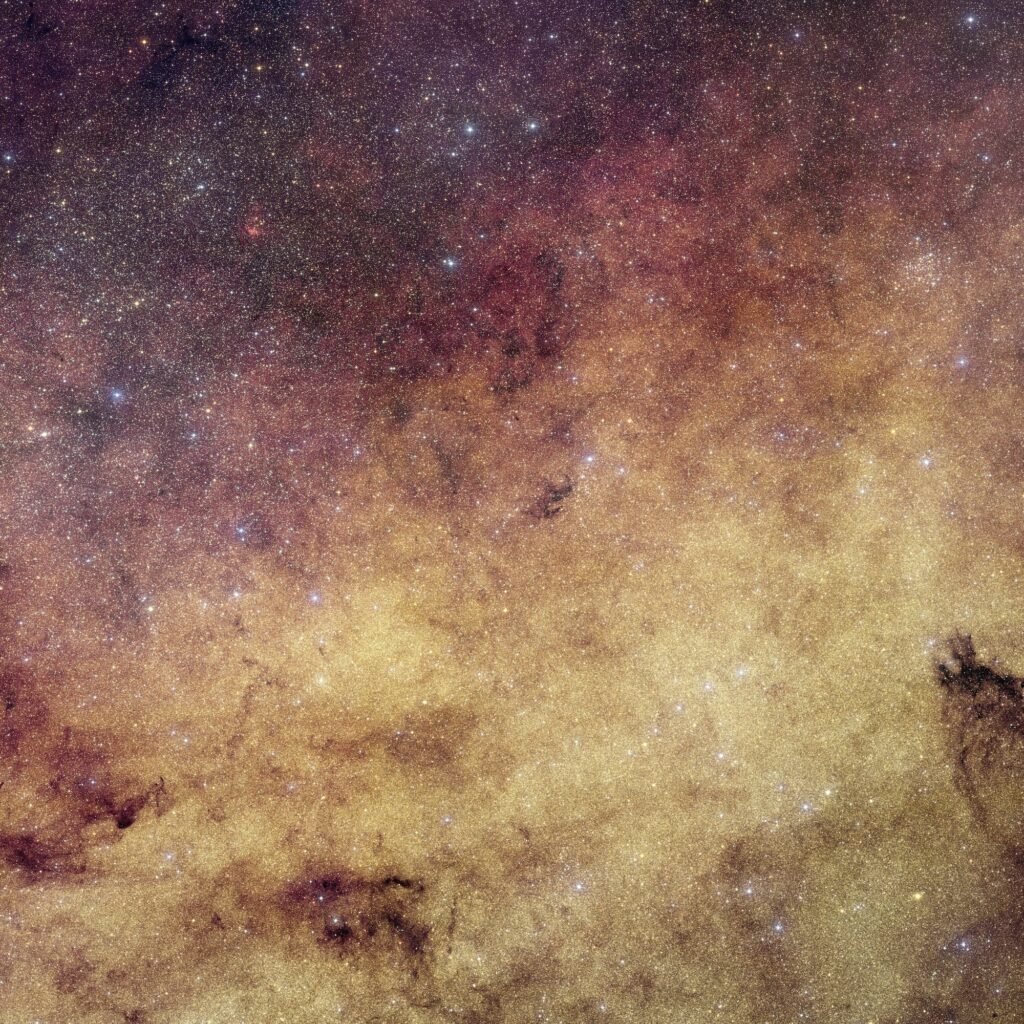

In March 2025, the Euclid mission led by the The European Space Agency (ESA) enabled scientists to capture the highest resolution image ever taken of the dense, glowing center of the Milky Way galaxy. An enormous swarm of stars forms a bulge at the heart of the spiral, and researchers continue to search amid its billions of stars for exoplanets, or any planet that’s located outside of our solar system.
“The galactic bulge—the central region of our galaxy—is a vast, tightly packed structure filled mainly with old, cooler stars, giving it its characteristic yellow colour,” ESA says. The photograph, which is taken with visible light, allows scientists to pinpoint exoplanets and measure their mass by monitoring tiny changes in starlight over time in a process called microlensing.
ESA’s Euclid image captures more than 60 million stars, plus other phenomena such as nebulae, bright star clusters, and molecular clouds that appear like amorphous, dark splotches in front of the brighter areas. Incidentally, to the human eye, they serve as a visual guide or cue to the incredible depth of field the image has actually captured.
“For comparison, Euclid’s sharpness and sensitivity in visible light is similar to the NASA/ESA Hubble Space Telescope’s wide field camera,” ESA says. “But each pointing that Euclid captures in a few hours spans an area 270 times larger than Hubble’s field of view. To observe the same Euclid mosaic, the Keck Observatory would need around 2,000 hours.”
Zoom in on the Galactic Bulge Survey image on ESASky.


Do stories and artists like this matter to you? Become a Colossal Member today and support independent arts publishing for as little as $7 per month. The article Scan More than 60 Million Stars in the Most Detailed Photo of the Milky Way Ever Taken appeared first on Colossal.