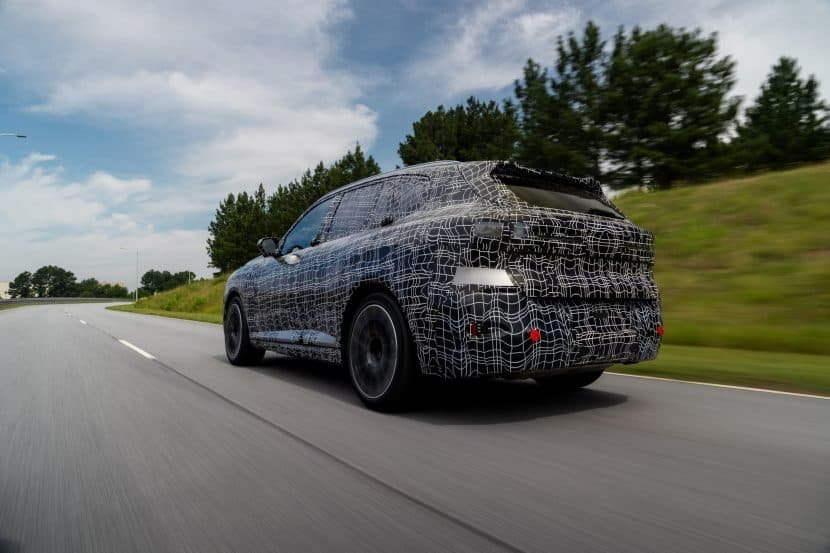
Not long to go until BMW lifts the veil on the fifth-generation X5. Before the luxury SUV breaks cover, the company is sharing some insights into the G65’s green credentials. For example, the first-ever iX5 will make use of a whopping 940 kilograms (2,072 pounds) of secondary raw materials. We’re told that equates to about a third of the vehicle’s weight. Putting two and two together, the electric X5 will tip the scales at just over 2,800 kg (6,173 lbs).
If our first-grade math is accurate, the iX5 60 xDrive jumps straight to the top of the list of BMW’s heaviest models ever. We’ll exclude the armored X5 and 7 Series since those are specialty models that don’t really count in the production run. Other contenders fighting for the heavyweight belt include the i7 M70 (2,770 kg), XM Label (2,720 kg), and the X7 M60i (2,600 kg). The only electric SUV that comes close is the iX M70 (2,580 kg). For clarity, all figures refer to the European version without a driver.
Perhaps we shouldn’t be surprised the 2027 iX5 will be BMW’s heaviest production vehicle ever. Well, until the iX7 arrives in 2027. After all, Munich has already confirmed the iX5 will feature the largest battery of any BMW EV to date. It has a usable energy content of 141 kWh in Europe and 144 kWh in the United States. It’s actually the same battery in both regions, with the minor difference stemming from how the measurements are calculated.

The BMW iX5 Has Strong Green Credentials
On a related note, the carbon footprint generated during battery manufacturing has been reduced by approximately 28% per watt-hour compared to the iX. As a refresher, the first-ever iX5 will use BMW’s Gen6 batteries with cylindrical cells rather than the prismatic cells used on pre-Neue Klasse models.
How did BMW arrive at 940 kilograms of secondary raw materials? The aluminum used in the doors is made from 35% recycled and closed-loop material from the Spartanburg press shop. The headliner fabric is a yarn made entirely from recycled PET. The base material used to cover the A-pillars is also produced entirely from recycled content.
Elsewhere, about half of the flat steel contains a high proportion of secondary material. The same applies to the aluminum used for the wheel rims, brake calipers, and other heavy-duty components. CO₂ emissions were also reduced during the development process by using renewable energy, cutting emissions by around 40%.
BMW has done the math and estimates the iX5 50 xDrive will have a smaller environmental impact than a combustion-engine equivalent after just one to two years of use. However, the break-even point depends heavily on mileage and, in particular, on how the electricity used to charge the battery is generated. The projection applies to ownership in Europe.


First published by https://www.bmwblog.com