Jake Epstein/Business Insider
- Ukrainian naval drones have been used to strike Russian ships in the Black Sea.
- A Ukrainian commander said he wants the drones to start detaining ships rather than sinking them.
- Policing missions would significantly expand the role of the naval drones.
Ukraine wants its naval drones to detain commercial vessels in the Black Sea rather than destroying them, a commander in Kyiv’s military intelligence agency told Business Insider.
Ukrainian naval drones have been used to attack vessels by striking them at the waterline and exploding. The targets were primarily Russian warships, although Kyiv has also attacked sanctioned oil tankers belonging to Moscow’s so-called shadow fleet.
Ninth, a commander in Ukraine’s GUR intelligence agency who requested to be identified only by his call sign, said “a new system is being developed” for the naval drone his unit uses for Black Sea operations.
“Its purpose is not to destroy oil tankers or grain carriers transporting sanctioned goods,” said Ninth. Rather, the intent is “to detain and tow them into port.”
“If they comply, they will be escorted to a designated port where the vessel and cargo can be seized under international law,” he said. “If they refuse, other measures may follow.”
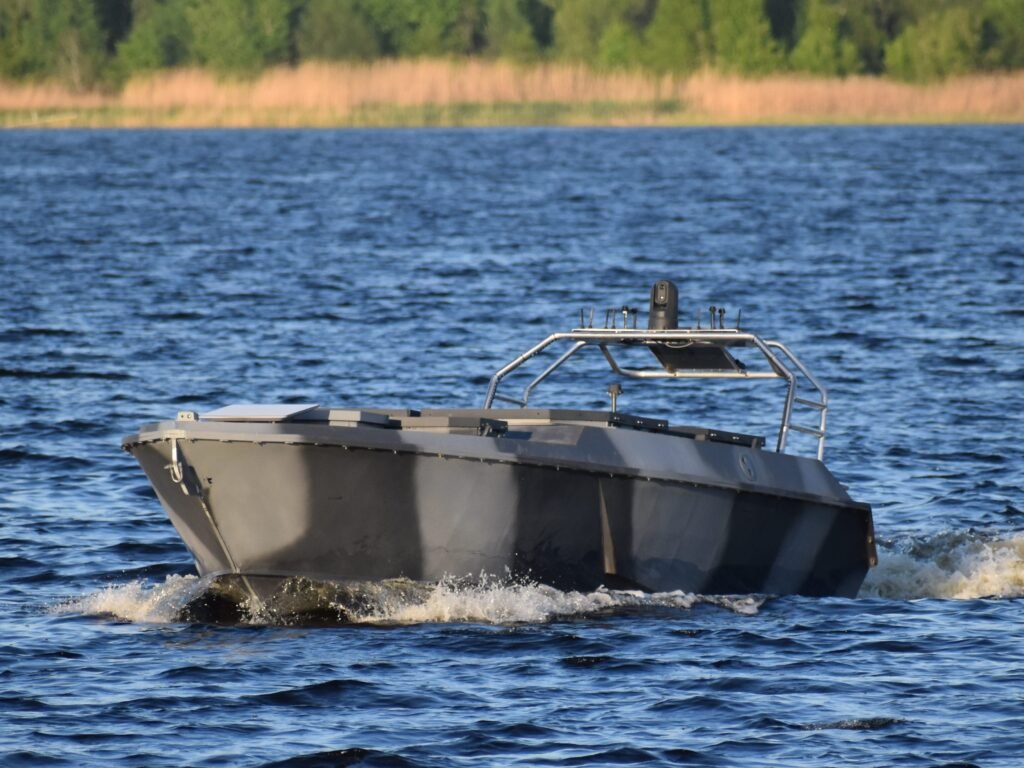
Policing missions like these would significantly expand the role of the “Katran,” a multi-purpose naval drone developed by the Ukrainian enterprise Military Armored Company HUB and operated by Ninth’s unit.
Jake Epstein/Business Insider
The Katran, like other Ukrainian naval drones, started out as a strike boat, packed with explosives and steered into enemy ships to detonate on impact. Kyiv has used these drones to weaken Russia’s Black Sea Fleet, waging what officials often describe as an asymmetrical campaign.
As the Black Sea fight evolved, Katran received modifications, including machine guns and surface-to-air missiles. Other Ukrainian naval drones underwent similar upgrades, making them more capable of more than just one-way explosive attacks.
In late November 2025, after years of focusing mainly on Russian naval vessels, Ukraine began attacking the shadow fleet, a network of ships that Moscow uses to transport oil and circumvent Western sanctions on energy exports.
Ukrainian naval drones struck several commercial ships in the Black Sea toward the end of last year. Now, the GUR wants to make the mission less destructive as Kyiv presses its international partners to adopt a more aggressive stance toward Russia’s shadow fleet and vessels linked to Moscow.
Ninth said that these ships are used to transport stolen goods, sanctioned oil, or weapons. He added that using the naval drones in a policing role could allow civilian crews and shipping companies to receive prior warning that their movements may be enforced by naval drones.
Pierre Crom/Getty Images
“If you encounter such a system, you are under arrest. Proceed calmly to the designated port. Everyone remains safe,” the commander said, speculating on how the policing could work. “The vessel and its cargo will be confiscated in accordance with international law.”
“Personally, I consider this approach far more humane than simply sinking ships carrying unknown cargo,” he added.
This anticipated new role for the naval drones could come as Ukraine continues to replace humans with uncrewed systems wherever possible. On the battlefield, for instance, ground robots are increasingly taking over deadly logistics missions from soldiers.
At-sea policing missions would build on numerous Ukrainian drone innovations that have reshaped the battlefield. One recent introduction, the mid-range strike drone, is having a tremendous effect. Conflict experts attribute the recent shift in momentum favoring Kyiv, particularly in the southern direction, to these newly deployed strike assets.
Ninth said he sees a future in which certain drones could secure a ship’s deck and temporarily detain its crew, while others control the airspace above the operation. If needed, Ukraine could sink a noncompliant vessel within seconds.
“The ability to test such concepts in the conditions of today’s Black Sea represents an enormous technological leap forward,” he said. “What we are discussing is not a single drone. It is an entire system.”