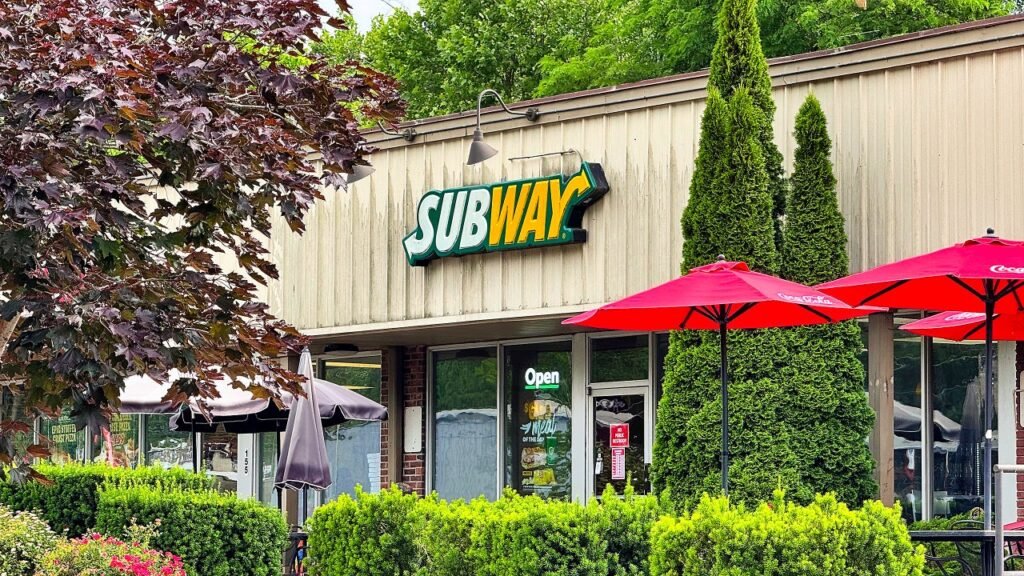
A number of Subway restaurants have closed their doors after their owner filed for bankruptcy, the latest wave of store closures to impact a large franchisee of a major fast-food chain this year.
Affiliates of MTF Subs, which together operate dozens of Subway restaurants across four states, have rejected the leases for six locations, court records reviewed by Fast Company show.
Additional stores could also close, as the franchisee has been evaluating the remainder of its store footprint. A bankruptcy judge recently gave the franchisee until August to decide if it will reject additional store leases.
The six shuttered restaurants, in Maine and Virginia, were all still listed on Subway’s store locator tool as of Monday, albeit with no operating hours. As of this week, most of the locations are also marked “temporarily closed” on Google Maps.
It was not immediately clear what will happen to the spaces. According to an April court filing, MTF said it expected to save more than $10,000 a month on lease costs as a result of the closures.
Fast Company has reached out to Subway, MTF Subs, and its legal counsel for comment.
The closures come after MTF Subs, through its business affiliates, sought Chapter 11 protection in January, citing financial problems as a result of merchant cash advances that had proved difficult to pay back.
Joint bankruptcy cases were filed in the U.S. District Court for the Eastern District of Pennsylvania, with limited liability companies MTF Enterprises and MTF Holdings listed as lead debtors.
Three months after its bankruptcy petition, MTF told the court that it had identified a number of its Subway locations whose lease costs could not justify continued operations. It said it notified the landlords of its intention to reject those leases and promised to vacate the stores by April 30.
Why did this franchisee file for bankruptcy?
MTF Subs has been in the Subway franchise business since 2017.
According to its website, its founder, Michael Fay, worked as a “sandwich artist” at the fast-food chain in high school. He loved the food so much that he decided to purchase his own location in Pennsylvania. He then amassed a small empire of Subway restaurants in Pennsylvania, Maine, Virginia, and New Hampshire.
In bankruptcy filings, MTF said its financial problems were largely the result of merchant cash advances, or MCAs, a type of cash injection that allows retailers to receive money up front and pay it back through a percentage of future sales. MTF says the daily and weekly draws from those advances became a “cash drain” on the business.
One lender eventually sought collection of hundreds of thousands of dollars directly from payment services providers, including Stripe, American Express, and Square, court documents show.
This is not the first time that merchant cash advances have contributed to a restaurant franchisee’s bankruptcy. Last year, the owner of 22 Del Taco restaurants cited 10 separate MCAs—to the tune of more than $2.7 million—as one of the reasons for its Chapter 11 filing, as reported by Restaurant Business.
Various other large fast food franchisees have sought Chapter 11 protection this year, including the owners of Popeyes Louisiana Kitchen, Carl’s Jr., and Applebee’s restaurants.
Restaurant owners commonly cite declining foot traffic and higher operating costs as being among the reasons for their financial distress.
Which Subway restaurants have closed?
In April, MTF said it planned to reject the leases of six of its Subway locations, three in Maine and three in Virginia. It said it expected to vacate the stores by April 30. The locations are as follows:
- 989 Wiscasset Rd, ME-27, Boothbay, ME 04537
- 6 Allen Ave, Portland, ME 04103
- 16 South Street, Blue Hill, ME, 04614
- 5251 John Tyler Hwy., Williamsburg, VA 23185
- 1430 Richmond Rd., Williamsburg, VA 32185
- 6448 Maddox Blvd, Chincoteague, VA 23336
As of this week, most of these locations were marked as “temporarily closed” on Google. The addresses are still visible on Subway’s store locator tool, but without operating hours. Fast Company has asked the sandwich chain and the franchisee for additional details.
It’s unclear how many jobs were impacted by these closures or if additional stores are also on the chopping block.
MTF initially had until May 21 to decide which leases it would reject as part of its restructuring. But it asked the bankruptcy court for more time and was granted an extension until August 19. It told the court that it was still in the process of evaluating its footprint.
Is Subway in trouble?
Subway is the largest fast-food chain in the United States by number of locations, but its national footprint has been declining rapidly.
As reported by Restaurant Dive, which cited Subway’s franchise disclosure document, the chain saw a net decline of 729 stores last year, bringing its total U.S. count to 18,773.
Subway was acquired in 2024 by the private equity firm Roark Capital, which owns or backs a broad portfolio of restaurant brands that includes Dave’s Hot Chicken; the parent company of Arby’s and Dunkin’; and the parent company of Hardee’s and Carl’s Jr., to name a few.
At the time of the acquisition, Subway claimed it had “three exceptional years” of sales growth, and its global store count was growing for the first time since 2016. It says it has more than 35,000 locations around the world, but as a privately held company, it does not regularly report financial results.
This story is developing and may be updated…