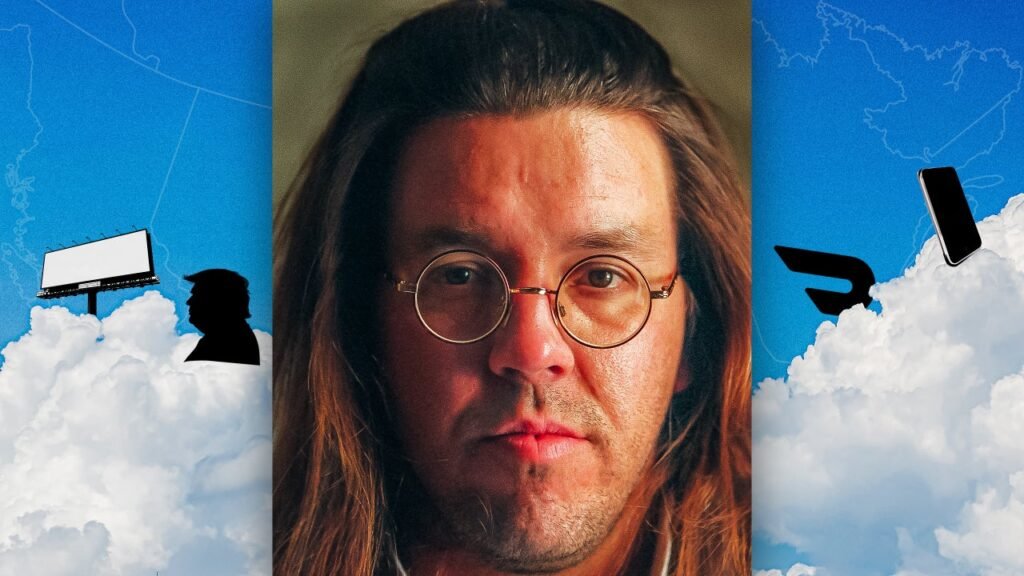
Few opuses come quite as magnum as Infinite Jest, an intimidating tree stump of a book that makes for singularly cumbersome beach reading.
Entertainment Weekly’s literary critic famously gave up trying to review it upon release in 1996, while The Onion later nodded to its author’s excessive verbosity with the headline, “Girlfriend Stops Reading David Foster Wallace’s Breakup Letter on Page 20”.
Anyone put off by the sheer bulk of Wallace’s masterpiece, however, or its reputation as catnip for pretentious book bros, has missed out not only on one of modern fiction’s more rewarding reads but one of literature’s all-time most prescient prognostications. As Infinite Jest reaches its 30th anniversary, it looks more and more like a roadmap for How We Got Here. Anyone reading in 2026 will inevitably agree Americans are now living in the future this book anticipated.
While it defies easy encapsulation, Infinite Jest traces the events surrounding a Quebecois separatist movement’s efforts to infest the U.S. with a film so entertaining, its viewers cede the desire to do anything other than watch it. Of course, a novel’s plot isn’t necessarily the same as what it’s “about.” Beneath the cascading storylines, circular structure (its first chapter is actually its last), and hundreds of distinct characters, Infinite Jest is ultimately about addiction, atomization, the Sisyphean search for meaning in modern life, and the innately American quest for endless entertainment, cost be damned.
In diagnosing what was wrong with America in 1996, Wallace, who died by suicide 12 years later, managed to diagram the future. In both broad strokes and tossed-off details, he used speculative satire to hold a crystal ball up to society and show us where we were headed. That he did so while the internet was still in its infancy only makes Wallace’s foresight that much more impressive.
Here are 15 ways Infinite Jest has proved prophetic in 2026.
The convergence of devices
The market for home computing had grown rapidly throughout the early ‘90s, but only 42% of Americans owned a PC in 1996. Still, it was crystal clear at the time that computers would occupy an outsized role in American life in the near-future. What would have been less obvious back then is that PCs would eventually also absorb the functions of entertainment systems and telephones. Infinite Jest finds Americans using the same device, a ‘teleputer,’ to do their computing, take in entertainment, and call friends and family. Wallace apparently couldn’t see far enough ahead to catch a glimpse of the iPhone, but he knew our devices would merge.
The VR craze of the ‘90s would not pan out
As much as personal computing had started taking over Americans’ lives by the mid-’90s, other technologies emerging at the time soon flamed out. One of them is virtual reality, which Wallace nodded to in the form of “Simulated Reality arcades,” which he mentions having flourished briefly before “the novelty wore off.” Thus far, reality has followed suit.
Gig-economy tech companies delivering groceries
Catalog ordering and phone delivery already existed in 1996 but Wallace imagined them as high-tech operations of immense scale. Buried in a footnote, he describes a service that sounds an awful lot like DoorDash, Instacart, or Amazon drone delivery: “Telegrocery services let you order off your [teleputer] and then have the stuff brought right to your door by college-studenty types, often within hours, saving one the stress and fluorescent hassle of public food-shopping.”
Video calls would not replace phone calls
Many sci-fi depictions of the 21st century created before the year 2000 imagined a world where people seem to communicate exclusively over video calls. Few if any grappled with the thought exercise of what that technology would actually demand of its users. In Infinite Jest, Wallace includes a section that reads like a standalone short story, describing the rise and fall of “videophony.”
Although his version veers wildly in parts from how reality has panned out, what it got right is the essential fact that video calls elevate the act of answering the phone to the level of answering the door, and there are far too many situations in which the former is vastly preferable. In 2026, video calls are a readily available option for many Americans, but they’re often agreed-upon in advance. Unsolicited FaceTiming still remains something of a taboo.
The rise of remote work and education
People may not be doing all of their calls visually in the world of the book, but “half of all metro Bostonians now work at home via some digital link,” while “50% of all public education” is “absorbable at home on couches,” and one of the primary characters, Avril Incandenza, attends conferences and conventions videophonically, “rain or shine.” It may have taken a global pandemic to beef up the numbers to the point where roughly half of Americans work in a hybrid format, but we got there eventually.
A cottage industry built on digital self-presentation
One of the reasons videophony never fully reached critical mass in the world of the book is because consumers started altering their digital selves and got addicted to yassification. In real life, countless companies and apps have capitalized on our insecurity about digital self-presentation, creating all kinds of ways to smooth out whatever we don’t like about our faces and bodies, including Instagram filters, FaceApp, and all kinds of selfie-editing AI.
Sadly, considerable evidence has emerged to suggest all this visual editing in social media is now shaping self-perceived attractiveness and self-esteem in dangerous ways. Just like in the book.
With diminished returns on TV advertising, ads are crammed in everywhere
Much of Infinite Jest takes place in the year 2009, but that’s not entirely accurate. Since the calendar year in the book is annually auctioned off to the highest corporate bidder, a practice known as Subsidized Time, the book’s main action transpires in the Year of the Depend Adult Undergarment. One of the reasons Subsidized Time exists in the book is because broadcast TV has fallen—rather than “been reduced to hanging on by a thread,” as is the case in reality circa 2026.
With broadcast TV ads no longer effective, the book imagines a world where advertising gets crammed into every available surface, at home and outside. The idea of Subsidized Time is even inspired, one passage describes, by one character attending a football game known as the “Ken-L-Ration-Magnavox-Kemper-Insurance-Forsythia Bowl.” To that end, sponsorships of college bowl games in real life have gotten very weird indeed.
The on-demand, endless choice of the streaming era
“What if a viewer could more or less 100% choose what’s on at any given time?” That is the explicitly stated value proposition of InterLace, the company that has a chokehold on home entertainment tech in Infinite Jest. The service offers viewers access to “cartridges” they can rent from home at any time, “over PC and modem and fiber-optic line,” and eventually in the form of pure “digital transmissions.” This service foreshadows the arrival of not only Netflix, but an era where Netflix has inspired a cavalcade of streaming competitors, allowing viewers to self-select all their entertainment needs from a seemingly unlimited array of options.
Even first-run movies are now often available at home too
Just as Netflix eventually moved into premiering big-budget, high-pedigree original movies on its service, InterLace also started to “purchase first-run features for its rental menus and hyp[e] the cartridges with one-time Spontaneous Disseminations.” In both cases, the goal seemed to be enticing people to leave home for entertainment as seldom as possible.
People now seem to pine for less choice in home entertainment…
Toward the end of the book, the character Orin Incandenza waxes nostalgic for the way TV used to be. “I miss being told things were filmed before a live studio audience,” Orin says, in a reverie about the formulaic sitcoms of yore. “I miss sneering at something I love.” He’s not alone in the desire for more simplified home entertainment; a 2024 survey of 2,000 subscribers found that viewers spend an estimated 110 hours per year scrolling for content, and 51% felt overwhelmed by the quantity of recommended programming.
… Which is partly why live events have become such a big deal
Streaming services have been aggressively pursuing live events like sports recently, as people seem magnetically drawn toward appointment viewing and live events in general. Wallace describes this phenomenon as “the new millennium’s passion for standing live witness to things… a whole sub-rosa schedule of public spectation opportunities, ‘spect-ops, the priceless chance to be part of a live crowd, watching.”
The loneliness crisis
The thread running through most of Wallace’s predictions is that Future America would be a lonely place where people spend far too much time at home, isolated from others. Sure enough, the U.S. Surgeon General in 2023 declared loneliness a widespread public health crisis, with nearly half of American adults reporting measurable loneliness even before the pandemic.
Donald Trump is the president
Americans had already elected an entertainer as president before Wallace wrote Infinite Jest, in the form of Bedtime for Bonzo star Ronald Reagan. In 2016, however, we elected someone closer to the book’s President Johnny Gentle: an entertainer and germaphobe whose victory seemed to be “an angry reactionary voter-spasm that made… Libertarians chew their hands in envy as the Dems and G.O.P.s stood on either side watching dumbly, like doubles partners who each think the other’s surely got it.”
Much like in the book, nothing has been normal ever since. Indeed, the second Trump administration regularly seems to punish U.S. states as revenge for how they voted, much like President Gentle’s process for choosing which states will undertake “massive toxic dumping.”
Animosity between U.S. and Canada
As of last summer, 75% of Canadians were upset with Trump following his efforts to annex the territory, compared with 80% in the book who “want the U.S. president dead”. (Incredibly, Canadian separatism, a major thread in the book, is also back in the news.)
The assassination of Charlie Kirk
Rush Limbaugh ultimately made it to the age of 70 before dying of lung cancer in 2021, but a throwaway line in Infinite Jest casually references the influential conservative talk radio host’s assassination. At the time Wallace wrote the book, Limbaugh embodied the growing intensity of American political commentary, which helped pave the way for our current polarization.
Nodding to his assassination in the novel may have been the author’s way of predicting an even more unstable political climate to come—perhaps the kind in which influential conservative talk radio host Charlie Kirk is assassinated for reasons that remain indiscernible.
Welcome to Infinite Jest World
Obviously, Wallace didn’t get everything right about America’s future. Characters in Infinite Jest still listen to music on compact disc, for instance, and pay for high toll hours on long-distance calls. (Congress passed the Telecommunications Act of 1996, which resolved the latter issue, the same year the book came out.) Wallace also notably and quite understandably did not see 9/11 coming, envisioning instead a U.S. whose ‘geopolitical supremacy’ led to a ‘consequent silence,’ that left it without ‘any external Menace to hate and fear.’ Still, the author got enough right about the direction of the country to qualify as a genuine oracle.
So much about life in America now feels cribbed from Infinite Jest. AI girlfriends and AI-assisted suicides. Live-streamed mass shootings. Alleged insider trading on prediction markets over when the U.S. would bomb Iran. Looksmaxxing influencers. A president who depicts himself as Jesus. Deadly Panera Bread lemonade.
All of it would fit snugly alongside news of a movie so compelling it kills you.
If such a movie did exist in 2026, though, it would just be a TikTok and its dissemination would happen so fast David Foster Wallace’s head would never stop spinning.