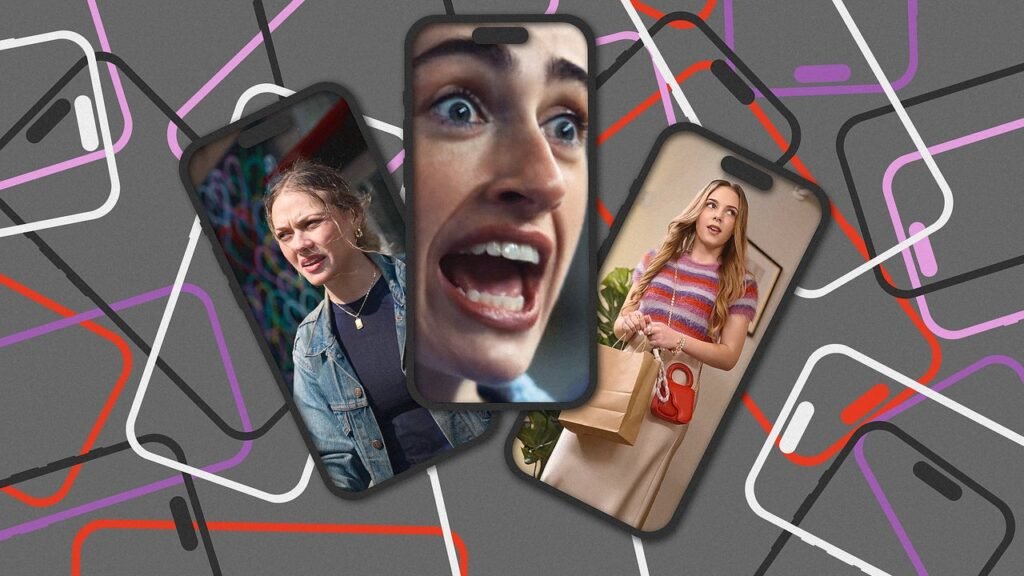
A young woman notices a pair of Crocs outside her neighbor’s apartment door. But there’s a huge problem. The Crocs don’t have a single Jibbitz charm. So she decides to take a charm off her own Crocs and put it on the shoes of her mysterious neighbor.
That’s the start to Charmed to Meet You, a scripted microdrama that launched in February on the ReelShort app. Apparently inspired by a true story involving a Crocs employee, it chronicles a flirty dialogue told across five short-form episodes. So far, it’s attracted more than 10 million views.
Microdramas—serialized episodes that run less than two minutes—have seemingly taken over the internet of late. Some data: The specialty apps that stream microdramas, including ReelShort and DramaBox, are outpacing traditional streamers in app store downloads. In 2025, ReelShort was downloaded 38 million times in the U.S.
TelevisaUnivision’s Spanish-language short-form vertical videos have 900 million social media views and 6 million daily users. And according to Variety, microdrama revenue in the U.S. reached $819 million in 2024 and is projected to hit $3.8 billion by 2030.
Whenever a new entertainment trend starts showing these kinds of numbers, inevitably brands are eager to jump on the bandwagon. TelevisaUnivision, for example, created a series for JCPenney, while other brands, including Starbucks and Maybelline, are also experimenting with the format.
Marketers, I know what you’re thinking. You’re dying to jump into the trend feetfirst. Those microdrama numbers! They’re just so mesmerizing. But that digital engagement oasis could well be a metaverse-style mirage. Or worse, an NFT-style one.
Before you take the plunge, read on to learn:
- Why one brand entertainment exec is actively discouraging clients from making microdramas
- Intel from Crocs’s CMO on how the brand found its footing in this new entertainment format
- The chasm between what brands want to create and what audiences want to see
Algorithmic sameness
Microdramas started coming to prominence in China about eight years ago on a ByteDance-owned app called Douyin (launched a year before its sister app, TikTok, was released worldwide). The stories were known for their almost exaggerated soapy-ness, with ridiculous plot twists, scandalous storylines, and emotional cliffhangers.
Take Forbidden Desires: Alpha’s Love. Based on the Chinese web novel, it starts with a college student named Chloe accidentally finding her semi-naked professor, Adrian, in the shower. Adrian is also her stepbrother. And a werewolf. With more than 160 million views, this microdrama series has become one of the most popular examples of the biggest trend in entertainment.
With sticky storylines served in short bursts that keep people coming back, it’s no secret why brands are interested. Like many brand entertainment trends, there are successful examples that can inadvertently encourage more marketers to get in on the action. Undoubtedly, any number of CMOs or agency leaders have pointed to Crocs, Starbucks, and P&G as beacons to follow.
Starbucks got a foot in the door back in 2024, when it launched a microdrama on Douyin called I Opened a Starbucks in Ancient Times. In the six-episode series, a barista travels back in time, opens a wildly successful coffee empire, becomes a wealthy tycoon, and finds romance along the way. The show reportedly attracted more than 60 million views, and helped boost the chain’s seasonal drinks sales in China.
Crocs CMO Carly Gomez says the brand’s experimentation with the microdrama format is directly tied to the viewing habits of its primary audience. Gen Z voraciously consumes content. Today, the 14-to-29-year-olds who comprise the generation account for 40% of all North American moviegoers and are driving the overall box office. And they are spending even more time online, where vertical video rules.
“I think that this snackable content is going to be more and more of what we’re going to be seeing just across the board,” Gomez says, noting that given the early stage of new platforms like ReelShort, she doesn’t measure success against more established platforms like YouTube or TikTok. Rather it’s a contained competition, where she tracks Crocs’s success against other branded content on the microdrama platforms.
Charmed to Meet You dropped on Valentine’s Day, and out of more than 250 programs it quickly climbed the ranks to the fourth-most-popular series. “It’s exciting to see that on a new platform,” Gomez says. “It’s doing really well right out of the gate and we’re really proud of it.”
The company worked with CAA’s Media and Entertainment Partnerships team on this initiative, and the content was produced by ReelShort. The goal for Crocs was to step away from what it calls “imitation and algorithmic sameness” to tell a fun story on an emerging platform and attract the attention of the brand’s biggest fans.
Part of Crocs’s success with this format comes from the fact that, at least as far as brands go, it was relatively early to the game. Its microdrama work felt like a novelty to viewers. But as the market and platforms become more saturated, marketers need to be careful not to turn microdramas into the next “witty” Brand Twitter banter.
Anjali Bal, associate professor of marketing at Babson College, tells me that microdramas are going to make sense for some brands, but certainly not all. She says these short, serialized videos are effective at capturing and sustaining attention thanks to their narrative-driven content. When done right, they can deepen emotional engagement and encourage continued consumer attention.
When done wrong, they seem like a shoe on the wrong foot. “Its effectiveness depends on strategic alignment with a brand’s identity, category norms, and audience, rather than adoption driven primarily by trend participation,” Bal explains. “For example, not every company benefits from spending on a Super Bowl ad, but for some companies a Super Bowl ad is the best expenditure.”
The disconnect
One brand entertainment executive who agreed to speak off the record told me that the phone is ringing off the hook about microdramas. But even clients’ own definitions of the format can differ wildly.
“There’s this disconnect between what audiences know these things are, and why they love them, and how marketers and advertisers took that label and made it mean something for ourselves,” the executive said. “We had to talk some clients out of this because they just didn’t understand it, and it wasn’t for their audience.”
If it’s not a soapy, cliffhanger-type story, then call it what it is: episodic vertical video.
One example is Marc Jacobs. In April, the fashion brand created a short film called The Scene, which follows Rachel Sennott through a chaotic day that leads to an invitation to the Met Gala. But while the brand called it a microdrama, it lacked the serialized episodic format and the cliffhanger hallmarks of the format. It has fewer than 2,000 likes on TikTok and fewer than 5,500 likes on Instagram.
If a brand wants to tap into the microdrama trend, it has to commit to making an actual microdrama. And there are a few considerations when doing so. First, they’re serialized, so they have to be seen in order. If episodes are just dropped on a brand’s TikTok or Instagram feed (à la Marc Jacobs), viewers get served episodes at seemingly random by the almighty algo.
This means marketers need to stick to dedicated platforms like ReelShort or DramaBox, or set up separate feeds for these shows on the traditional social platforms. If you’re not willing to build the infrastructure around your story, it won’t hit audiences like a true microdrama, which will defeat the purpose of trying to tap into the trend in the first place.
Crocs’s approach works because it took the microdrama format seriously, and created a fun story in which its product is central. This goes back to something I’d consider the golden rule of brand entertainment, based on what Eshan Ponnadurai, Meta’s head of consumer marketing, told me on Fast Company’s Brand New World podcast last year. For all the award-winning films they’ve created with WhatsApp, they never set out to make a film. The first priority was to find a story with the product at the center, and then decide what the best format for that story should be.
Part of deciding on the format is knowing if, as a brand, you’re willing and able to make the best possible version of your story in a way that serves the audience as much as it serves your marketing needs. The result can be a film like Netflix’s The Seat, a top sports doc on the streamer that resonates with F1 fans and just happens to have WhatsApp at its core.
The potential for the right brands to do very well in microdramas is there. But just know that if you wade into the latest marketing trend, you’ll likely be among a horde of other brands that are simply there to ride the biggest wave until it peters out. Blatant trend-chasing without the right commitment results in garbage content that will inevitably get quickly scrolled as just more feed pollution.
Or as my executive source said, “There are a lot of people willing to do it. There aren’t a lot of people willing to do it right.”