Research & Developments is a blog for brief updates that provide context for the flurry of news regarding law and policy changes that impact science and scientists today.
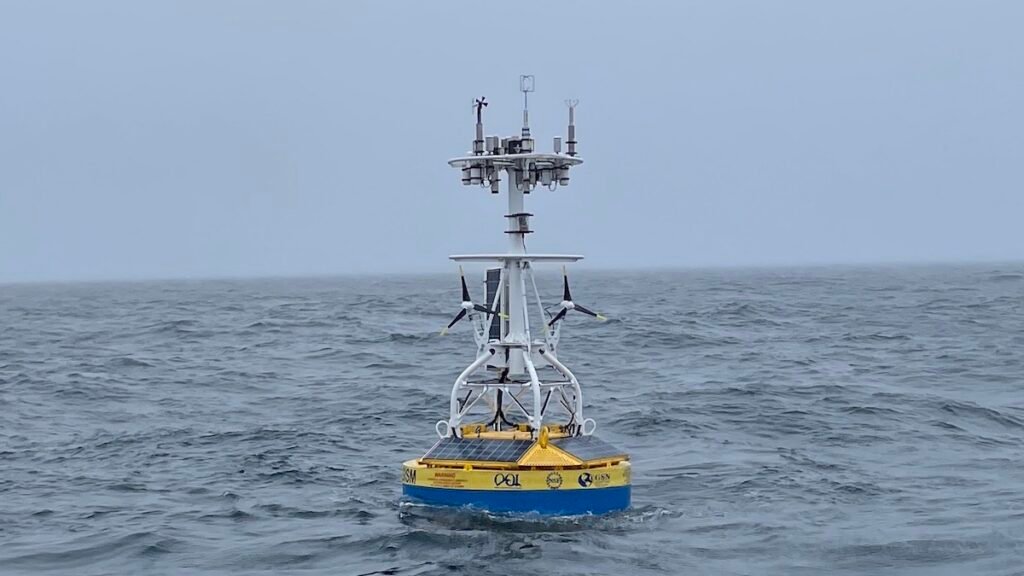
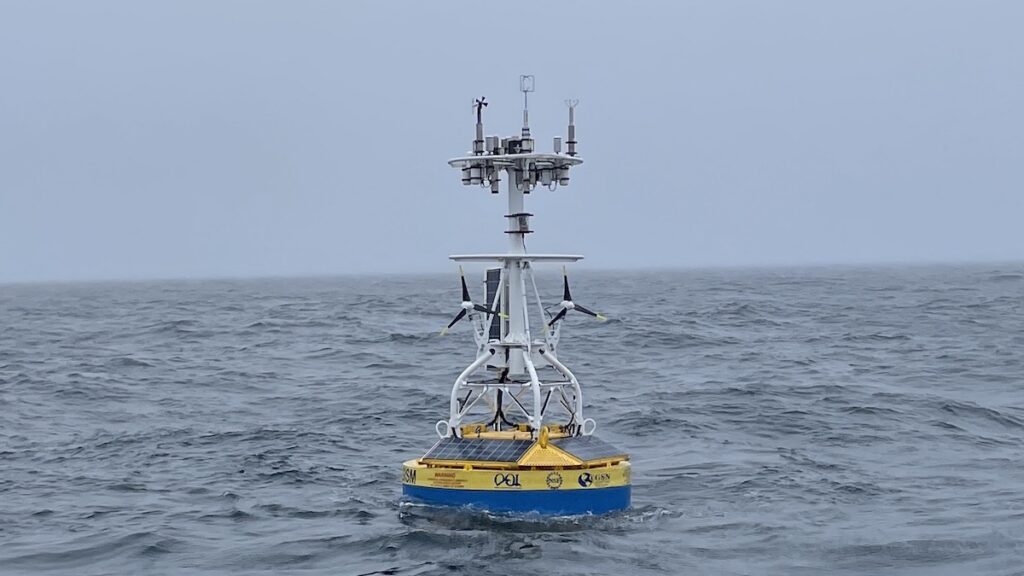
The Trump administration’s National Science Foundation (NSF) has begun dismantling the infrastructure of a $368 million deep-ocean observing program critical to monitoring marine ecosystems, global currents, marine heat waves, and more, according to a 21 May announcement.
The Ocean Observatories Initiative (OOI), funded by the NSF, has been collecting long-term oceanographic data at multiple deep-ocean sites since 2016. The information about ocean temperature, chemistry, currents, biological conditions, and more is used by scientists to understand a multitude of marine research questions including the activity of the Atlantic Meridional Overturning Circulation (AMOC), a critical ocean current.
“I worry that … we’ll be losing this enormously valuable site where we could really contextualize and detect these changes going forward.”
“There’s a real danger that we lose the ability to keep looking for long-term changes [in the ocean]” as climate change alters Earth systems, said Hilary Palevsky, a marine biogeochemist who has used OOI data for a decade to study how the ocean absorbs carbon dioxide. “I worry that … we’ll be losing this enormously valuable site where we could really contextualize and detect these changes going forward.”
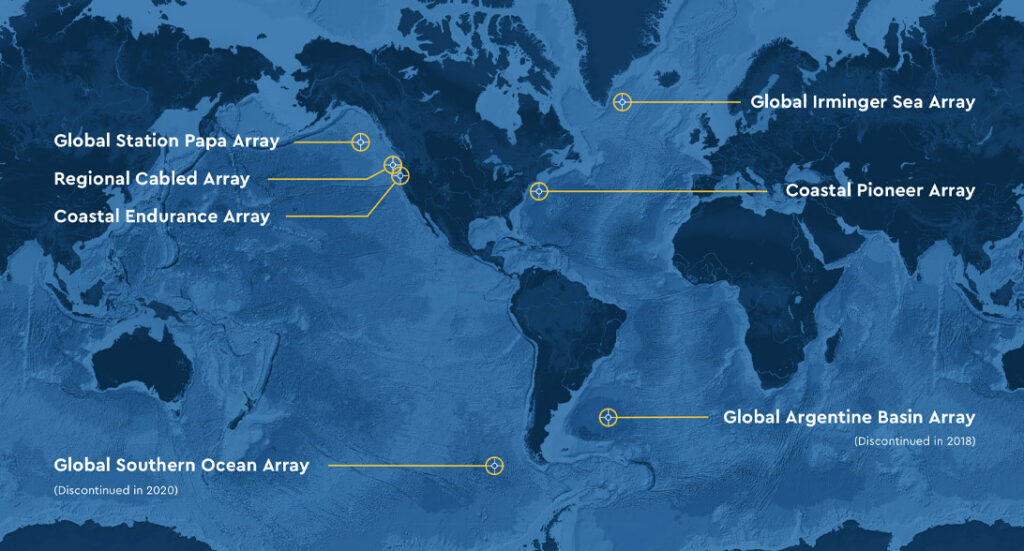
The NSF plans to remove all in-water arrays and infrastructure—including hundreds of deep-sea instruments—from four of the five currently-operating sites within the project: the Global Station Papa Array (in the Gulf of Alaska), Coastal Endurance Array (off the coasts of Oregon and Washington), Global Irminger Sea Array (southeast of Greenland), and Coastal Pioneer Array (off the coast of North Carolina). The removal is expected to occur over the next 15 months, though the process has already begun at the Endurance Array.
The Trump administration attempted previously to downscale OOI operations, proposing to cut its funding in 2025 and 2026, though Congress never approved the cuts.
The administration’s decision to dismantle the arrays “aligns with NSF’s wider strategy to have a nimbler approach to prioritizing support for evolving scientific priorities and emerging technologies as well as a deliberate approach to smart life cycle management within its portfolio of research infrastructure,” Michael England, an NSF spokesman, told the New York Times.
A Dearth of Data
As each array is dismantled, data streams will end, though all previously collected data from OOI networks will remain accessible, Jim Edson, principal investigator for the OOI, wrote in a letter to the oceanographic community.
Palevsky said there’s “a lot of real concern” among the oceanographic community that the Endurance Array is being dismantled just as an intense El Niño event—and associated marine heat wave—is expected this summer. “It would be especially important to be able to document the effect that [El Niño] is having on coastal physical circulation and ecosystems,” she said.
“We encourage the community to use the ten-plus years of OOI data by including it in proposals, publications, presentations, and conversations with colleagues. Continued engagement demonstrates the scientific impact and wide-ranging applications enabled by the OOI and its data, underscoring its importance as a resource for the oceanographic community,” the 21 May announcement stated.
There are other sources of data that researchers like Palevsky can use. But oceanographic research often requires stitching together different data sets, including OOI observations, satellite observations and observations from the U.S. research fleet. Many of these other sources of data are also facing uncertain futures.
Palevsky also worries about the loss of expertise that will occur as the program scales down. Installing these deep-sea observing networks was a huge achievement for U.S. science that will not be easy to replicate, she said. “If, in five years, we as a community decide we want to again be able to deploy this kind of complicated infrastructure in places that have really difficult oceanographic conditions … it’s going to be a lot of reinventing the wheel to figure out how to put things out again.”
“The complete cessation without community input or a community conversation about what’s going to happen to all this equipment and what’s going to happen with all of the expertise,” she said, “feels like a huge loss.”
—Grace van Deelen (@gvd.bsky.social), Staff Writer
These updates are made possible through information from the scientific community. Do you have a story about how changes in law or policy are affecting scientists or research? Send us a tip at eos@agu.org.

Text © 2026. AGU. CC BY-NC-ND 3.0
Except where otherwise noted, images are subject to copyright. Any reuse without express permission from the copyright owner is prohibited.