The Justice Department took a small step back Monday from its controversial $1.8 billion “Anti-Weaponization Fund.” It wasn’t nearly enough to quell the furor on Capitol Hill.
Republican senators, including some top leaders, said a DOJ statement that it would “abide by” a federal judge’s recent ruling to temporarily halt any payouts did not do enough to clear the intraparty concerns that have thrown the GOP’s immigration enforcement bill into limbo.
Instead they nudged President Donald Trump to make a more explicit move to renounce the fund, which could be used to pay participants in the Capitol attack on Jan. 6, 2021, and other Trump political allies that have been subject to federal prosecution.
“It’s pretty clear that the president has to say very explicitly that there’s not going to be a weaponization fund,” Senate Judiciary Committee Chair Chuck Grassley (R-Iowa) told reporters.
Sen. James Lankford, a member of the Senate GOP leadership team, added that the administration needs to “say what they actually mean.” Sen. Shelley Moore Capito (R-W.Va.), another junior party leader, said the fund still needs “more investigation” and that there are still “a lot of questions” for the administration to answer.
Those warnings come as Acting Attorney General Todd Blanche heads back to Capitol Hill Tuesday for the first time since a heated closed-door meeting last month with GOP senators that led to the scuttling of planned votes on a more than $70 billion funding package for immigration enforcement agencies.
In a scheduled appearance before a House Appropriations subcommittee, Blanche is likely to face more pointed questions about the fund and its future. During an appearance before Senate appropriators last month, Blanche refused to put any concrete guardrails on how the $1.8 billion might be paid out — specifically refusing, for instance, to rule out payment to Jan. 6 rioters.
This time, he will be under pressure to say more as Republicans grow more eager to revive the immigration enforcement bill this week — legislation they are counting on to fund agencies such as Immigration and Customs Enforcement for the remainder of Trump’s presidency.
The administration’s obstacle is that there were wildly different interpretations of the DOJ statement Monday. Some, like Sen. John Cornyn (R-Texas), said the statement about respecting the court decision left the fund “moot.”
But others said the language fell short. The order is in place pending a June 12 hearing before a Virginia district judge, who could then remove or extend the injunction.
Enough Republican senators to block progress on the immigration bill, given the united Democratic opposition, said there were unanswered questions that could keep the bill from moving forward without a clear resolution.
“The reconciliation bill looks like a broken arm with the bones sticking out,” said Sen. John Kennedy (R-La.). “They have to abide by the district court decision — that’s in the Constitution. I’d have to know more about their position on the weaponization fund to know whether it would be enough to dislodge the reconciliation bill.”
“If it means it’s completely pulled, then that would satisfy me, but I haven’t heard anybody say that that is actually what is happening,” added Sen. Lisa Murkowski (R-Alaska). She also hinted she could oppose the immigration enforcement bill regardless of how the fund debate plays out.
The qualms aren’t limited to the Senate. One House Republican granted anonymity to speak frankly about the situation said the fund was “DOA” in the closely divided House and that it “seems telling this is the court order they decide to abide by.”
Some Republicans in the House are privately mulling how to add language to the reconciliation bill that would kill off any future attempts by Trump to create such a fund, adding another complication to the stalled effort, according to the House Republican and two other GOP lawmakers.
Senate Republicans will discuss the status of the fund and the immigration enforcement bill during a closed-door lunch Tuesday, according to several Republican senators — just hours before Blanche is set to testify on the other side of the Capitol complex.
Also testifying Tuesday is Homeland Security Secretary Markwayne Mullin, who is expected to underscore the need for the much larger tranche of immigration enforcement funding to the Senate Appropriations Committee.
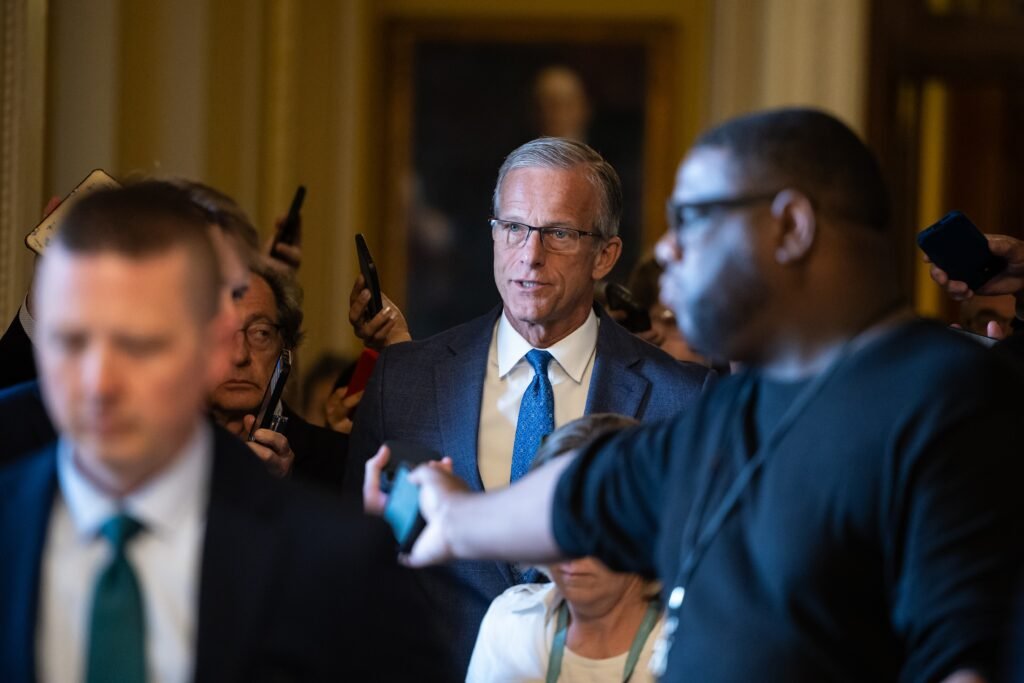
Senate Majority Leader John Thune, for his part, characterized the Justice Department’s comments as reflecting a broader shift away from the fund by the Trump administration.
“The way the statement is worded, I think it’s clear that they’re not proceeding with the fund, but obviously whether that’s sufficient to satisfy a number of our members is something we’re still sorting through,” Thune told reporters.
He added that Republicans should know by Tuesday if they are going to be able to revive the immigration enforcement bill this week.
The risk for GOP senators is a certain flurry of Democratic amendments to the legislation meant to expose incumbents to politically risky votes just months ahead of the midterm elections. Under the party-line process Republicans are employing, Democrats can force a slew of amendment votes before the bill’s final passage.
“The first amendment I will offer will be to ban the slush fund permanently and forever,” Senate Minority Leader Chuck Schumer said on the Senate floor Monday. “And if Republicans try to use toothless constraints to make the slush fund more palatable, we will press them to dismantle it entirely.”
To help inoculate the bill against efforts to add in language related to the fund, Thune said Monday night Republicans would remove a section of the bill related to the Justice Department. That, Republicans believe, will require any amendments related to the department to clear a higher 60-vote threshold instead of a simple majority.
But several GOP senators didn’t completely close the door when asked about adding language related to the DOJ fund into the bill or supporting separate legislation. Some Senate Republicans could also still vote to add a preemptive ban to the bill or vote for other amendments that would limit or nix the fund, four Republican aides acknowledged.
Such a step, if it’s not explicitly backed by Trump, could threaten to sink the overall bill.
Asked if he was worried about a possible Trump veto if the fund was banned, Thune said, “Oh yeah, don’t you?”
Calen Razor and Meredith Lee Hill contributed to this report.