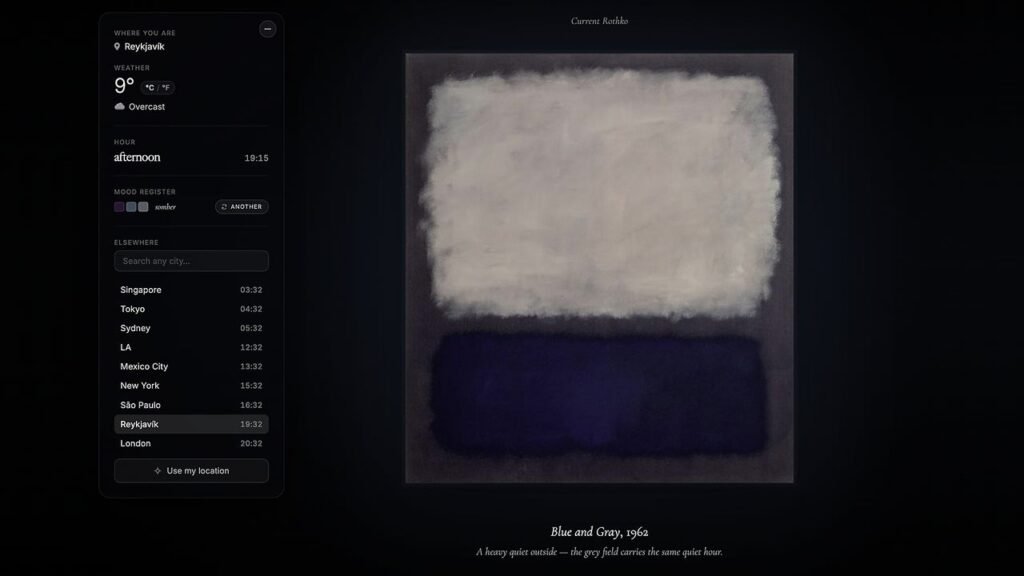
Sometimes a quick glance at the weather app is not enough to decipher what truly awaits outside the comfort of indoors. But now, a project is using an unexpected tool to tell users what the weather feels like outside your window—Mark Rothko paintings.
A leading figure in Abstract Expressionism, Rothko produced immersive color field paintings across various hues and tones, each setting a different mood. The Finnish product designer and creative director Joonas Virtanen noticed how the paintings could also represent the atmosphere. So he created Current Rothko, a weather forecast using the painter’s colorful artwork as its visual metric.
“The weather forecast tells you the temperature and whether to bring an umbrella, but I’m interested in translating all of that into what the day or the moment feels like, what emotional register it belongs to,” Virtanen tells Fast Company.
He adds, “Weather is data, but it’s also a shared experience, and those two things rarely look alike.”
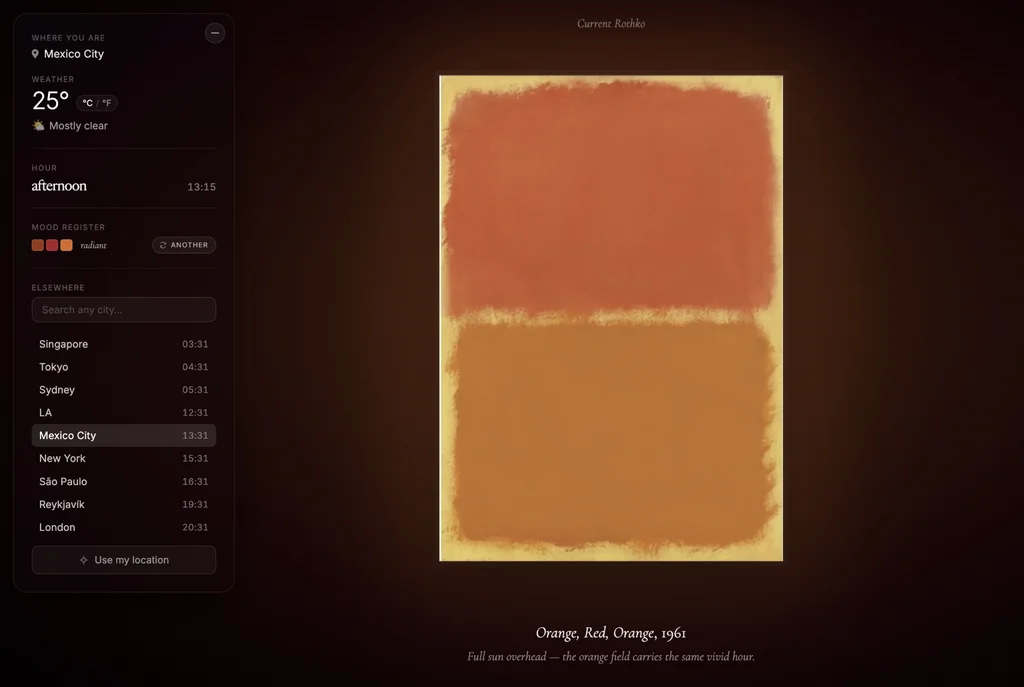
Using a user’s location, the application shares the temperature in both Celsius and Fahrenheit and generates a color palette depending on the time of day and weather conditions. Then it pairs the data with one of 89 Rothko paintings. A gloomy day might evoke the greys, deep blues, and purples found in the paintings in the Rothko Chapel while, a sunny afternoon is more associated with yellow and red, like the hues in his 1950 piece No. 5/No.22.
The site offers weather forecasts for anywhere in the world, fetching local data on conditions, temperature, time of day, sunrise and sunset. The data is then translated into what Virtanen calls a “mood register,” qualifying brightness, temperature, and mood words. To arrive at a painting, the site uses a matching engine that scores each of the 89 paintings, which are tagged with mood registers, against the data.
Virtanen goes a step further, taking into account factors that might contribute to what the day looks like beyond just what the weather app might say. For instance, the site also measures cloud cover, rain, fog, and storm conditions, which might alter the mood despite the time of day. An 80-degree (F) day in the tropics is not the same as in the desert.
“All of that together produces a mood profile, and the painting that matches it best wins,” he says.
The set of reference paintings are Virtanen’s favorites from Rothko, which he sourced from WikiArt and Wikimedia. He plans to expand the set in the future.
The project took a few days to build. The core challenge was making “matches feel emotionally right rather than just algorithmically correct,” Virtanen says. However, tedious tasks like designing the engine logic and tagging the paintings took the most time. “Getting the scoring system calibrated so it doesn’t just always return the most visually striking painting regardless of weather took a lot of iteration,” he adds.
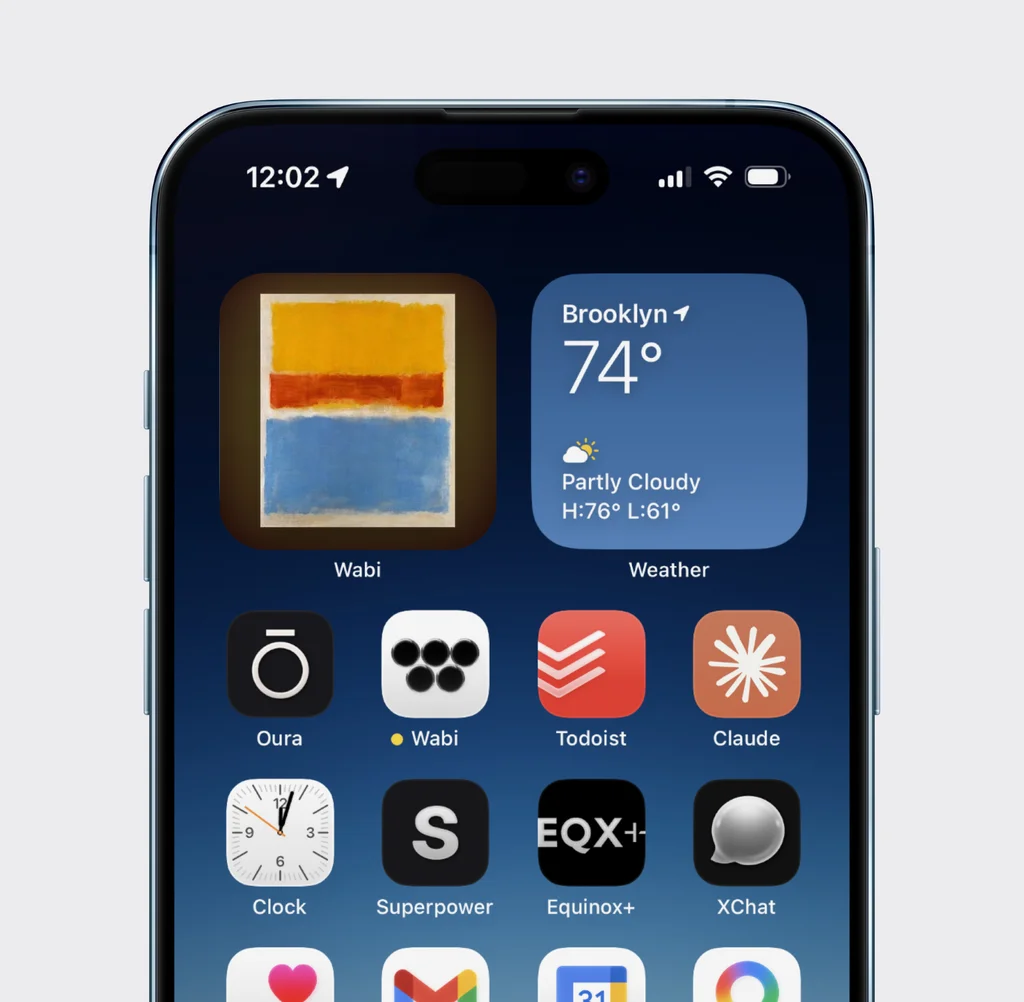
Virtanen built the site on his own AI platform, Wabi.ai, and also used other AI tools to publish it. The personal software allows users to create, remix, and share miniapps, even for users without coding experience.
While not available to the public yet, Wabi would allow users to integrate the site as a widget, as Virtanen did. And online, users are asking for it, with one user on X saying, “make this a widget, and I will download it on my phone immediately.”
Virtanen sees the project as restoring whimsy to an otherwise grim internet. His other projects include Timeforms, which generates art based on time and temperature, and Tangled Lines, which depicts NYC subway service status.
“I’m always trying to come up with ways to use technology in more playful, delightful, pro-human ways,” he says. “I make them because I believe projects like this are what the internet was actually made for.”