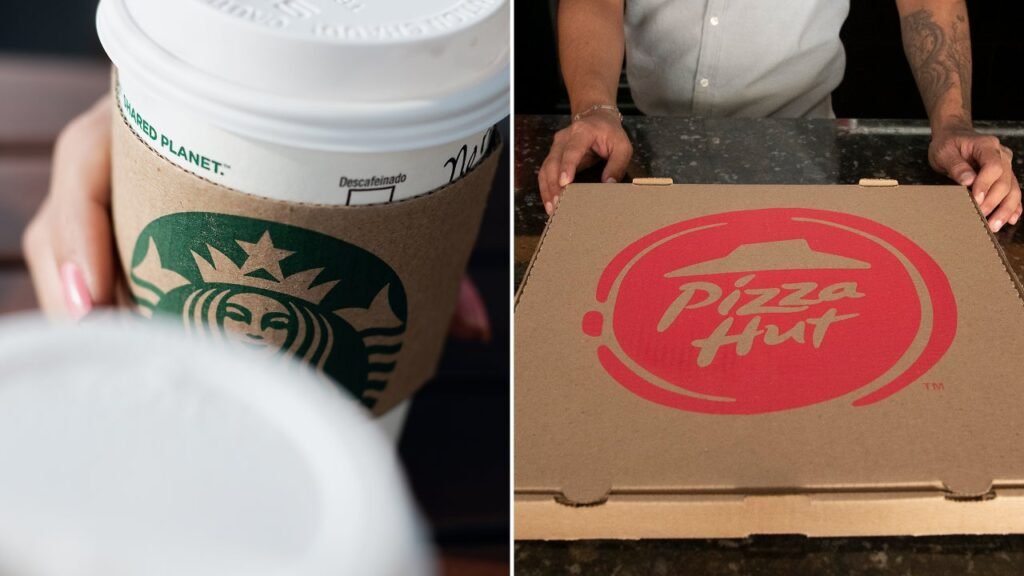
AI woes are coming for the food service industry, and social media can’t help but celebrate.
This week, both Starbucks and Pizza Hut made headlines for controversies around their internal applications of AI. At Starbucks, an inventory tool got the chop after making frequent counting mistakes, while at Pizza Hut, a delivery tool drove a franchisee to file a lawsuit.
Social media users are saying the two stories may point to a larger trend: that for the first time in the AI era, more companies will pull away from AI than embrace it.
Starbucks walks back an AI tool
On Monday, Starbucks told employees it was retiring an inventory-counting tool powered by AI after the technology led to inaccurate counts and mislabeled products.
“Starting today, Automated Counting will be retired,” read an internal company newsletter verified by Reuters. “Beverage components and milk will now be counted the same way you count other inventory categories in your coffeehouse.”
In a statement to Fast Company, a spokesperson for Starbucks explained that the company’s choice to axe its Automated Counting tool is in line with its larger AI strategy, which is based in trial and error. “We test ideas in our coffeehouses, listen closely to partner feedback, and make changes to deliver a better, more consistent experience,” they said.
Starbucks’ move to ditch one AI tool doesn’t mean the company is foregoing the technology entirely. The company is still investing in internal AI applications, including an AI assistant for baristas called Green Dot Assist and an AI-powered order-sequencing system called Smart Queue. The brand is also experimenting with an integrated Starbucks app within ChatGPT.
Pizza Hut’s delivery system backfires
Where Starbucks’ choice to nix its AI tool came from the top down, the anti-AI sentiment at Pizza Hut started with a disgruntled franchisee.
In a lawsuit filed on May 6, franchisee Chaac Pizza Northeast, which operates more than 100 Pizza Hut locations, alleged that the company forced it to adopt an AI tool called Dragontail that inadvertently drove its wait times from a less-than-30-minute average to over 45 minutes in more than half of all orders.
The complaint explained that the issue wasn’t with Dragontail itself, but with the information the tool provided to DoorDash drivers. Dragontail is meant to optimize food delivery by giving delivery drivers real-time updates on order preparations and timing, but according to the lawsuit, its implementation in 2024 caused “cascading operational breakdowns and customer dissatisfaction,” resulting in more than an estimated $100 million in lost business and enterprise value.
Reportedly, once DoorDash drivers could see the real-time status of multiple orders through Dragontail, they would wait inside restaurants until multiple orders were ready, meaning some orders were being held for up to 15 minutes after they were ready for delivery. Because Chaac relies on DoorDash for all of its deliveries, the forced change to its delivery model reportedly had a major impact on its sales. At its New York City locations, Chaac said its sales swung from positive 10.19% to negative 9.78% after implementing Dragontail.
“With the intention to improve efficiency and service to the customer, Dragontail did the exact opposite,” reads the lawsuit. “It caused significant delays and pummeled consumer satisfaction.”
Pizza Hut has not responded to Fast Company’s request for comment.
Social media sees a trend
With the stories from Starbucks and Pizza Hut breaking in quick succession, social media users are drawing connections between the two food service chains’ AI troubles.
“Over the next 1-2 years we’re going to start hearing more reports about companies pulling back from AI than adopting AI, and markets aren’t ready,” one user theorized.
“The AI bubble might burst quicker than I thought,” echoed another.
“You’re going to be hearing a lot more about forced AI integration and what a disaster it is for businesses and consumers,” agreed a third.
Other users pointed out that all of these problems could’ve been avoided if tasks hadn’t incorporated AI in the first place. “To err is human,” one user quipped, “but to really screw things up you need a computer.”