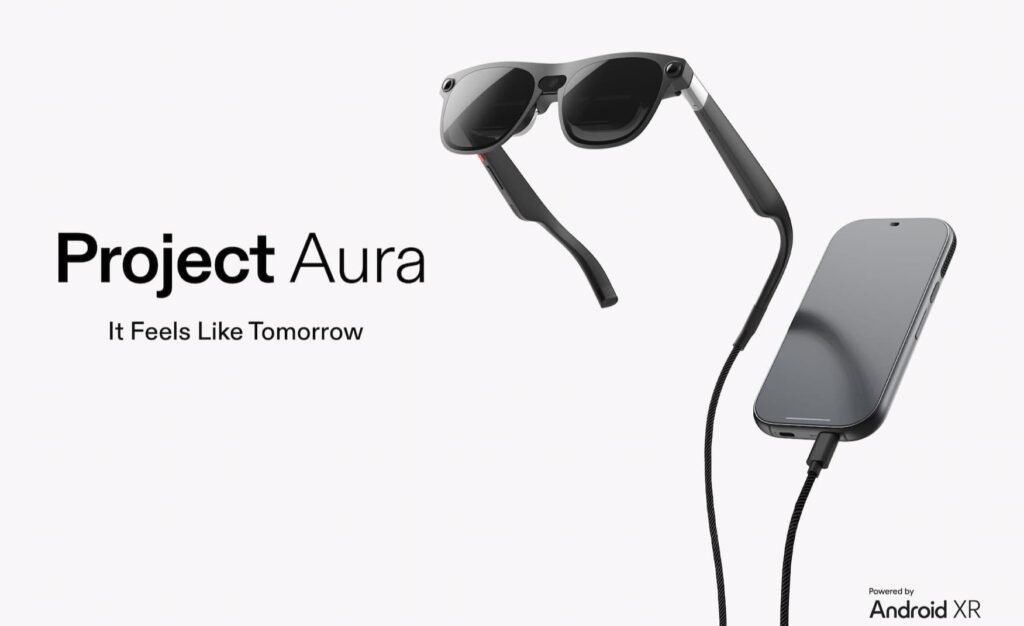

Extended reality hardware is quickly stepping out of secretive research labs and moving straight onto retail shelves. At Google I/O 2026, tech developer Xreal, alongside software giant Google, took the stage to announce that their highly anticipated “Project Aura” smart glasses, powered by Android XR, are no longer just an early prototype. Ths lightweight wearable will officially launch in global commercial markets before the end of the year.
True optical transparency meets high-end silicon on Xreal’s Project Aura
Forget about those bulky mixed reality headsets that rely on forward-facing camera feeds to display a digitized video reproduction of your surroundings. Project Aura uses an optical see-through design. This setup uses a modern generation of birdbath optics and high-resolution OLED displays to project sharp digital interface panels directly onto a shaded pair of electrochromically dimmed lenses. The setup provides a field of view of over 70 degrees. This creates a significantly larger canvas for spatial computing windows compared to previous retail models.
The internal processing hardware marks a major three-way partnership. The smart glasses combine a proprietary Xreal X1S spatial computing chip with a Qualcomm Snapdragon XR platform processor.
To keep the wearable frames exceptionally lightweight and comfortable for long-term daily usage, the engineering teams utilized a split-compute architecture. The glasses feature a wired tether that hooks into a pocket-sized external compute puck. This companion block houses the primary operating battery. It also doubles as a physical trackpad to complement the native hand and gesture tracking systems. There are three outward-facing cameras on the frames to detect the gestures.
Deep integration with Google applications and Gemini AI
Project Aura runs on Google’s brand-new Android XR operating system. So, it features native access to an entire library of specialized spatial applications. During live floor demonstrations at the developer conference, attendees tested immersive 3D spatial navigation layouts for Google Maps alongside full-screen 180-degree and 360-degree virtual reality playback frameworks for YouTube.
The most unique software capability centers on the onboard multimodal Gemini AI integration. When connected to a computer using a native DisplayPort link, the software platform automatically triggers a process called autospatialization. This workflow converts standard flat laptop applications, legacy mobile software, and traditional video assets into floating 3D windows instantly. This allows users to control their workspaces through simple conversations with the AI assistant.
Seeding the ecosystem early
For now, consumer retail pricing models remain a secret. Still, both companies are focused heavily on securing a robust catalog of launch day software. Google has officially opened public applications for its new Android XR Developer Catalyst Program. Fully functional Project Aura hardware developer kit will reach selected software teams over the coming weeks.
The post Xreal Project Aura Smart Glasses Will Ship Before the End of 2026: The Android XR Revolution appeared first on Android Headlines.