
In today’s smartphone industry, the expensive “Ultra” devices grab most of the headlines. However, due to an ongoing global memory shortage, these are becoming increasingly expensive. The situation is leading many to look towards more affordable models, and phones like the Vivo V70 aim to capitalize on this. This handset uses flagship-like build quality and aesthetics as an immediate hallmark for those who are fleeing from the most expensive models.
However, isn’t all about design. Our review of the Vivo V70 found a neat combination of key features that most buyers look for. The handset promises a high-level camera system, all-day battery life and quite capable performance thanks to the implementation of some flagship-level key components. This way, Vivo aims to offer a more affordable product, but still delivering the “complete package” without resounding compromises. Will it succeed? Keep reading to find out.

The Vivo V70 seeks to capitalize on the ongoing scenario where flagship products are becoming increasingly expensive by offering a premium coating, solvent photographic system, excellent performance and all-day battery life at a more moderate price tag.
Pros
- One of the most premium-looking phones in the segment
- High-quality OLED display at 120Hz
- Smooth performance
- Massive 6,500mAh battery with 90W wired charging support
- LPDDR5X RAM amid global memory shortage
- Good camera performance with periscope telephoto
Cons
- Some synthetic benchmarks show room for optimizacion
- The 8MP ultrawide stands out negatively in the camera system
- Some bloatware and ads by default
The manufacturer provided us with a review unit of the Vivo V70. We used it as our primary device for three weeks before writing this review, which was not sponsored.
Vivo V70: Specs
Vivo V70: Specs
| Display | AMOLED 6.59 inches, 1,260 x 2,750 px |
| Processor | Snapdragon 7 Gen 4 |
| RAM | 8GB/12GB LPDDR5X |
| Storage | 256GB/512GB |
| Battery | 6,500mAh, 90W wired charging |
| Cameras | 50MP main (f/1.9 aperture, 11/1.56″, PDAF, OIS) / 50MP periscope (f/2.7 aperture, 3x zoom, 1/1.95″, PDAF, OIS) / 8MP ultrawide (f/2.2 aperture, 115˚ FOV) |
| Colors | Golden Hour, Alpine Gray (Sand Beige), Sandalwood Brown, Canary (Lemon) Yellow, Authentic Black, Passion Red |
Vivo V70 Review: Hardware and Design
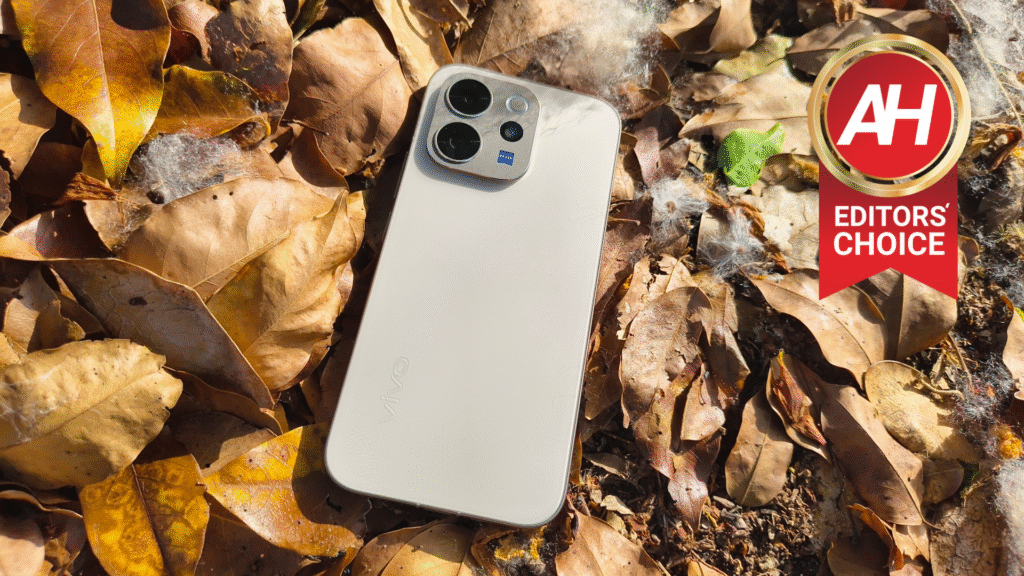
Design is a main selling point of the Vivo V70. The company has invested significant effort into making this device look and feel premium. The color nomenclature for this variant, however, is kind of complicated. The “Alpine Gray” designation suggests a cool, slate-like appearance, but instead, the finish sits somewhere between a warm sand beige and a soft gold, depending on how ambient light interacts with the surface. It’s a refined hue that moves away from aggressive gradients and glossy finishes so prevalent in the mid-range market.
Vivo uses a glass back featuring a matte finish. It feels soft, almost velvety to the touch, and successfully repels the fingerprints and smudges that constantly plague glossy devices. This ensures the phone maintains its premium look throughout the day. Even the brand logo contributes to the overall premium feel. The word “Vivo” is elegantly engraved into the lower section of the back panel using a 3D finish. When you run your finger over it, you notice a distinctly rougher texture.


Moving to the upper section, the camera island looks quite different from that of its predecessor, the Vivo V60. The V70 now houses all its sensors within a single, unified module. If you look at it quickly, you’ll find similarities to the design language of the iPhone 16 Pro. However, Vivo adds its own character through material choices. To start, the camera module is thicker than on the Apple device. Plus, it’s covered by an aluminum plate rather than the matte glass used on the rest of the body. This creates a nice contrast in color tonality, making the camera system especially stand out—something that Vivo was probably looking for in a camera-focused premium midranger. Within this aluminum module, the classic ZEISS logo sits proudly with its characteristic bright blue color.
The physical buttons—all placed on the right side of the aluminum frame—offer a firm click. Plus, the overall weight distribution feels nicely balanced in the hand. Despite the large camera module, the phone avoids feeling top-heavy. However, if you use it on flat surfaces without a cover, prepare for a “wobbly” experience due to the protuberant camera island. Of course, Vivo includes a protective case in the box.
Vivo V70 Review: Display
The Vivo V70 offers a high-quality OLED panel that easily handles diverse lighting environments. If legibility outdoors is one of your main concerns, this is a phone to consider. The 1,800 nits HBM translated into perfect visibility even under the harsh glare of direct afternoon sunlight. You will not find yourself squinting or shielding the screen with your hand to read the contents.
Beyond raw brightness, the panel excels in color reproduction. The OLED technology delivers vivid, punchy colors that make media consumption highly engaging. Skin tones appear natural in videos, while the interface elements pop with crisp saturation. Vivo provides several color profiles in the settings, allowing you to adjust the display’s “vibrancy” to your liking.


This display also stands out for its smoothness. Scrolling through long articles and interacting with social media feeds is a joy on this phone. The Vivo V70 does not present any sign of “black smearing”—a visual artifact that leaves a purple or gray trail behind moving objects at low brightness levels—reflecting the high quality of the OLED panel despite the range of the device.
The bezels surrounding the display are not only thin but also uniform. This also helps generate an aesthetic “premium” overall where every design detail seems taken care of to a minimum. The optical in-display fingerprint sensor sits at a comfortable height, allowing for quick, natural unlocking without requiring an awkward thumb stretch. Overall, the display on the Vivo V70 requires no compromises. It is bright, vibrant, fast, and free of the visual artifacts that sometimes plague non-flagship devices.
Vivo V70 Review: Performance
The Vivo V70 is powered by the Qualcomm Snapdragon 7 Gen 4 processor. This chipset firmly occupies the mid-range category, focusing on efficiency and sustained performance rather than raw, record-breaking speed. On its own, it is a highly capable piece of silicone. However, Vivo pairs this processor with a fast 12GB LPDDR5X—a welcome surprise amid a global memory crisis—and UFS 4.1 internal storage. This specific combination impacts very positively the daily performance.
In practical terms, this means the processor spends far less time waiting for data to load from the storage drive. App installations finish in seconds, loading large video files into an editing timeline happens almost instantaneously, and heavy games transition past their loading screens with flagship-level speed. The ultra-fast storage acts as a massive accelerator for the Snapdragon 7 Gen 4.
Navigating the operating system is extremely fluid. The 12GB of RAM ensures that background applications remain open and ready. It allows you to jump between a web browser, a streaming app, and the camera without experiencing any reload stutters. The phone handles heavy multitasking with great ease, while the processor provides more than enough power to drive all the features of the OS seamlessly.
Gaming performance is pretty robust. You can play demanding, graphically intensive games without problems. The device handles high-action sequences without dropping frames or freezing. However, to maintain this smooth experience in the heaviest titles, the system occasionally scales back the maximum graphical settings. You will not have to suffer through low-resolution textures or blocky character models, but you might not access the absolute highest tier of particle effects and ray-tracing features reserved for flagship GPUs.


The device can flawlessly run titles like Genshin Impact, Honkai: Star Rail, and COD: Mobile. Vivo also offers its gaming tools that allow you to tweak the hardware settings to customize your experience. For the vast majority of consumers, the gaming experience is great.


Vivo V70 Review: Benchmarks
Do the benchmarks reflect the positive impressions regarding the Vivo V70’s performance? Well, most likely yes. The device achieves good results in our usual battery of tests. However, that’s considering it’s not a performance-focused phone, but a well-rounded package.
Geekbench 6
Starting with Geekbench 6, the phone achieves more than satisfactory results. The Snapdragon 7 Gen 4 delivers more than adequate CPU performance levels, both in single-core and multi-core tasks. In this respect, the handset is on par with—or even surpasses—the vast majority of its rivals in its segment.
| Device | Single-Core | Multi-Core | GPU |
| Vivo V70 | 1,341 | 4,231 | 4,875 |
| Google Pixel 9a | 1,705 | 4,416 | 7,721 |
| Redmi Note 15 Pro+ 5G | 1,237 | 3,193 | 3,531 |
AnTuTu V11
In AnTuTu, the V70 achieved a very respectable overall score of 1,453,984. Again, while this figure is far from competing with modern flagships, it puts it at the top of its segment.
| Device | Score |
|---|---|
| Vivo V70 | 1,453,984 |
| Google Pixel 9a | 1,253,414 |
| Redmi Note 15 Pro+ 5G | 1,048,401 |
3DMark’s Wildlife Extreme Stress Test
In the most demanding test of our set, the Vivo V70 exhibited somewhat peculiar behavior. On the one hand, in terms of raw performance, the device once again stood out as a powerful midranger. However, for unknown reasons, the stability score obtained after the tests left much to be desired. This suggests that there is still room for optimization on Vivo’s part.
| Device | Best Loop | Lowest Loop | Stability |
| Vivo V70 | 2,097 | 1,342 | 64% |
| Google Pixel 9a | 2,634 | 1,795 | 68.2% |
| Redmi Note 15 Pro+ 5G | 1,106 | 1,099 | 99,4% |
Vivo V70 Review: Thermals
The Vivo V70 is one of those phones that never feels too hot. The chipset choice and effective VC cooling are likely responsible for this. Whether gaming, recording video, taking photos, or simply using it all day, the device stayed admirably cool. Only synthetic benchmarks triggered temperatures above normal on this device. Considering that it is not a particularly thick handset and the massive size of its battery, it seems that Vivo did a great job in terms of thermals.
Below are the figures for the maximum temperature reached during the benchmarks:
| Benchmark | Temperature |
|---|---|
| Geekbench | 33,7 °C/92,66 °F |
| 3D Mark Extreme Stress Test | 44,1 °C/111,38 °F |
| Antutu | 40,1 °C/104,18 °F |
And these were the temperatures reached during continuous video recording (4K/60 fps):
| Device | 5 minutes | 10 minutes |
| Vivo V70 | 37,6 °C/99,68 °F | 41,3 °C/106,34 °F |
| Google Pixel 9a | 34,16 °C/93,5 °F | 37,56 °C/99,6 °F |
| Redmi Note 15 Pro+ 5G | 33,2 °C/91,76 °F | 34,4 °C/93,92 °F |
Vivo V70 Review: Battery Life and Charging
The Vivo V70 benefits greatly from the efficient architecture of the Snapdragon 7 Gen 4 chipset. The device houses a massive 6,500mAh battery capacity that, during our testing period, consistently delivered reliable all-day performance.
A typical day involving several hours of Spotify streaming, constant messaging, a solid hour of GPS navigation, and frequent use of the camera system usually concluded with a comfortable thirty percent charge remaining by late evening. The standby power consumption is particularly low, ensuring the phone loses barely any charge if left unplugged overnight. You can trust this device to get you from a morning commute to an evening dinner without inducing battery anxiety. If you’re not a heavy user, this battery can easily last even more than a day.
Despite the cell size, you won’t have to wait several hours to fully charge it. This device supports 90W wired fast charging, allowing you to get a full battery in under an hour. Charging speed may vary slightly depending on factors such as starting point and ambient temperature. Still, the average full charge time remained around one hour in our tests.
The thermal management we observed during performance benchmarks also extends to the charging process. The phone regulates the charging current to prevent excessive heat buildup, protecting the long-term health and degradation curve of the battery cell.
Vivo V70 Review: Software
The Vivo V70 runs on Android 16-based OriginOS 6. The skin, formerly known as Funtouch, has received a lot of refinement and optimization work in recent years. While it remains highly customizable, there’s a cleaner, more streamlined approach with the global audience in mind. Don’t get it the wrong way; this iOS isn’t a Google Pixel—nor does it try to be. However, compared to previous versions of the software, the “cleaning up” work the brand has been doing is noticeable. We can say that the software on the V70 feels “mature,” something that several custom skins of Chinese origin lacked until a few years ago.
One of the aspects Vivo has put a lot of effort into is the animations. Opening folders, swiping between home screens, and pulling down the notification shade all happen with buttery smoothness. Overall, the system rarely stutters, reflecting excellent optimization between the software code and the Snapdragon processor. You can also customize the animations for actions like swiping right/left on the home screen, turning the screen on/off, and even the visual effect of the fingerprint reader pointer.
OriginOS 6 also includes a variety of smart features designed to enhance daily usability. The multitasking capabilities are robust, enabling easy split-screen usage and floating windows, which genuinely benefit from the expansive 12GB of RAM. The software aggressively manages background power consumption, which aids battery life, but it does so without overly restricting essential notifications from messaging apps.
As with most modern phones, there’s a suite of AI-powered tools. Fortunately, these can be quite useful rather than just gimmicks. You’ll find a writing assistant that can generate text for you or transform your messages into different tones. There’s also AI Call Translation and AI-powered subtitles for any video playing. For AI image editing, the V70 offers the classic object/subject eraser, image extender, and quality enhancer.


One area where mid-range devices often face criticism is the inclusion of pre-installed third-party applications. The Vivo V70 does come with several pre-loaded apps and games out of the box. While you can uninstall the majority of this software during your initial setup, it adds a few minutes of housekeeping before you achieve a completely clean app drawer. Despite this minor annoyance, the overall software experience is highly positive. Last, but not least, Vivo also provides a respectable commitment to future Android version updates (4 major Android upgrades).
Vivo V70 Review: Camera
The ZEISS-powered photographic capabilities of the Vivo V70 represent one of its core selling points. The hardware configuration on the rear aluminum island features three distinct lenses.

Main sensor
The main sensor is the true star of the show. In daylight environments, the level of detail captured by this lens is quite remarkable for a device operating in the premium mid-range segment. The images are sharp, displaying natural color science that avoids the aggressive oversaturation often seen in competing brands. The dynamic range control is highly competent on the vast majority of occasions. When photographing high-contrast scenes, such as a shaded street with a bright sky in the background, the sensor successfully preserves details in the shadows without completely blowing out the highlights.


When the light goes down, the main sensor holds its ground nicely. The detail remains decent, and the noise reduction algorithms work well to keep the image clean. However, the lens is prone to capturing more reflections than desirable in scenarios with prominent artificial lightning. Occasionally, this results in a slight “fog effect” or glare across the image. It does not ruin every night shot, but it requires the user to be slightly more mindful of their framing.


3x periscope telephoto
If the main sensor is the star, the 3x periscope telephoto lens is a worthy “deuteragonist.” For starters, finding a true periscope zoom in the mid-range is rare, and its performance here is highly competent. In daylight, the 3x optical zoom delivers solid results that bring distant subjects closer without the digital artifacting of standard digital zoom. The level of detail and absolute sharpness does not quite reach the heights of a pseudo-flagship like last year’s Vivo X200 FE (Review). This difference is normal and expected; higher-tier devices benefit from superior Image Signal Processors (ISPs) and more advanced computational algorithms. Still, it will be difficult for you to find a better zoom camera in this specific segment.


Another good thing about having a capable periscope lens is that, thanks to the power of computational photography, you can get decent results at zoom levels beyond the sensor’s native optical range. Is this possible on the Vivo V70? Well, it is, occasionally. Below you can see some shots at 10x zoom. The results can be convincing at first glance, although they depend heavily on the subject. The results will be better on less complex surfaces (less textured).


Ultrawide camera
The final sensor in the array is an 8MP ultrawide lens. This one is far less exciting and seems included simply to fulfill a requirement on the spec sheet. In bright daylight, it can produce decent results suitable for sharing on social media, capturing wide landscapes or large group photos.


However, once the lights drop, the level of detail decreases noticeably. The images become soft, and the dynamic range struggles to keep up with the primary sensors. This ultrawide sensor pales in comparison to the rest of the photographic system. Integrating a slightly larger, higher-resolution ultrawide sensor would have rounded out the camera array. As it stands, the camera system is a tale of two excellent lenses carrying a mediocre third.


Should You Buy the Vivo V70?
The Vivo V70 appeals strongly to the senses, prioritizing a premium look and feel. Design-wise, the premium matte glass, the uniquely textured 3D logo, and the slim bezels—in addition to being symmetrical—make the phone feel significantly more expensive.
Beyond its looks, the Vivo V70 delivers excellent daily performance. The decision to pair the Snapdragon 7 Gen 4 with ultra-fast UFS 4.1 storage and 12GB of LPDDR5X RAM was a success. You’ll find an extremely fluid user experience avoiding annoying load times or multitasking bottlenecks. The bright, 1,800-nit OLED display is perfectly visible even under intense sunlight.
The camera system, co-engineered with ZEISS, offers a compelling reason to purchase this device. The main sensor takes beautiful, detailed pictures with a wide dynamic range, and the 3x periscope telephoto lens gives you a real optical zoom experience that you don’t often find at this price. While the 8MP ultrawide lens is quite underwhelming, the overall photographic package remains highly competitive.
You should buy the Vivo V70 if:
- You are looking for the most premium design possible in its segment.
- You’re looking for a device that offers a capable and versatile camera system with a true optical zoom periscope lens.
- You’re looking for a great display experience even in bright sunlight, a battery that easily lasts all day, and performance that can handle virtually anything.
You should not buy the Vivo V70 if:
- Your primary requirement is capturing expansive, high-detail ultrawide landscapes.
- If you’re seeking the absolute maximum frame rates on the highest graphical settings in the most demanding games.
- You’re looking for a phone on the “budget” mid-range side.
The post Vivo V70 Review: The ZEISS-Powered Gold Standard for Premium Mid-Range appeared first on Android Headlines.