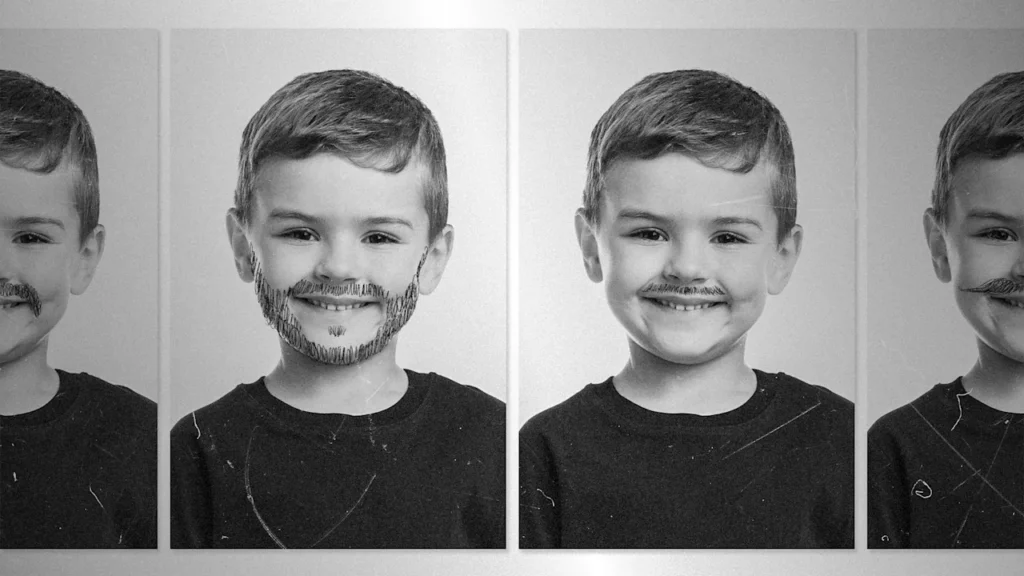
For those who think a fake mustache is not fooling anybody, think again.
Since 2023, the United Kingdom’s Online Safety Act has tasked social media and search engine companies with protecting young users by restricting harmful content and even resorting to age verification to access platforms.
But unsurprisingly, the tech-savvy young generation is already developing ingenuous ways to jump through the extra sets of hoops.
A recent study by Internet Matters, a British child online safety organization, found that around one-third of children in the UK have bypassed safety measures like age verification.
The safeguard often requires users to take a selfie or show a valid ID to verify their age.
“I did catch my son using an eyebrow pencil to draw a mustache on his face, and it verified him as 15 years old,” an anonymous mother of a 12-year-old boy told Internet Matters.
“I have helped my son get around them”
The survey polled 1,000 children and their parents, with 46% of those surveyed believing that age checks are easy to bypass.
Some shared more high-tech alternatives to fool the system, like turning to AI to distort their face to appear older, or using video game characters to reveal an older face.
But sometimes kids don’t even have to get creative. They can simply ask for help, with 17% of parents helping their children bypass age checks.
“I have helped my son get around them. It was to play a game, and I knew the game, and I was happy and confident that I was fine with him playing it,” a parent revealed.
Many agree that the restrictions, while intended for good, don’t do much to keep users safe. One kid even shared how unreliable the safeguards can be, even when one is not trying to trick the system.
“On Roblox there’s a thing where you put your face in and only allowed to chat with that age group . . . I got 15 when I’m 12, so I’m chatting with people older than me when I shouldn’t be,” a 12-year-old said.
But the creative techniques employed by kids are garnering attention and laughs online.
“All that fancy age verification tech &millions spent… &kids just draw a fake mustache,” one user said on X. “Clever little legends.”
The study also reveals that the gaps in the system expose young users to harmful content. Almost half of the children surveyed reported that they’d experienced harm online, with 11% seeing unrealistic body types promoted and 10% reporting hateful content like homophobia or slurs.
Additionally, 12% reported seeing violence online, particularly inadvertently seeing videos related to the assassination of Charlie Kirk.
It’s not just parents surveyed who are concerned. In response to the study, users on social media also shared their discontent toward tech companies that build systems that so easily fail.
“A fake mustache getting past age verification systems that billion dollar companies built is genuinely one of the funniest and most embarrassing tech failures in recent memory,” a user said on X. “The people who designed these systems need to sit in a room and have a serious conversation.”