
During the Victorian era, innovators made huge leaps with optical technologies. It was the period of the stereoscope and an early projector known as the magic lantern, not to mention one in which eyeglasses became more affordable and entering the mainstream. These advances also influenced scientific inquiry, making microscopes more powerful, and the pursuit of microscopy enabled researchers and enthusiasts to discover creatures invisible to the naked eye.
One of these enthusiasts was London-based educator and amateur scientist Charles Thomas Hudson. Along with other scholars and aficionados, he participated in interest groups. “As President of the Royal Microscopical Society and a Fellow of the Royal Society, Hudson was a leading figure in this growing scientific community,” says a statement from Osh Gallery, which is currently exhibiting a collection of unique illustrations in The Hudson Transparencies.

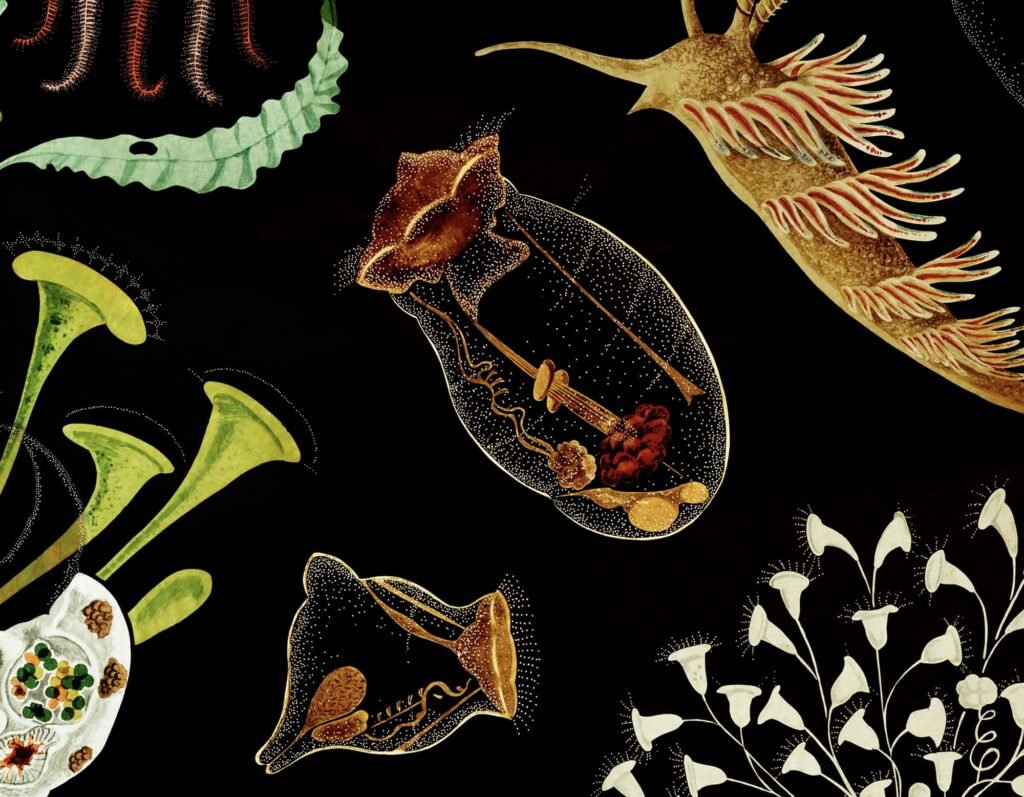
Curated by Luke Powell and Jody Hudson-Powell of design firm Pentagram, which runs Osh Gallery, the exhibition literally brings to light a number of colorful transparencies that Hudson used during his lectures. While they appear dark and even unfinished in a typical setting, “when lit from behind these intricate works transform into magical visions of life previously only glimpsed when viewed under a microscope,” the gallery says.
The Hudson Transparencies includes 58 original transparencies that measure a surprisingly large 37.8 by 29.5 inches. Each of the graphics’ proportions are “the equivalent of drawing ants the size of elephants,” says a statement. The animals and botanicals emerge through a combination of painted paper and perforations, which are made with lines and clusters of pinholes.
Hudson was particularly fascinated by rotifers, a phylum of zooplankton named for their so-called “wheel-bearing” characteristics. He also catalogued algae, protozoa, and larvae—such as that of the mayfly with its feather-like tail. Microscopic marine organisms were a particular favorite, though, and these back-lit images highlight the convergence of science and spectacular visuals that not only brought these creatures to life in a unique way for 19th-century viewers but continue to awe us today.
The Hudson Transparencies continues through June 11 in London. You might also enjoy Martin Kunz’s turn-of-the-century tactile graphics and Lorenz Oken’s seminal natural history work, Allgemaine Naturgeschichte Für Alle Stände.


Do stories and artists like this matter to you? Become a Colossal Member today and support independent arts publishing for as little as $7 per month. The article Vibrant Victorian-Era Transparencies Illuminate a Host of Microscopic Creatures appeared first on Colossal.