

Everyone knows that being a working mom is hard. Working from home, part-time, full-time with an hour-long commute — it’s all tough. But depending on where you live, being a working mom might be a little easier (or a lot tougher) than for other moms.
The United States is clearly behind when it comes to progress — especially for mothers. And of course that trickles down to working moms, what with our lack of federal maternity leave and childcare costs. But each state has its own laws and regulations, and a working mom’s location can make all the difference in if she’s able to feel supported.
WalletHub looked at the data and compared key factors for working moms’ success — what childcare looks like in each state, the professional opportunities, and how the work-life balance shakes out. Each of these metrics was broken down into a points scoring system. For example, when scoring how childcare looks in each state, WalletHub gave points for everything from the quality of the school systems in that particular state to how many childcare workers are in each daycare center.
Here’s how the states ranked overall for the best versus worst states for working moms. (1 is best, 51 is worst.)
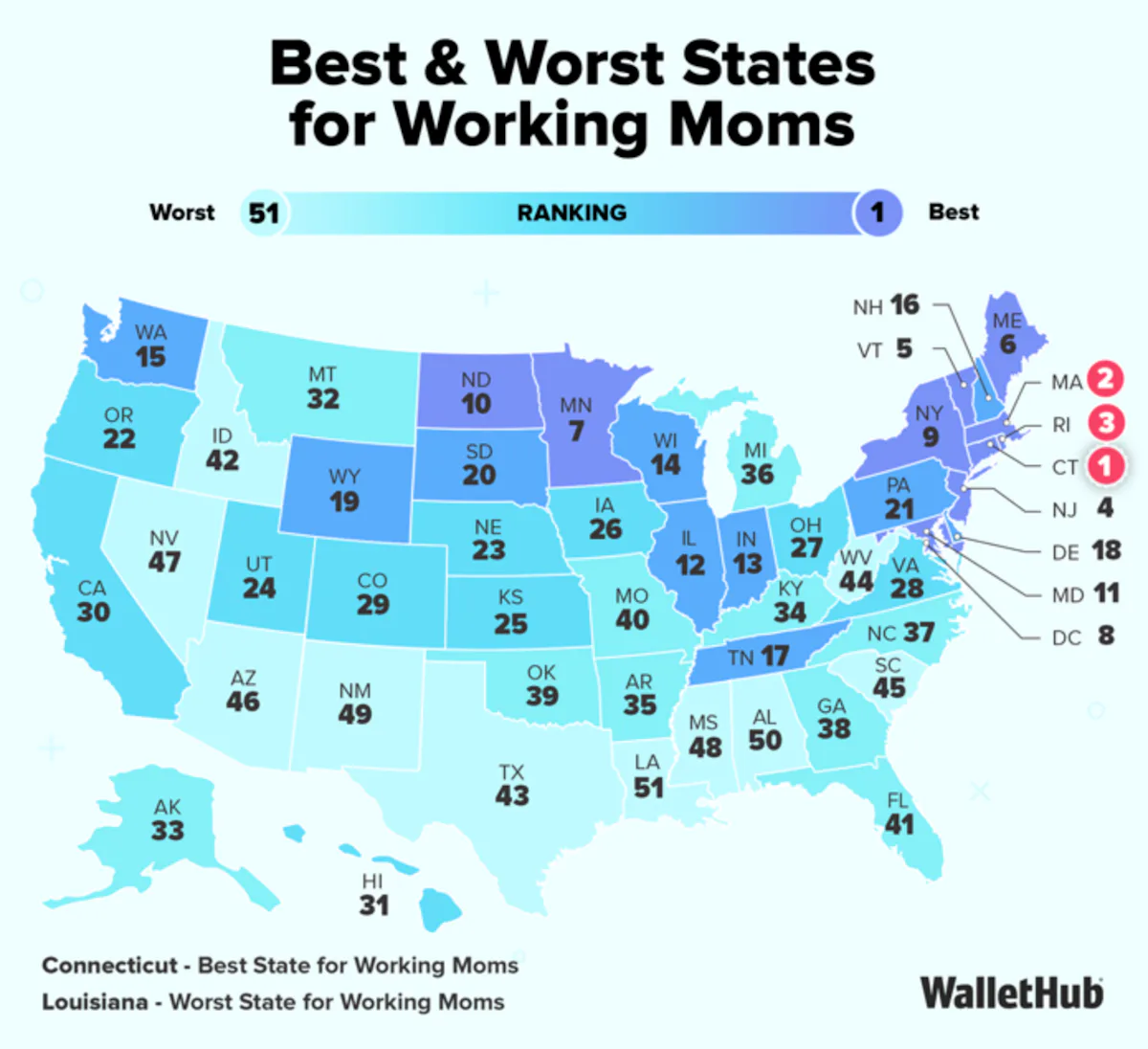
But we all know affordable childcare is hard. We all know finding good working opportunities for mothers (for women!) is hard.
It’s the work-life balance per state that got me the most.
In some states where they scored high on childcare and even professional opportunities, they might still score low on work-life balance. The scores were ranked 1 to 51, with 1 being the best in each category.
In Maryland, for example, WalletHub gave them a score of 15 for childcare and a 1 for professional opportunities. Great! But then Maryland has a 44 for work-life balance. How can a state be #1 in professional opportunities and in the top 50% for childcare in the country, but be one of the worst for a work-life balance?
WalletHub used this rubric for work-life balance scoring:
- Parental-Leave Policy Score: Double Weight (~15.00 Points)
- Average Length of a Woman’s Work Week (in Hours): Full Weight (~7.50 Points)
- Women’s Average Commute Time (in Minutes): Full Weight (~7.50 Points)
And with that system, these were the top 10 work-life balance states for working moms:
- Massachusetts
- Washington
- Rhode Island
- Oregon
- California
- District of Columbia
- New Jersey
- Connecticut
- Vermont
- Wisconsin
And the bottom 10 work-life balance states for working moms:
- Georgia
- Mississippi
- Tennessee
- Texas
- Florida
- Nevada
- South Carolina
- Maryland
- Alabama
- Virginia
You know, there’s a mixture in some of these, but that red-blue divide is hard to miss.
The thing is, even with a great childcare system and a great job, the work-life balance for working moms can feel impossible. As the WalletHub scoring system found, a terrible commute (especially in states with rural areas and high traffic areas — looking at you, Atlanta) can really make or break how a mom feels about her job at the end of the day. It’s not enough that we don’t get federally mandated maternity leave or any help from the government with childcare costs and systems — we still have to make it to our jobs and then make it home with a good attitude and plenty of energy for our children.
And a bad work-life balance can really suck the joy out of both a job you love and the family you adore.
Rachel Wu, Ph.D., Associate Professor with the Department of Psychology at University of California, Riverside, commented on the WalletHub findings and noted that jobs with “very strict schedules, especially ones that interfere with daycare/school drop-off and pick-up times” can deeply affect that work-life balance. It’s the strain and stress of ending your work day and then rushing across town to pick up your kids — and then the day still doesn’t stop.
And professor of political science at St. Lawrence University, Dr. Grace Huang, pointed out that while a lot of people think a “high-powered career” like a lawyer or a manager affects work-life balance, it’s those types of careers that can usually make their day-to-day hours and expectations a little more flexible once they reach a senior level. “Jobs that do not provide a living wage are clearly difficult for work-family balance as families need to work even longer hours or multiple jobs simply to survive,” she noted.
It’s not just the ability to come home and be home — it’s all the little things stacked on top that affect a work-life balance. Worrying about your kids’ childcare situation because you can’t afford the daycare closest to your work, so you have to leave extra early in the morning. Worrying about how you’ll have enough time during your lunch break to go to the grocery store because you won’t be home in time to grab something and cook it for dinner before sports practice starts. Worrying about how you can stretch that paycheck when gas prices are rising and you have a 25-mile commute because you live in a rural area.
And all of it is connected — the job opportunities, the childcare available. That’s why some states can have great places of employment for working moms, but still score low on a work-life balance.
Until we start making some big changes country-wide, I’m afraid this kind of split between red states and blue states, between HCOL areas and LCOL areas, will always be.


