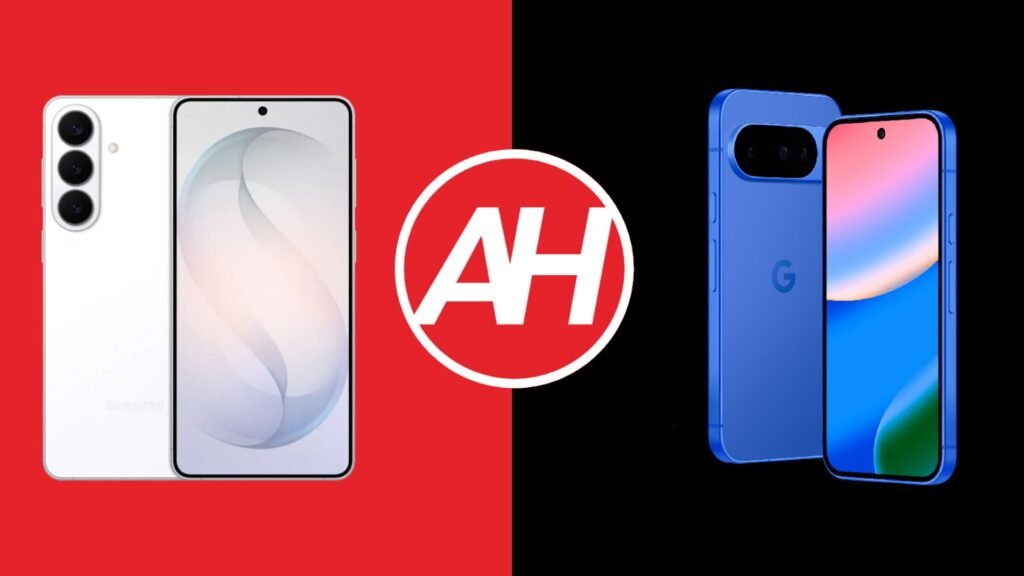

Today, we’ll be comparing phones from Samsung and Google. To be more accurate, we’ll compare the Samsung Galaxy S26+ vs Google Pixel 10. Neither of these two phones is a flagship device, but they’re members of the flagship smartphone series, that’s for sure. The Galaxy S26+ is larger, and they’re actually quite different in quite a few ways. There are some similarities, though, but very few.
As we usually do when it comes to comparisons, we’ll first list the specs of both smartphones. Following that, we’ll compare their designs, displays, performance, battery life, cameras, and audio output. As already said, there are quite a few differences here, so there’s plenty to talk about. Let’s get to it.
Specs

Samsung Galaxy S26+

Google Pixel 10
| Samsung Galaxy S26+ | Google Pixel 10 | |
|---|---|---|
| Dimensions | 158.4 x 75.8 x 7.3 mm | 152.8 x 72 x 8.6mm |
| Weight | 190 grams | 204 grams |
| Display | 6.7-inch Dynamic LTPO AMOLED 2X | 6.3-inch Actua OLED display |
| Refresh rate | 1-120Hz (adaptive) | 120Hz |
| Resolution | 3120 x 1440 | 2424 x 1080 |
| Chipset | Qualcomm Snapdragon 8 Elite Gen 5 for Galaxy / Samsung Exynos 2600 | Google Tensor G5 |
| RAM | 8GB/12GB | 12GB (LPDDR5X) |
| Storage | 256GB/512GB (UFS 4.0) | 128GB/256GB |
| Main camera | 50MP (wide, f/1.8 aperture, 1/1.56-inch sensor size, 1.0um pixel size, dual pixel PDAF, OIS) | 48MP (f/1.7 aperture, 1/2.0-inch sensor size, 82-degree FoV) |
| Ultra-wide camera | 12MP (f/2.2 aperture, 1/2.55-inch sensor size, 120-degree FoV, 1.4um pixel size) | 13MP (f/2.2 aperture, 1/3.1-inch sensor size, 120-degree FoV) |
| Telephoto camera | 10MP (f/2.4 aperture, 1/3.94-inch sensor size, 1.0um pixel size, PDAF, OIS, 3x optical zoom) | 10.8MP (f/3.1 aperture, 1/3.2-inch sensor size, 5x optical zoom, 23-degree FoV) |
| Periscope telephoto camera | N/A | N/A |
| Selfie camera | 12MP (f/2.2 aperture, 1/3.2-inch sensor size, 1.12um pixel size) | 10.5MP (f/2.2 aperture, 95-degree FoV) |
| Battery size | 4,900mAh | 4,970mAh |
| Charging | 25W wired, 20W wireless (Qi2 Ready), 4.5W reverse wireless (charger not included) | 30W wired, 15W Qi2 wireless (charger not included) |
| Colors | Cobalt Violet, Sky Blue, Black, White, Silver Shadow, Pink Gold | Indigo, Frost, Lemongrass, Obsidian |
Samsung Galaxy S26+ vs Google Pixel 10: Design
You can easily tell these two phones apart when you look at them, even from the front. Yes, they both have flat displays with a centered display camera hole up top and rounded corners. However, the camera hole on the Galaxy S26+ is considerably smaller, the bezels are thinner, and the corner curvature is less pronounced than on the Pixel 10. Both phones do have uniform bezels, though.
They’re both made out of aluminum and glass. The frame on both devices is flat all around, while curving a bit towards the corners for comfort’s sake. It turns out this is the best way to handle frames, the most comfortable way, which is why basically everyone is doing it these days. Both phones include physical buttons on the right-hand side, but the positioning is different, though. The Galaxy S26+ includes a power/lock key below the volume up and down buttons, while it’s the other way around on the Pixel 10.
What about the back side? Well, both phones include a flat backplate there, with different camera setups. The Galaxy S26+ includes three vertically-aligned cameras in the top-left corner. Those cameras sit on top of a camera island. The Pixel 10, on the other hand, has a horizontal visor on the back, a pill-shaped one. It’s located at the top of the back side, and it includes three cameras as well. The Galaxy S26+ does wobble on a tabletop, while the Pixel 10 does not.
Both phones are quite slippery, though, so take that into account. The Galaxy S26+ is taller, wider, and thinner in comparison. That is not surprising considering that it has a noticeably larger display. Samsung’s phone is also a bit lighter, by 14 grams, which is a bit surprising despite the fact it has a slightly smaller battery.
Samsung Galaxy S26+ vs Google Pixel 10: Display
The Samsung Galaxy S26+ features a 6.7-inch Dynamic LTPO AMOLED 2X display. That panel is flat, and it has an adaptive refresh rate of up to 120Hz. HDR10+ content is supported, while the peak brightness is 2,600 nits. The screen-to-body ratio is around 91%. The display aspect ratio is 19.5:9, while the resolution here is 3120 x 1440 pixels. Corning’s Gorilla Glass Victus 2 protects this display.

The Google Pixel 10, on the other hand, has a 6.3-inch OLED display. That display is also flat, while it supports a refresh rate of up to 120Hz. HDR10+ content is supported, while the peak brightness is 3,000 nits. The screen-to-body ratio is around 86%, while the resolution is 2424 x 1080 pixels. The display aspect ratio is 20:9, while the Gorilla Glass Victus 2 from Corning protects this display.
Both of these displays are quite good. They are both vivid and bright enough, while the viewing angles are very good on both of them as well. Now, the Galaxy S26+ does have several advantages in comparison, though. It has thinner bezels, so the display is more immersive, while it is also sharper in comparison. Not many people will notice that, however. On top of all that, it’s also an LTPO display, so it should be more power efficient.
Samsung Galaxy S26+ vs Google Pixel 10: Performance
The Samsung Galaxy S26+ comes in two SoC options. One variant is fueled by the Snapdragon 8 Elite Gen 5 for Galaxy processor, a 3nm chip from Qualcomm. The other model is fueled by the Exynos 2600 chip, a 2nm processor from Samsung. Both of these chips are flagship offerings from their respective companies. They’re paired with 12GB of LPDDR5X RAM here, and UFS 4.0 flash storage, which is not expandable.
The Google Pixel 10, on the other hand, is fueled by the Google Tensor G5 processor. That is a 3nm chip, and the very best Google has to offer at the moment. It’s the first Tensor chip manufactured by TSMC. That processor is paired with 12GB of LPDDR5X RAM and UFS 3.1 or UFS 4.0 flash storage. Its 128GB storage model uses UFS 3.1, while the 256GB storage variant utilizes UFS 4.0. The storage is not expandable.
Both of these smartphones offer good performance on a day-to-day basis. However, it’s undeniable that the Galaxy S26+ is more powerful, and that it’s also snappier. You definitely notice that when you use the two devices side-by-side. The Pixel 10 is plenty fast, though, no doubt about that. While both of them can run demanding games, the Galaxy S26+ will offer better performance, technically.
Samsung Galaxy S26+ vs Google Pixel 10: Battery
Samsung opted to include a 4,900mAh battery inside the Galaxy S26+. Google, on the other hand, included a 4,970mAh battery in the Pixel 10. Neither of these two battery packs is particularly large in terms of capacity, though the Pixel 10 does have a noticeably smaller display. Neither company uses silicon-carbon tech at this point in time, by the way, which explains these battery capacities.
With that being said, despite having a slightly smaller battery and a larger display, the Galaxy S26+ offers more in terms of battery longevity. In fact, it offers quite a bit more. We were able to squeeze out around 1.5-2 hours of extra screen-on time from the device more often than not. Samsung apparently did a great job with optimization, or that chip on the inside is making a difference, or both. Either way, the Galaxy S26+ does offer a noticeably better battery life.
Samsung’s phone will also charge faster. It supports 45W wired, 20W wireless, and 4.5W reverse wireless charging. The Pixel 10, on the other hand, supports 30W wired, 15W wireless, and reverse wired charging. The Galaxy S26+ can reach a full charge in an hour, while it will take the Pixel 10 around an hour and a half. Do note that neither phone ships with a charger in the box, though.
Samsung Galaxy S26+ vs Google Pixel 10: Cameras
The Samsung Galaxy S26+ has three cameras on the back. A 50-megapixel main camera (1/1.56-inch sensor size) is backed by a 12-megapixel ultrawide camera (1/2.55-inch sensor size, 120-degree FoV). The third, and last camera on the back is a 10-megapixel telephoto unit (1/3.94-inch sensor size, 3x optical zoom). This camera hardware is pretty dated, as Samsung has been using it since the Galaxy S22.

The Google Pixel 10, on the other hand, also has three cameras on the back. Its main camera is a 48-megapixel unit (1/2.0-inch sensor size), while there is also a 13-megapixel ultrawide camera (1/3.1-inch sensor size, 120-degree FoV) placed on the back. The last camera on the back is a 10.8-megapixel telephoto snapper (1/3.2-inch sensor size, 5x optical zoom). These camera sensors are not particularly impressive either. The Pixel 10 is considerably more affordable, though.
Both phones do a good job in the photography department, but they cannot compete with the best camera smartphones out there. The Pixel 10 prefers more contrasty shots, like we’re used to seeing from Google. The company’s image processing does the heavy lifting here. The Galaxy S26+ is usually closer to what you’re actually seeing, but it’s far from great. As already mentioned, both camera setups will be good enough for most people.
Audio
When it comes to speakers, both phones include stereo setups. The speakers on the Google Pixel 10 are a bit louder in comparison, but the difference is not that big. Both setups offer good audio output.
There is no audio jack on either one of these two smartphones. You can, however, connect your wired headphones via the Type-C ports at the bottom. Alternatively, Bluetooth 6.0 is supported by both devices.
The post Phone Comparisons: Samsung Galaxy S26+ vs Google Pixel 10 appeared first on Android Headlines.