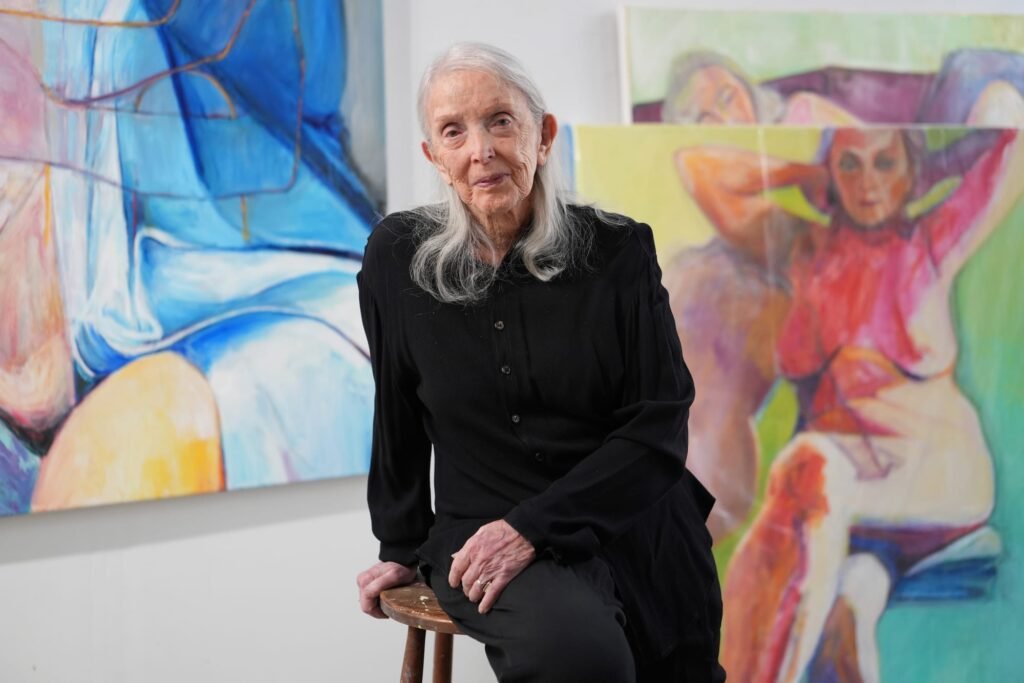
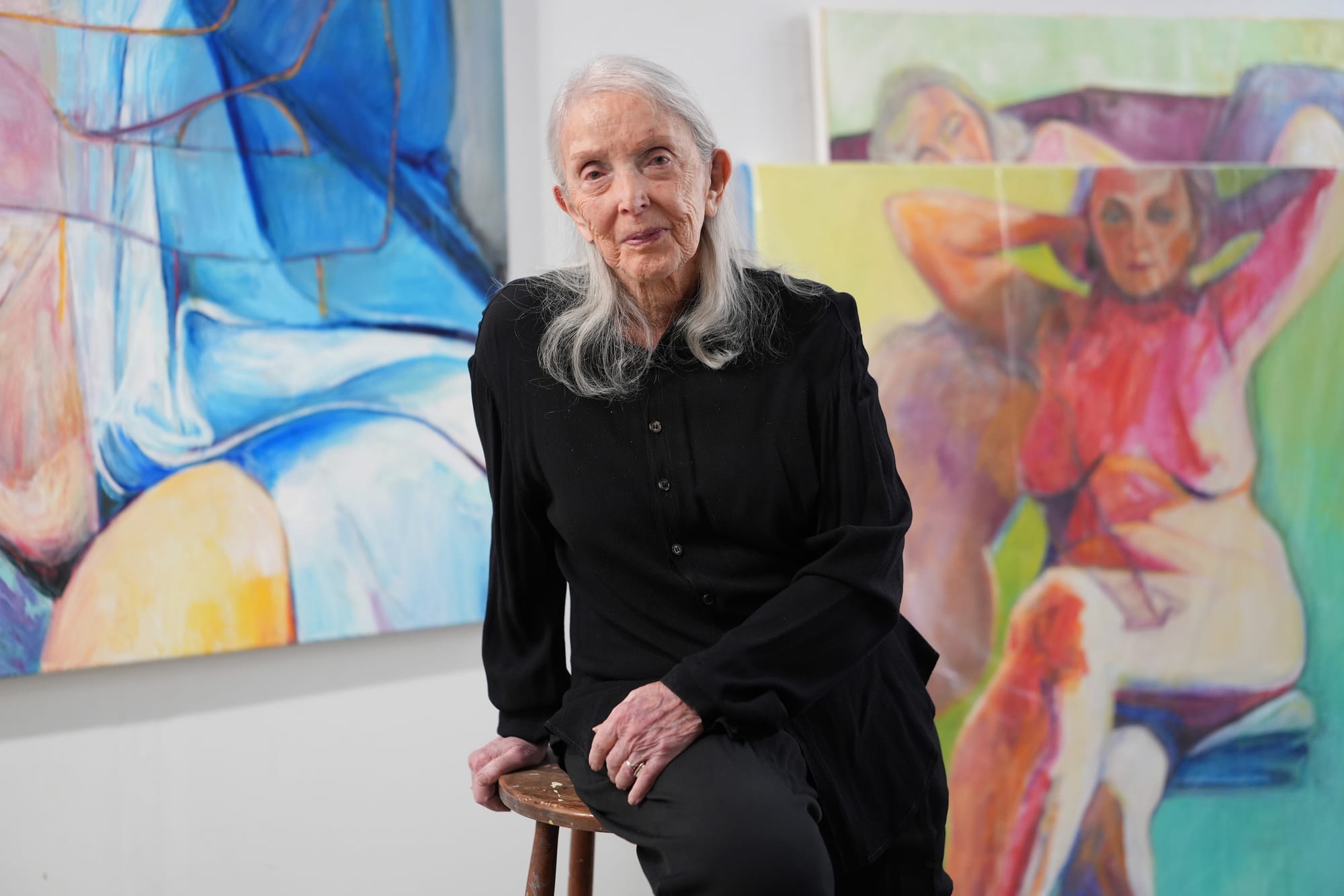
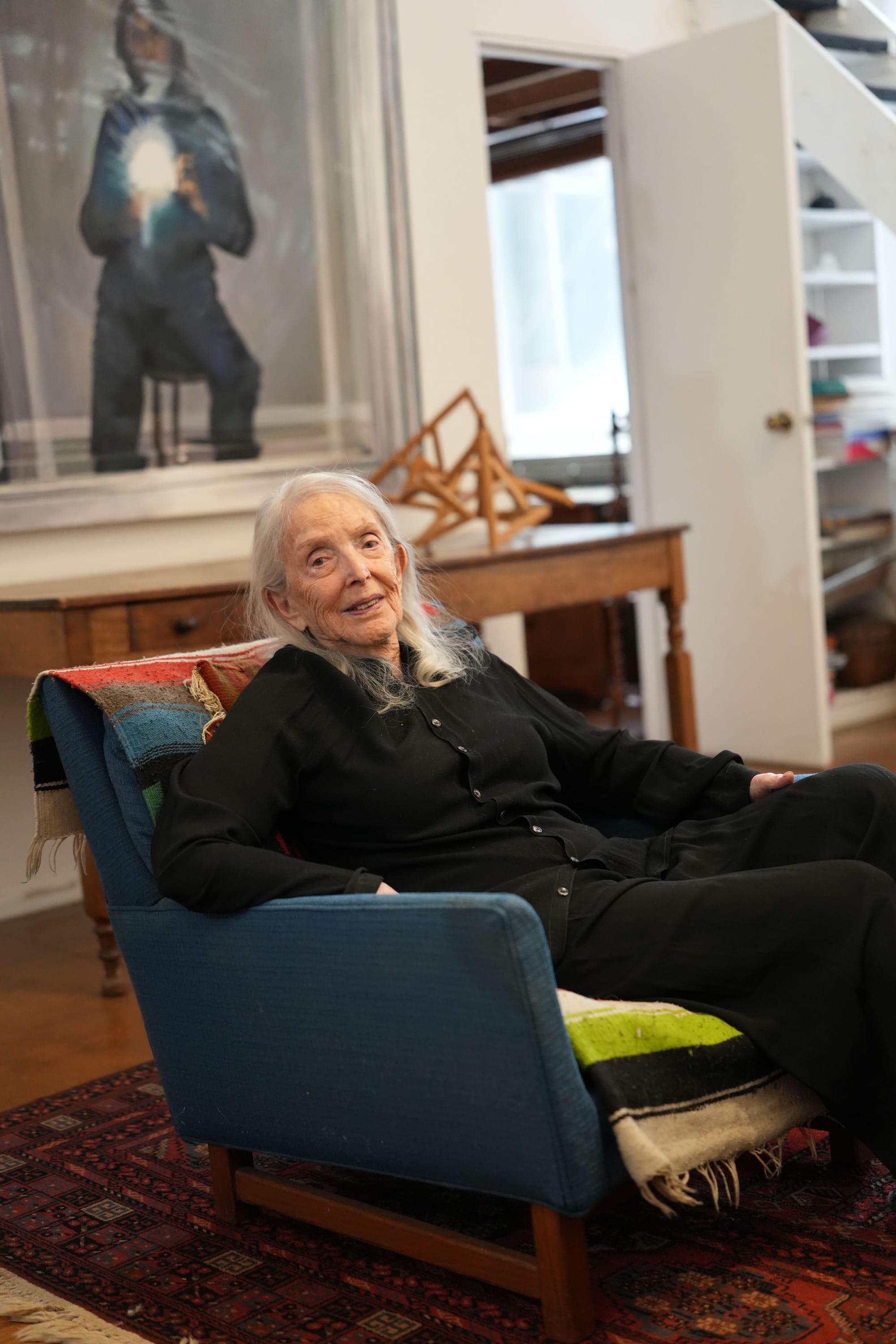
The first thing one encounters upon entering Joan Semmel’s Soho loft is an eerie oil self-portrait of the artist sitting on a stool, the flash of her camera exploding in a ring of light. Her silver-framed work, “Mirrored Screen” (2005), rests on a wall near the entrance of her second-floor Spring Street studio, where she has lived and worked for more than half a century. It almost looks like a mirror when Semmel stands in front of it, with her arched eyebrows and dark eyes, although her long, dark, wavy hair is now gray, streaked with white.
The piece is part of a series on locker rooms she made more than 20 years ago, when she was interested in narcissism in popular culture. Her fitness center on nearby Bleecker Street seemed like an ideal place to explore the subject as seen through other people’s bodies, so she brought a point-and-shoot film camera and asked permission to snap pictures of fellow artists and dancers while they changed. She positioned herself behind her subjects, aiming her lens at their reflection in a mirror so they wouldn’t pose for the shot. Once she developed the film, she found she had accidentally appeared in the frame as the flash went off. The result was a prescient 21st-century viewpoint.
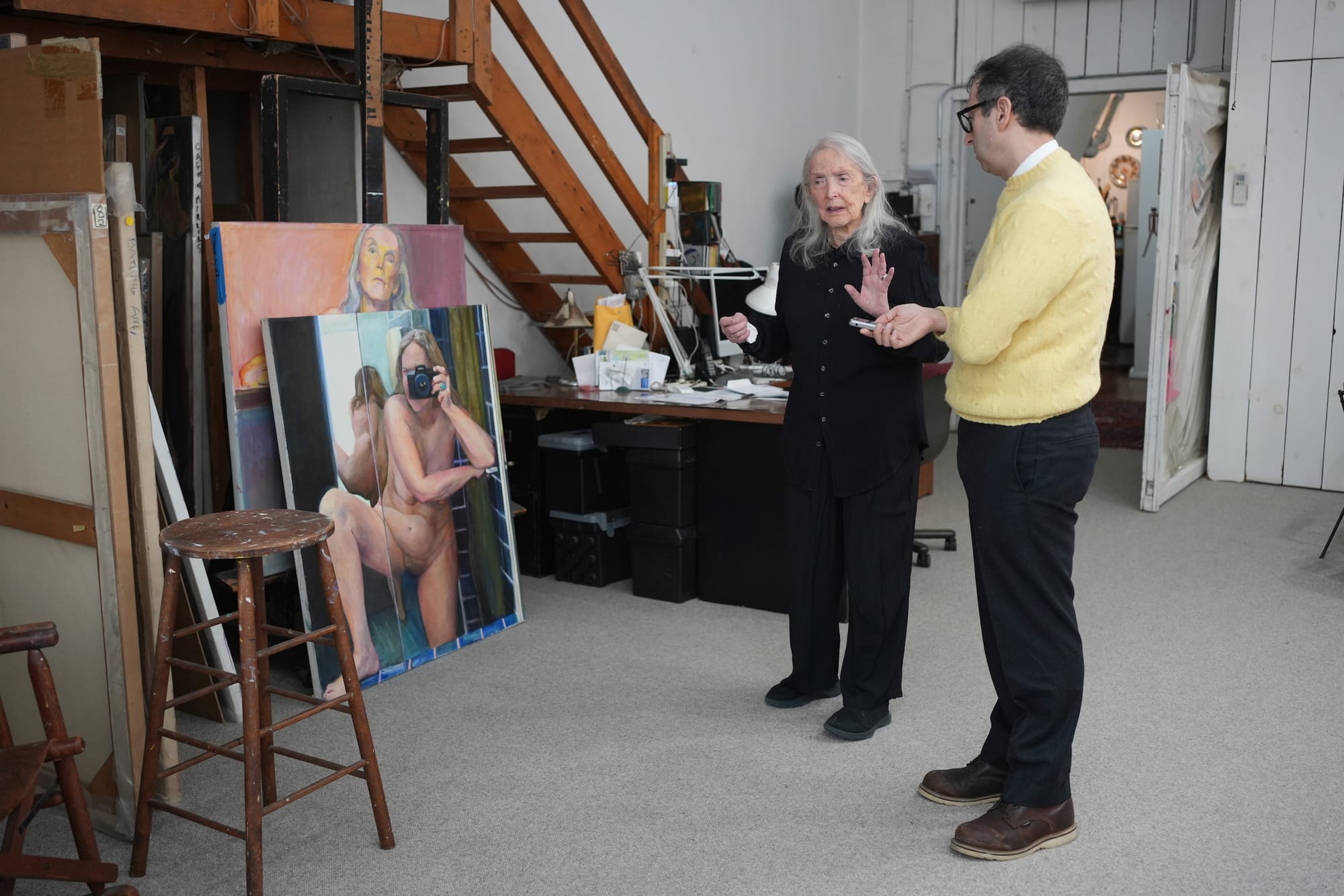
“The camera was being pointed in the mirror so you got an angle, and I was naked, because I was part of what they were doing,” said Semmel, dressed in a black button-down shirt and flowy black trousers, during a visit to her studio. “So that’s how I got to do the selfies with the mirror.”
Semmel’s portraits are increasingly in demand at the moment. Two recent Alexander Gray shows, a retrospective at the Pennsylvania Academy of the Fine Arts in 2021, and an Xavier Hufkens show in Brussels in 2024 helped spark renewed interest among the broader public. Another survey of her work, Joan Semmel: In the Flesh, is currently on view at the Jewish Museum through May, while Alexander Gray opens its ninth exhibition of her work, Continuities, today, April 17.
Yet Semmel remains surprised when young people tell her how much her work has meant to them.
“I’m told how I’ve been an inspiration to them, and of course, it’s very flattering to hear,” she said. “I never started out to be an inspiration. I started out to just do what I’ve tried to do. It’s just because I got to be 93 years old, and I’m still talking.”
Joan Semmel was born in 1932 to a secular Jewish family in the Bronx. Her father had few aspirations for her other than to grow up and “have babies,” she said. Semmel wanted to pursue a career in the arts and found like-minded friends while studying at the Cooper Union and the Art Students League of New York.
She got married at 19 in 1952 and had a daughter, Patricia, soon after, while living in Bayside, Queens. But it wasn’t until five years later, when she was hospitalized for tuberculosis for several months, away from her family, that she began to reassess her life’s direction.
“That’s when I finally was able to break the family restrictions and say, ‘No, this is not where I’m going. This is not what I want,’” she said.
In 1963, Semmel and her family moved to Madrid and had a son, Andrew. There, she found herself among a far wider social circle than she had in the outer boroughs. While she first became interested in the avant-garde at Cooper Union, contemporary artists in Spain approached abstract art in a different way, incorporating sandy and dark muted colors while making nuanced political statements to pass government censors during Francisco Franco’s fascist regime. That influenced her own abstract work, pushing her into a more structured abstraction.
She returned to New York, moving into her Spring Street studio in 1970, but found little connection with many of the minimalist, conceptual works by male artists dominating the art world at the time. Newly divorced and in her mid-30s, Semmel became fascinated with sexuality, but was unsettled by a commercialization of women’s bodies in art and culture that veered toward exploitation.
“A lot of pornography dealt with power rather than erotic stimulation, and that power is what was interesting about pornography for men,” she said. “I wanted to make sexuality an empowerment for women rather than a disempowerment.”
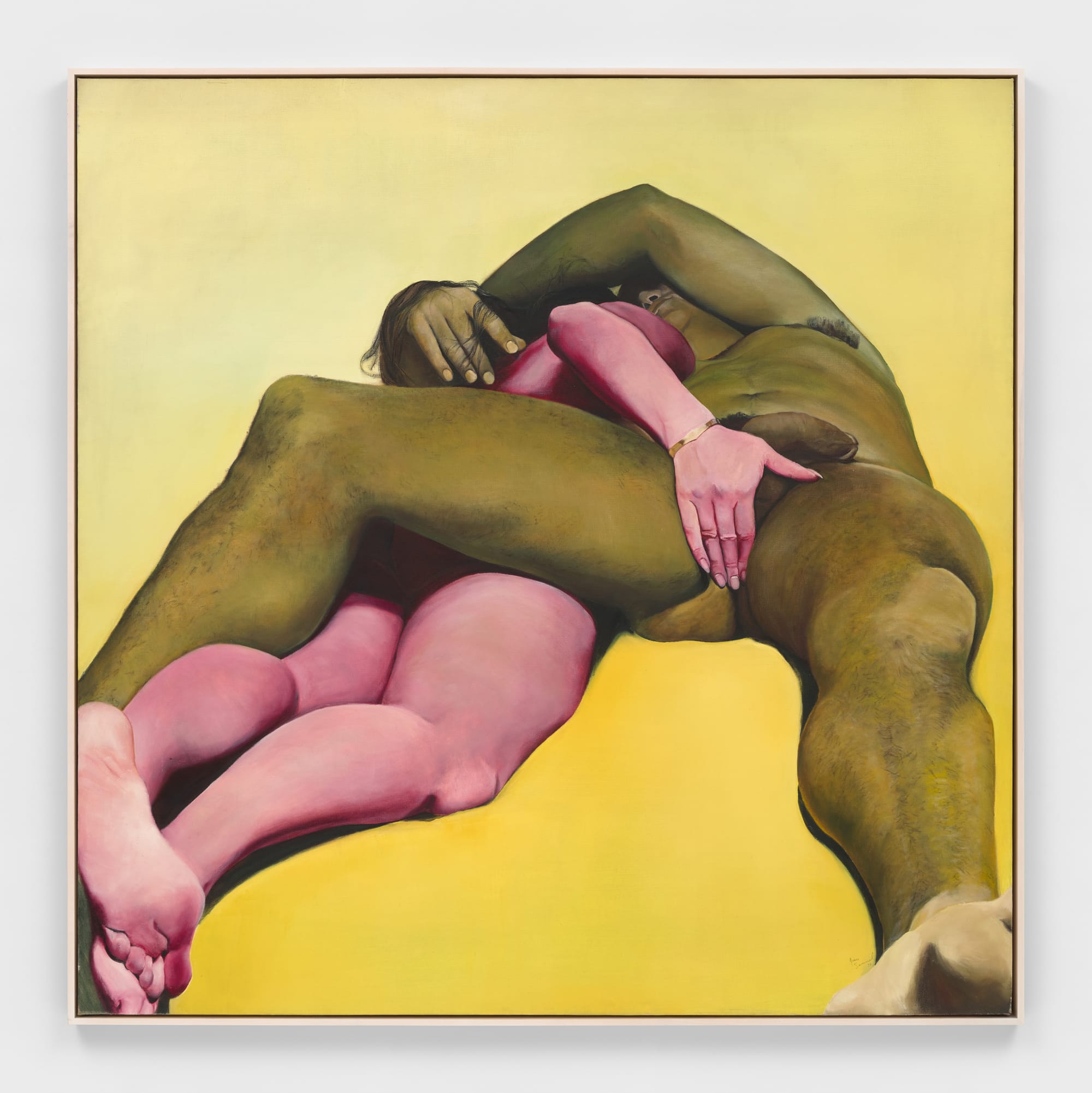
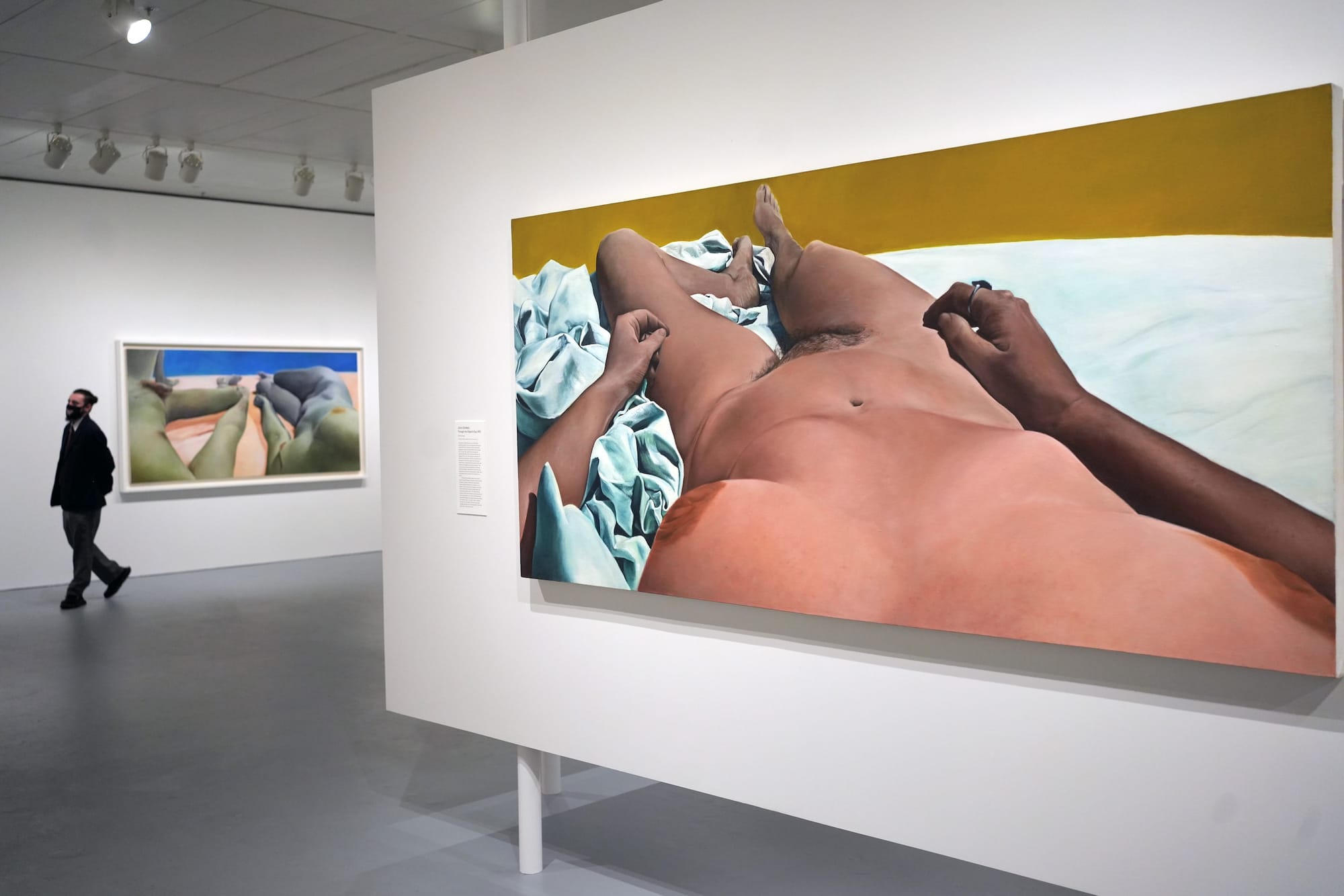
Semmel began making sketches of couples and used her camera to record intimate sex acts that she turned into boldly colorful, closely cropped paintings. The resulting works, which became her now widely celebrated Erotic Series (1972–73), radically shifted perspective from the male gaze toward a woman’s view.
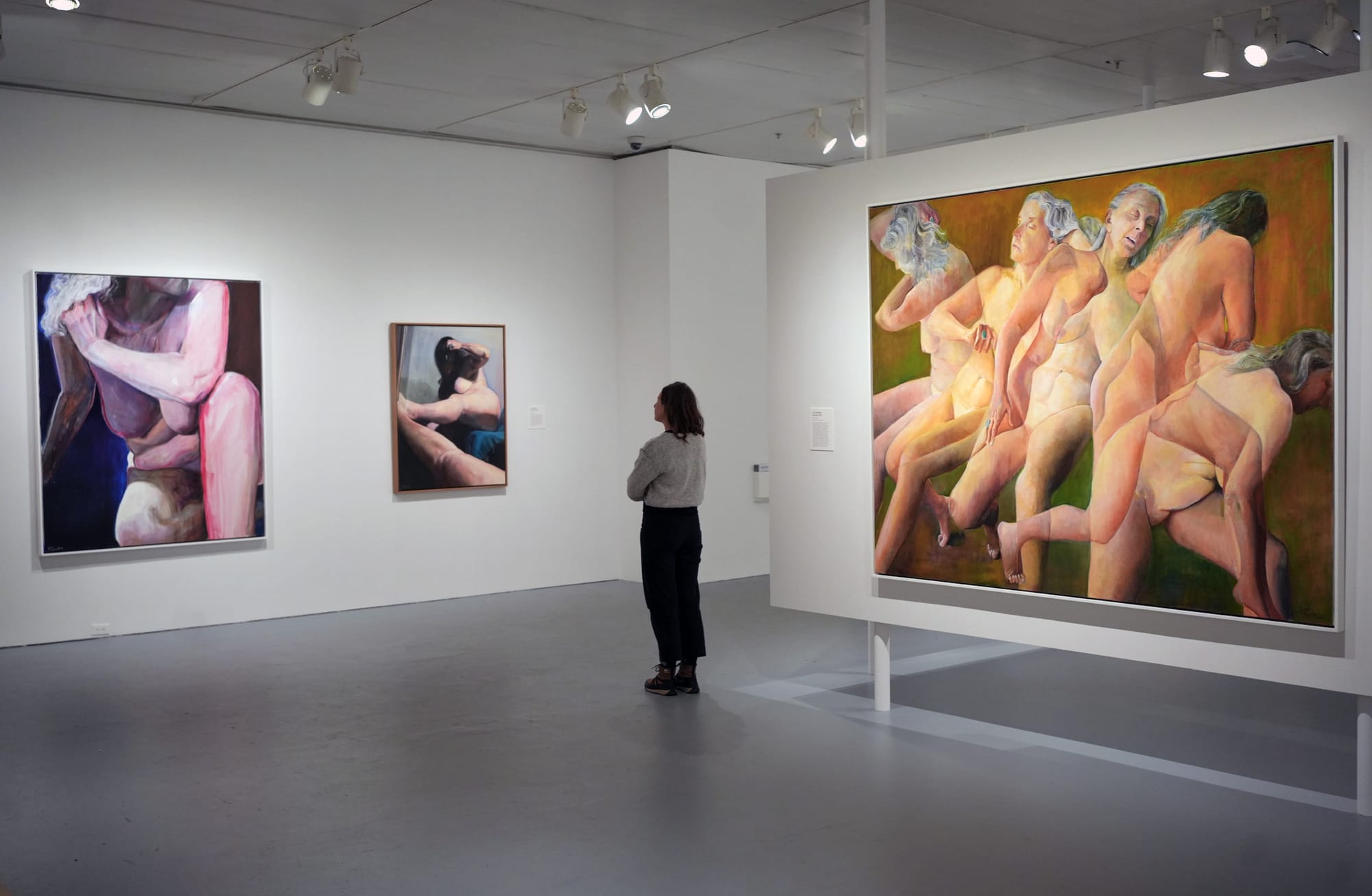
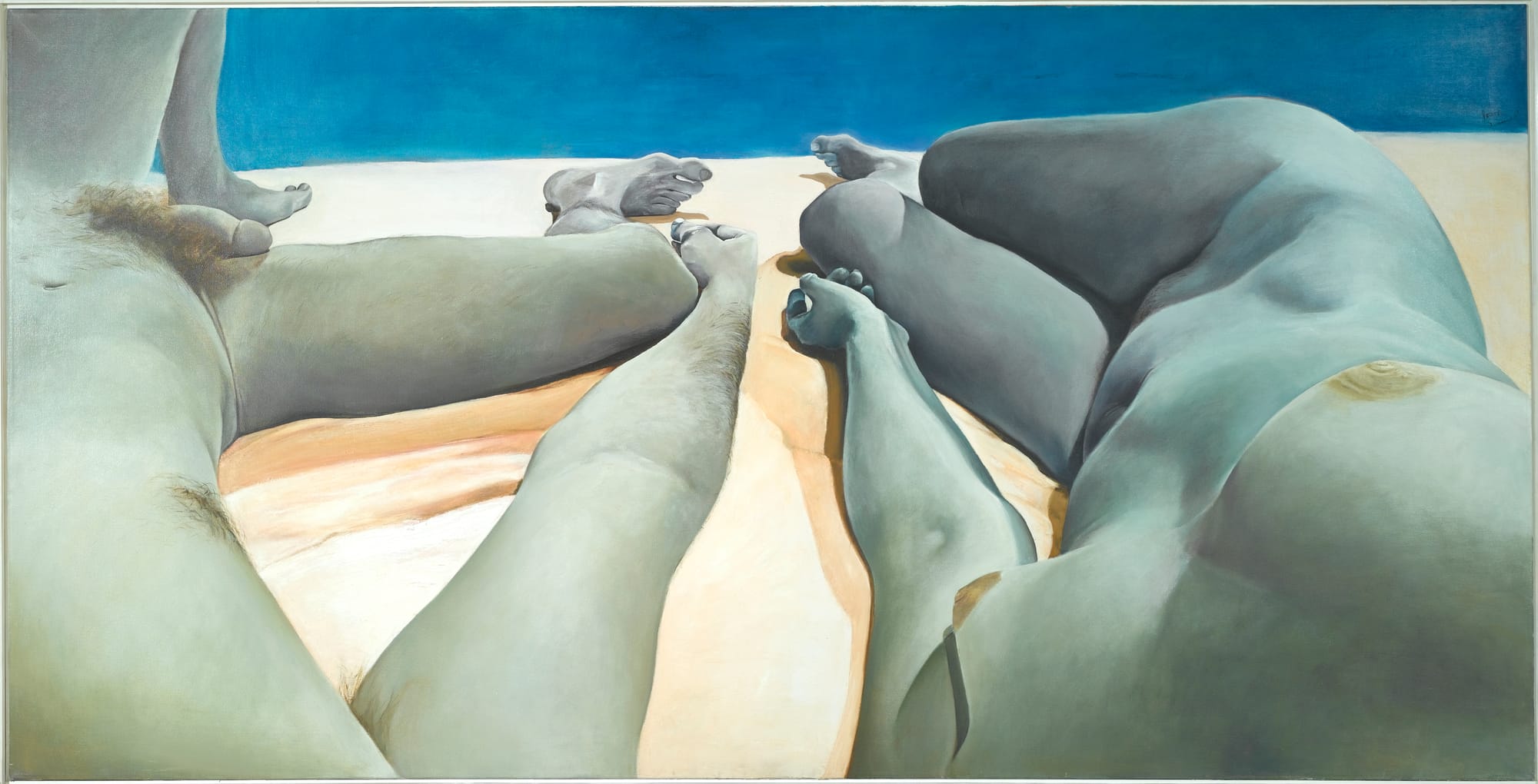
Semmel also began photographing herself and her partner before collaging the images, so each figure had its own vanishing point. Her 1974 painting “Intimacy Autonomy,” on view at the Jewish Museum, evokes a western landscape with a far-off horizon, with bodies as a mountain range and the wall at the end of a bed as the sky.
“It was a feminist statement,” she said. “I wanted to deal with some of the issues that were important in sexuality that had to do with intimacy and connectedness.”
During this period, she found a large community of feminist artists in Manhattan, including Joyce Kozloff, Nancy Spero, Judith Bernstein, Li-Lan, and Harmony Hammond. But she still had trouble selling her work in galleries, where her works were seen as provocative, and she had few professional connections. She eventually rented a space down the street from her studio and launched her own exhibition in 1973.
“On one hand, you say, ‘What am I doing wrong?’ On the other hand, you say, ‘Fuck you. I’m good and you’re wrong,’” she said. “Who’s right? I don’t know. But it’s like, ‘This is who I am, this is what I do, and this is what I care about.’ So you just keep doing it.”
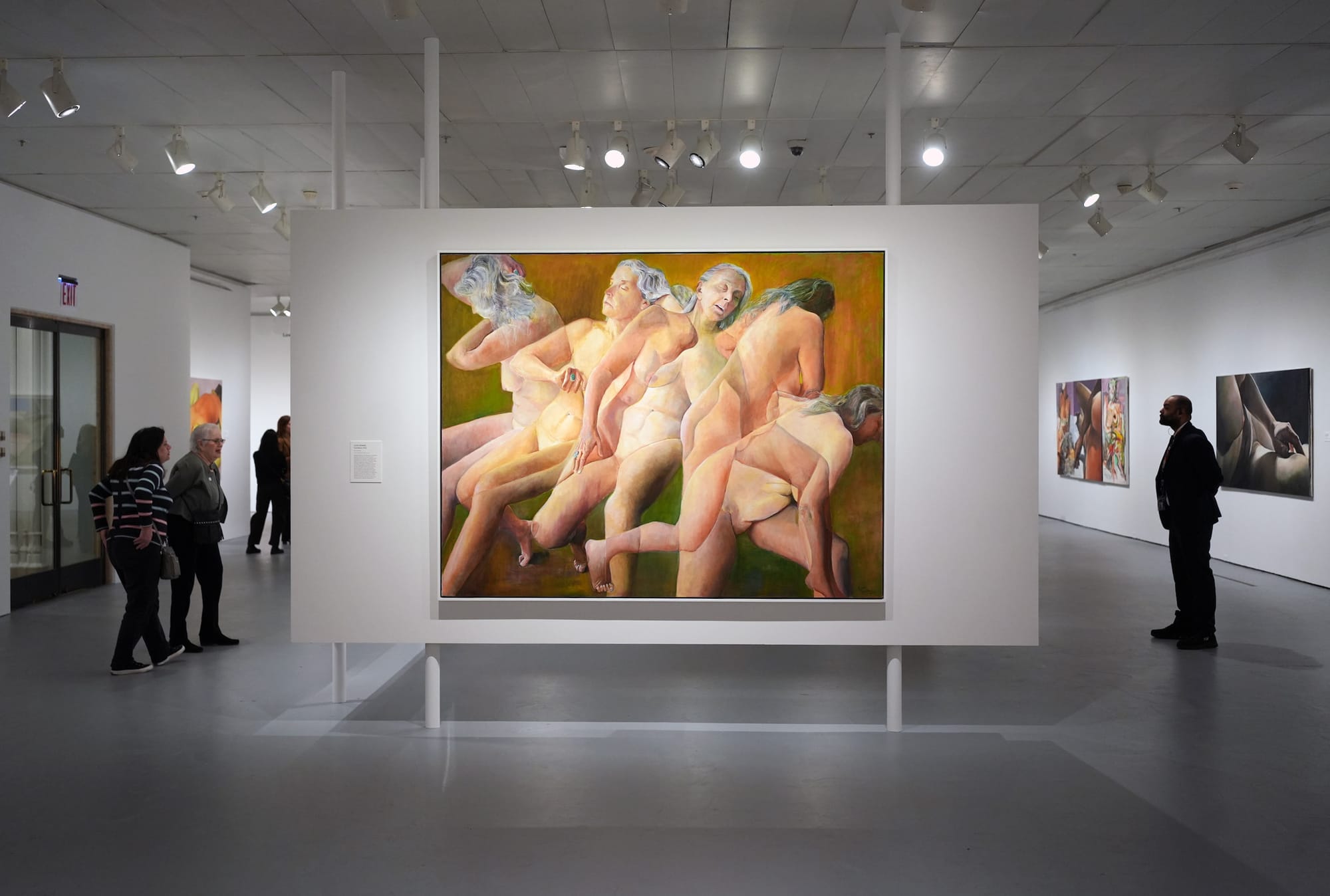
By the 1980s, Semmel began to make a series of self-images, deploying the same photographic techniques in her earlier paintings. Far more personal, the portraits centered on a woman living her life as an agentive person in the world.
“I was trying to hammer at the image of the woman as a powerful figure — biologically, figuratively, in every way,” she said. “I don’t want to flatten the image. I want the image to come out into your space.”
Hundreds of portraits later, Semmel continues to take up space. Her home contains a handful of intimate artworks that she created over different periods of her life above an unfinished wooden table, a comfy overstuffed couch, a Persian rug, and a shelf containing an assortment of African figurines — accumulated from ex-boyfriends, she said. Light streams through three large windows facing Spring Street to the right of the entrance, where three new works lean against the room’s spare white walls. She stores another 50 canvases and many discards in a loft, a collection she intersperses with several newer works.
She believes her most recent paintings on display at Alexander Gray this spring, including “Blue Space” (2025), a nude double figure seated in front of a saturated background that suggests the duality of seeing and being seen, and “Satin Wrap” (2026), a cropped, partially nude robed figure, are among the best she has ever made.
She has begun to reflect on the astonishing breadth of her practice as well. When her retrospective in Philadelphia, arranged chronologically, opened, her friend approached her and said she wanted to cry.
“She said, ‘You really, really did something.’ And that’s how I felt too. I felt, ‘Okay, I really did something,’” Semmel said. “You’re not supposed to say that about yourself, I suppose. But that’s how I felt. And I’m still doing it.”