LOS ANGELES — After years of planning, construction, ballooning budgets, and design changes, the Los Angeles County Museum of Art’s (LACMA) new building will finally open this weekend. Spearheaded by the museum’s director, Michael Govan, the ambitious project not only transforms much of LACMA’s hodgepodge campus into a single, sinuous structure but also aims to challenge what an encyclopedic museum can be, renouncing traditional museological divisions in favor of thematic connections across time and space.
“Nineteenth-century museums were a lot about categorization and knowledge, but we live in modern Los Angeles, where migration and interconnectedness are so essential to our daily life,” Govan told a crowd at a press preview this week.
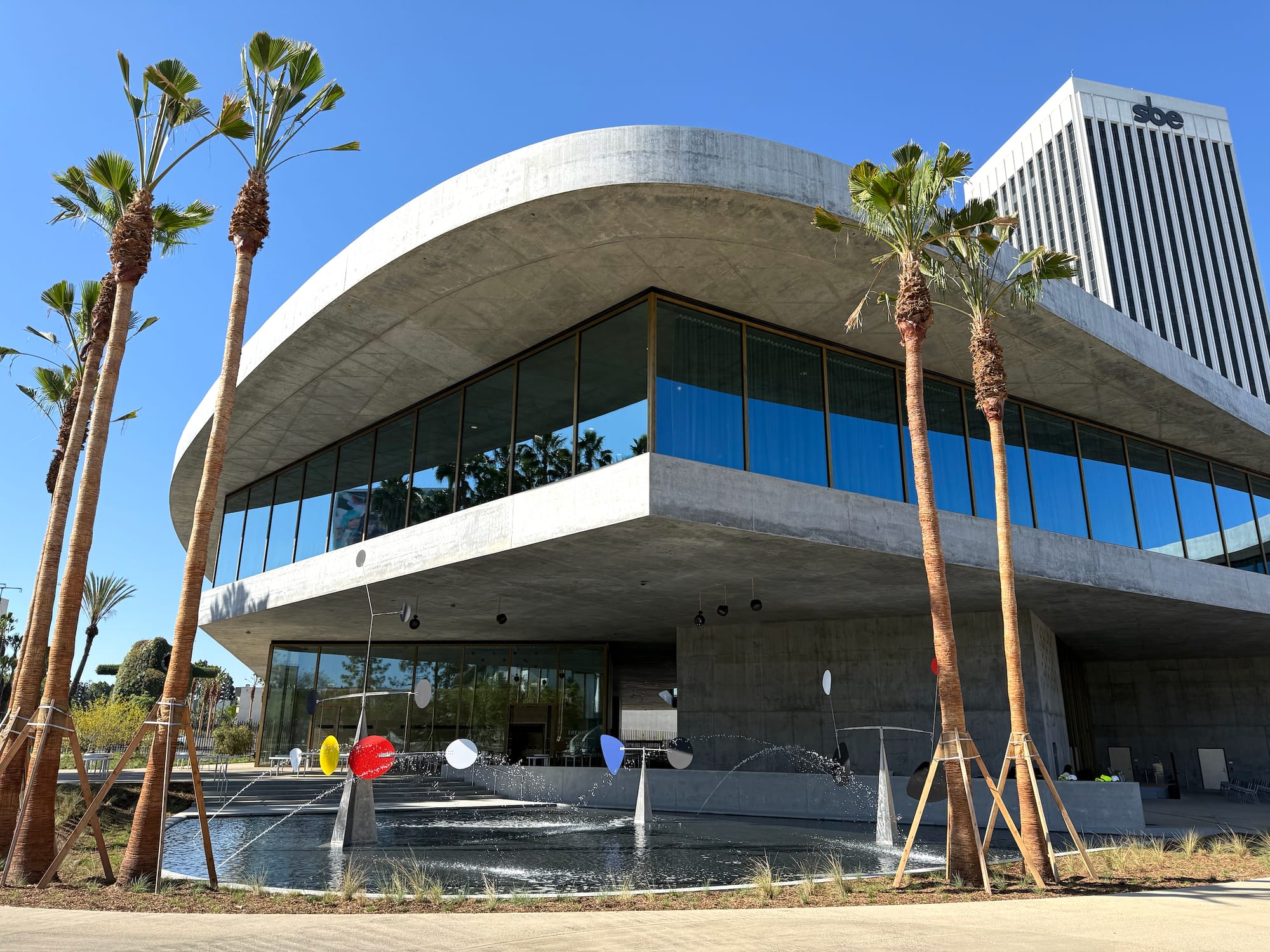
Along the way, LACMA has been the subject of endless debate and controversy, as critics have attacked everything from its blob-like, grey, concrete form that pours across Wilshire Boulevard (Swiss architect Peter Zumthor’s first building in the US) to its staggering $720 million budget (up from an initial $650 million) and the fact that it has less exhibition space than the buildings it replaced. Its curatorial approach has also been the subject of scrutiny: The Ahmanson Foundation, longtime donors, stopped giving art to the museum in 2020 over concerns about LACMA’s new direction. At the same time, Govan has worked tirelessly to drum up support — and money — for the building, securing $150 million from media mogul David Geffen, for whom the new galleries are named, in the largest individual cash donation in the museum’s history. Elaine Wynn, who passed away last year, gave $50 million, and $125 million came from LA County taxpayer funds.
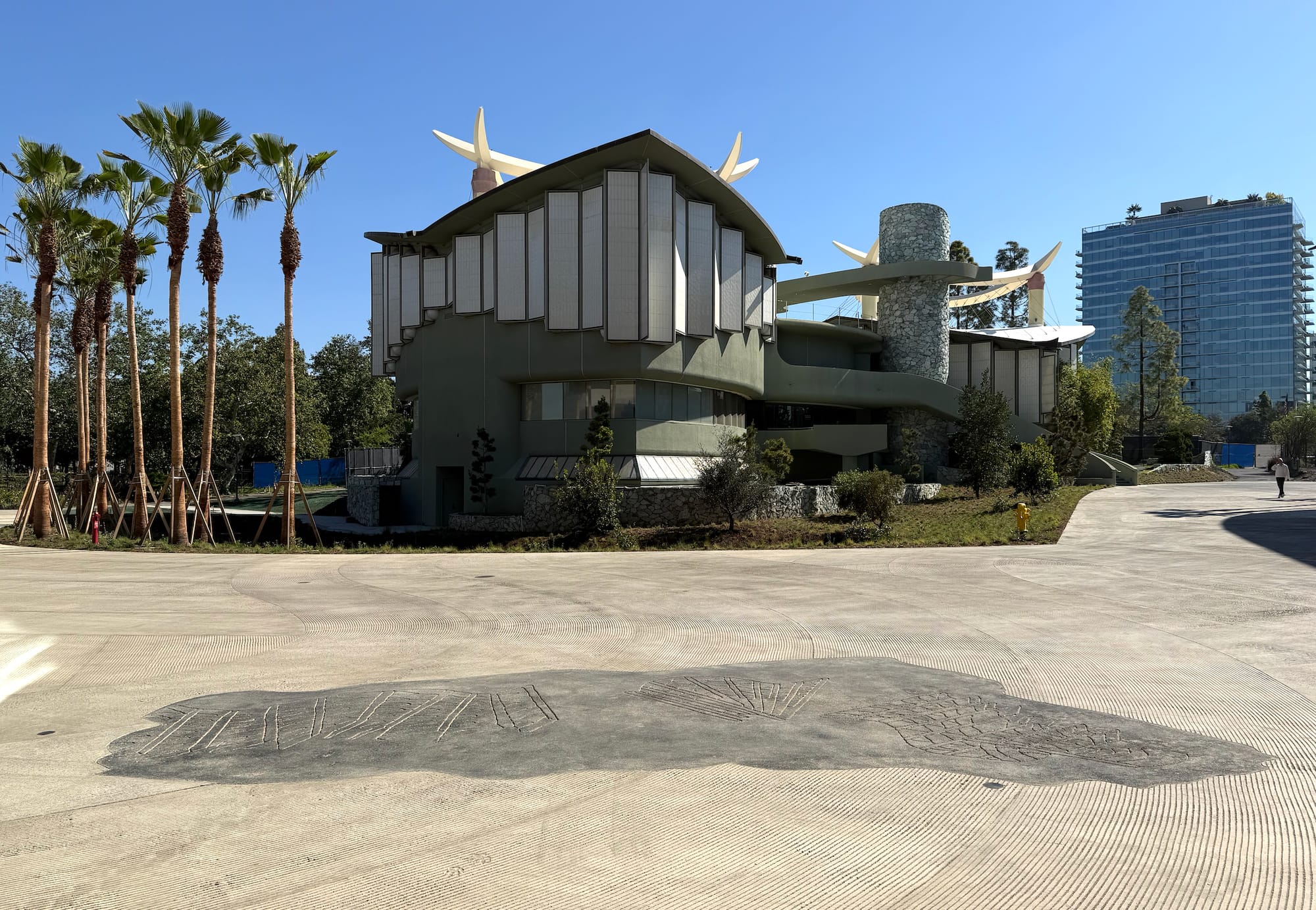
Outside the museum, visitors will find a few links to the old LACMA, including Tony Smith’s “Smoke” (1967), Alexander Calder’s newly restored fountain “Three Quintains (Hello Girls)” (1964), and Bruce Goff’s whimsical 1988 Pavilion for Japanese Art — one of the only older buildings to avoid demolition, which is now highlighted as opposed to being hidden as it was previously. These are joined by new arrivals such as “Feathered Changes” (2025) by Mariana Castillo Deball, a massive concrete commission the size of three football fields that unfolds underfoot throughout the plaza grounds, and Jeff Koons’s splashy “Split-Rocker” (2000), composed of 50,000 drought-resistant California plants. The latter was donated by pistachio billionaires Lynda and Stewart Resnick, somewhat ironic given the accusations over their water use in the Central Valley.
And then there’s Erewhon, which has garnered almost as much controversy as the building itself. Located in its own glass box under the galleries, next to the Calder fountain, the LACMA branch of the infamous high-end eatery will offer organic coffee, pastries, smoothies, and cold-pressed juices, the green variety of which members of the press sampled before opening remarks.

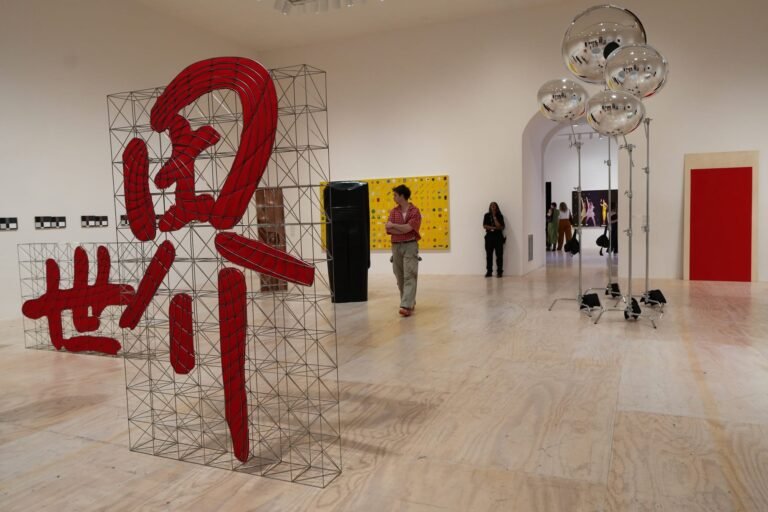
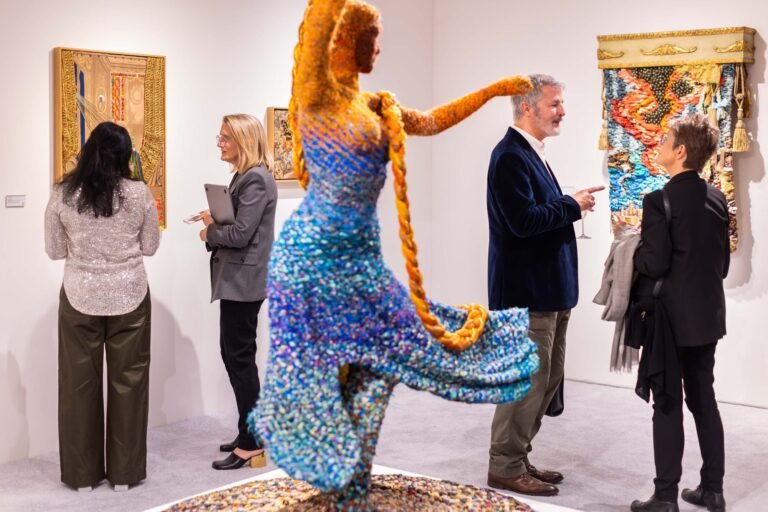
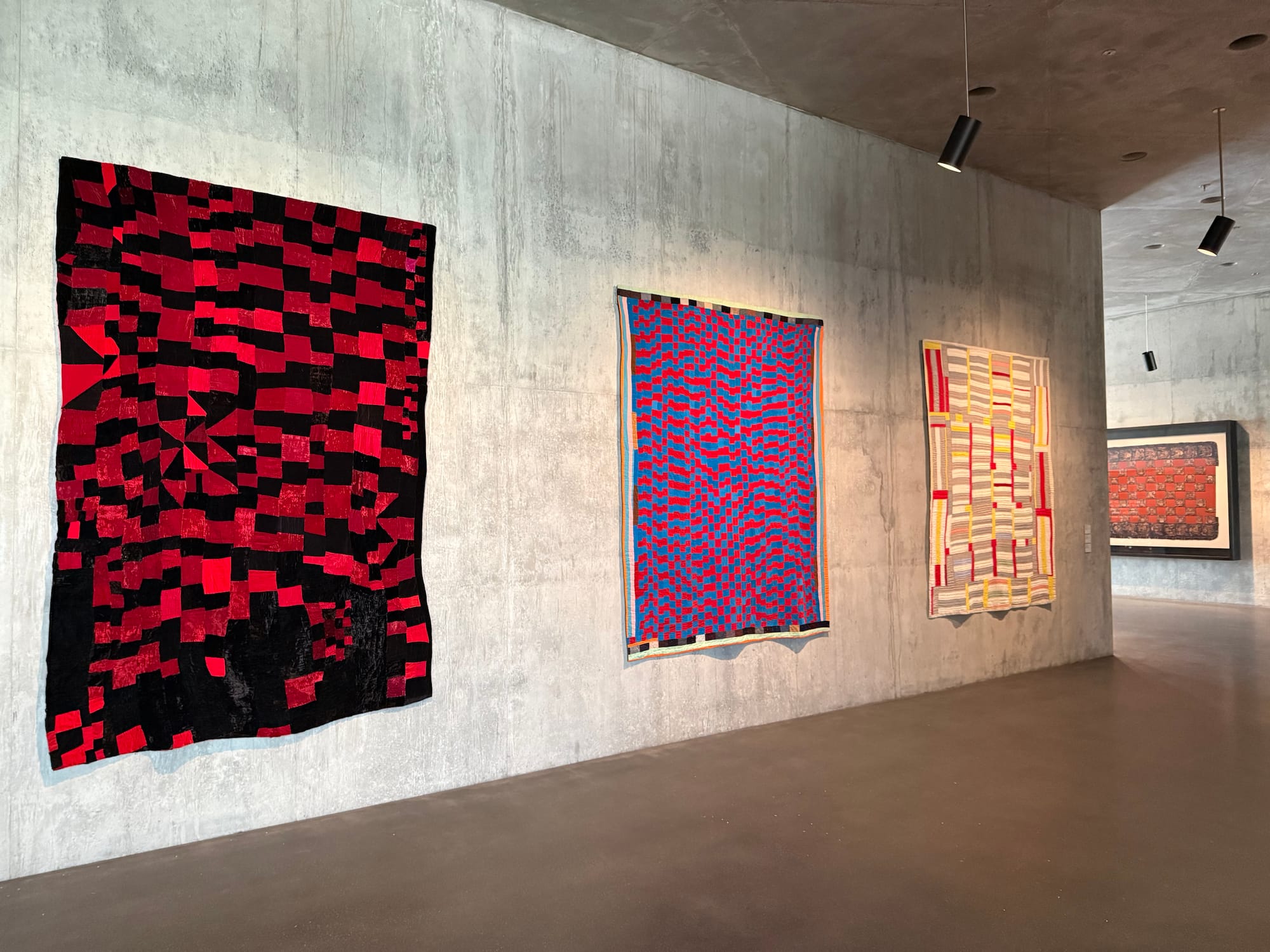
Inside the museum, there are fewer signs of continuity, as familiar art-historical regional and chronological presentations give way to fusions, disruptions, and juxtapositions. But that is by design. “There’s no one path through the museum, just as there’s no one story of art history,” Govan said. The new David Geffen Galleries provide 110,000 square feet of exhibition space, all laid out on a single level, hoisted 30 feet above the street. LACMA’s globe-spanning permanent collection spanning 6,000 years unfolds across this organic plateau, allowing visitors to chart their own courses. It is roughly organized geographically, around bodies of water — the Pacific, Atlantic, Indian, and Mediterranean — emphasizing travel, communication, and exchange rather than borders and fixed identities.
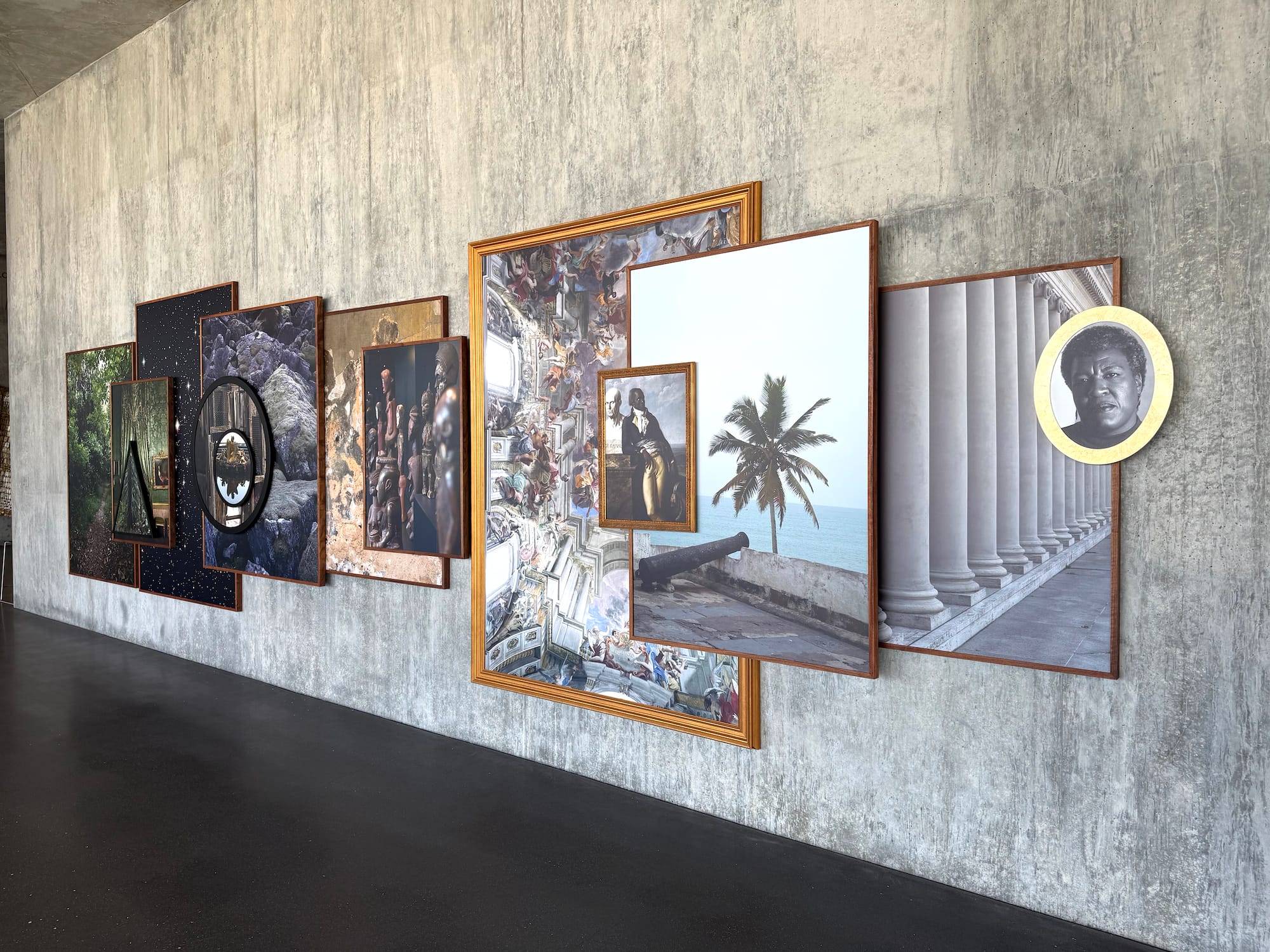
A staggering 78 enclosed galleries and unbounded displays laid out around the flowing perimeter are arranged according to themes such as “Indigenismo in Latin America,” “Car Culture,” “From Kashmir to Cashmere,” and “The Ancient Mediterranean: Merging Beliefs.” Contemporary and classical works sit side by side, as with a Mexica sculpture of the Aztec goddess of agriculture, Chicomecoatl (c. 1325-1521), in front of Diego Rivera’s “Flower Day” (1925), or the Egyptian installation, which features ancient funerary objects alongside Lauren Halsey’s sphinx-like sculpture and wall relief that fuse Egyptian and African iconography with contemporary African-American culture. A new commission by Todd Gray, “Octavia’s Gaze” (2025), layers photographs from across time and places with a portrait of Octavia Butler, the late visionary African-American Angeleno science-fiction author, staring straight back at the viewer.
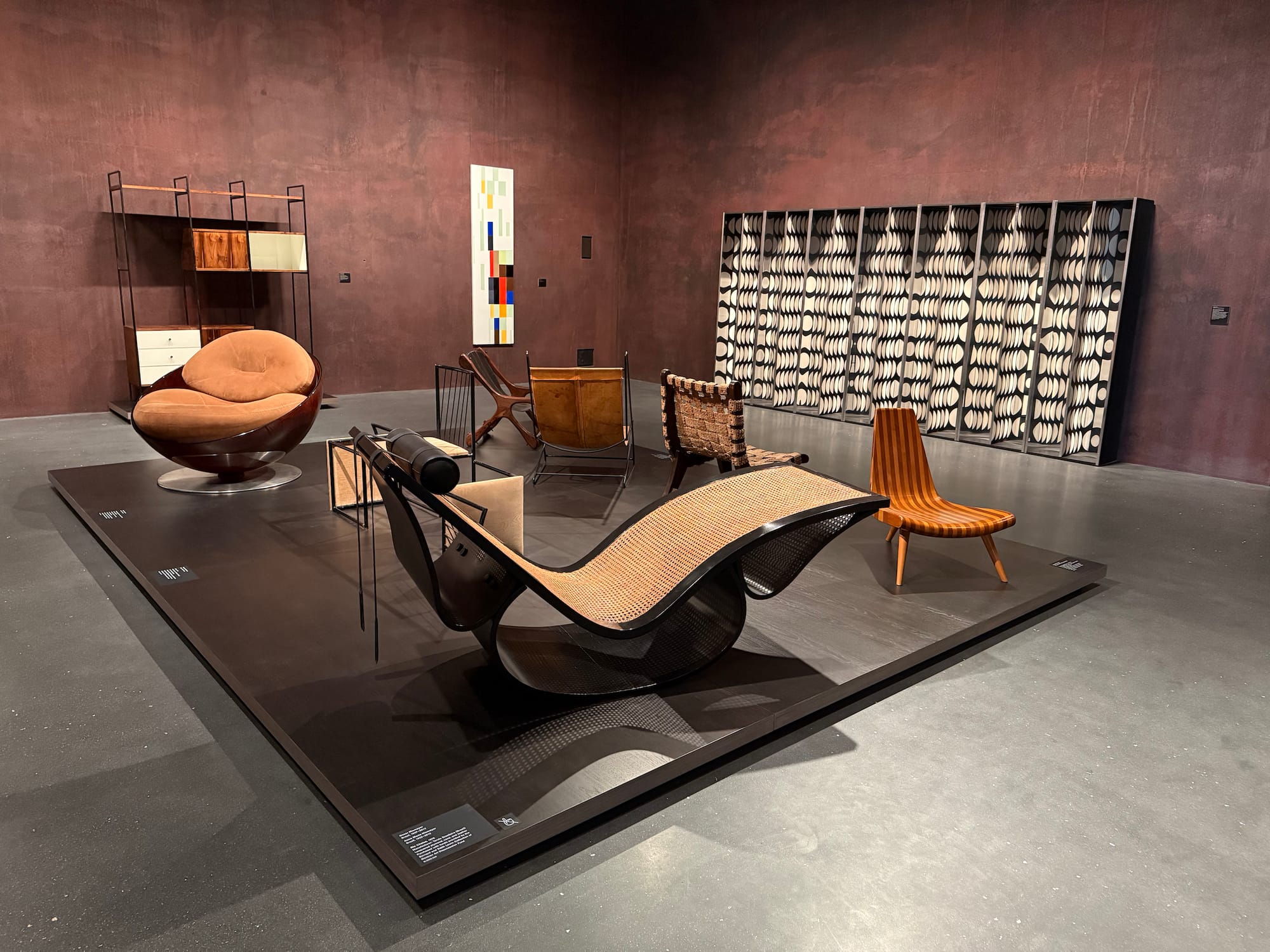
The free-flowing, undefined quality of the perimeter spaces is balanced by the contained and intimate interior gallery spaces, many painted deep blue or red. There are a few traditional galleries, often associated with collectors, such as the Perenchio Collection of Impressionist and Modern Art, with Kees Van Dongen’s heartrending “Woman with a Cigarette” (1906–8) and Paul Cadmus’s “Coney Island” (1934), a post-Bosch, pre-Crumb grotesquerie. A gallery pairing mid-century furniture and abstract art from Latin America is another highlight, not quite as disarming as the rest of the museum, but still innovative in its juxtaposition of craft and fine art.
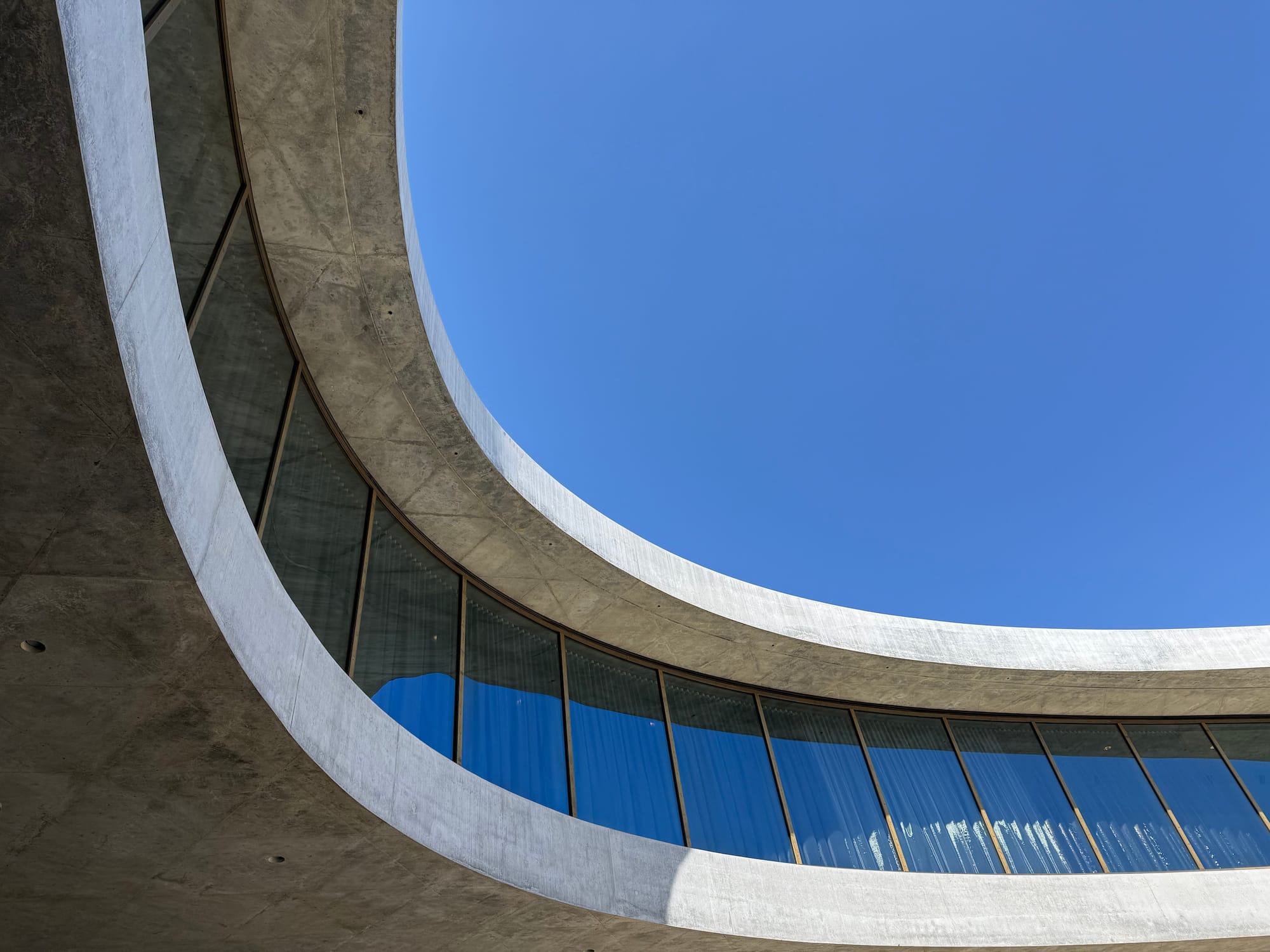
In addition to blurring borders between disciplines, time periods, and regions, the new LACMA sets out to dissolve boundaries between the museum and the world beyond. The entire perimeter is surrounded by glass, with curtains designed by Reiko Sudö mediating the natural light. Visitors are always reminded of where they are, connected to the context and landscape of Southern California. However, the beloved experience of getting lost, of being completely immersed in the museum, will be missing for some visitors. If one is constantly being reminded of the mountains, of the beaming LA sunshine and the bustling Wilshire Boulevard, it can be an effort to truly lose oneself in an ornate 18th-century Ottoman-era home from Damascus, or a wall of gilded medieval altarpieces.
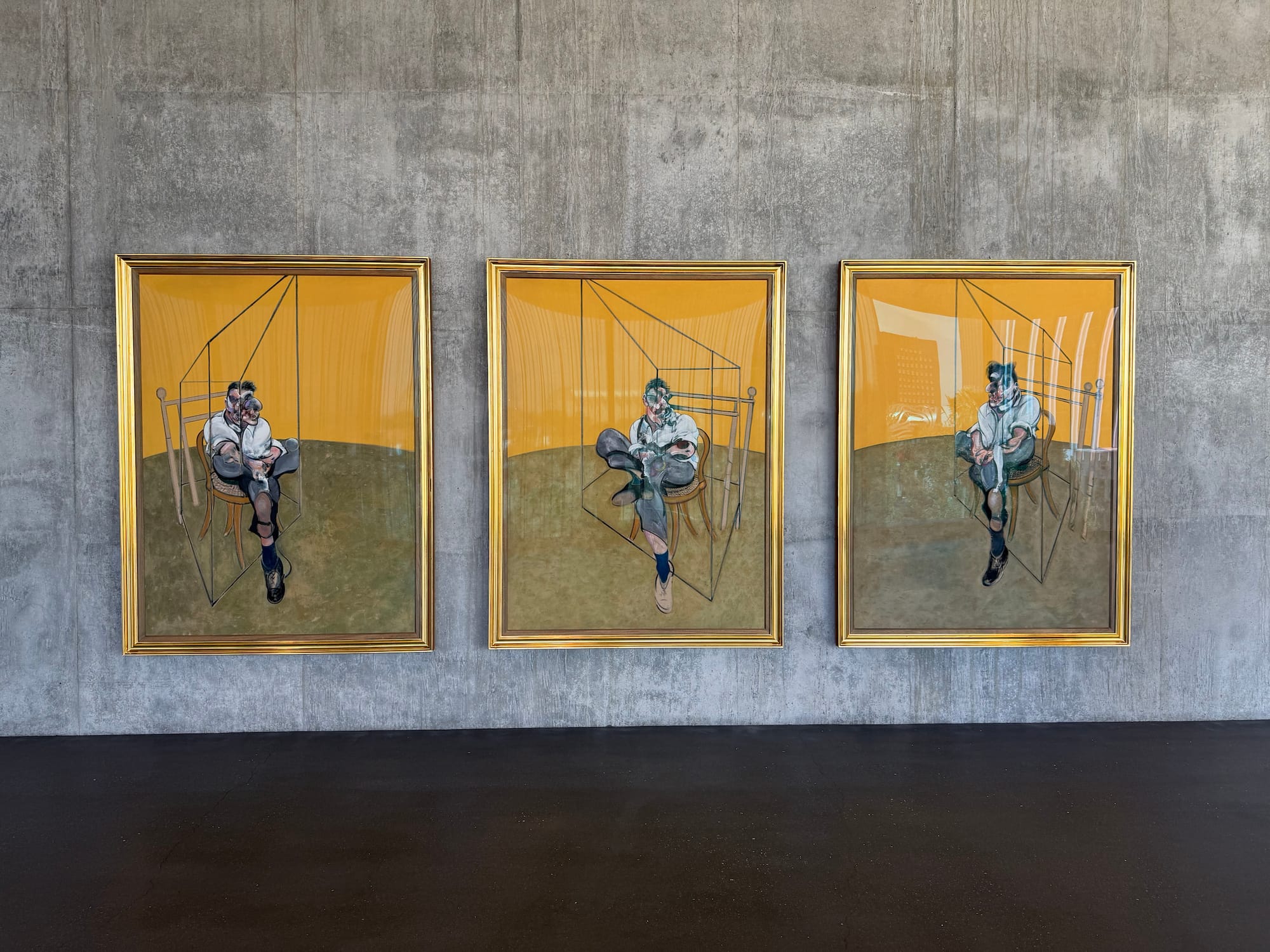
The windows and sunlight prove challenging for other reasons as well. Three-dimensional works, from Assyrian reliefs to Greek statuary, and especially a glowing purple cast glass sculpture by Roni Horn, “Untitled (‘The sensation of satisfaction at having outstared a baby’)” (2013), are nicely complemented by the natural light. But anything with glass, including the display cases for smaller sculptures, suffers from the glare. This is certainly something to contend with in traditional museums, and for some works, like Francis Bacon’s “Three Studies of Lucian Freud” (1969), it is only a minor annoyance. Others, like Andreas Gursky’s large-scale photographs of the ocean, are virtually impossible to view properly. Because of conservation concerns about sunlight, more sensitive works will be constantly rotated out of the exterior galleries, so this may be an issue that can be addressed; still, the concrete structure is less flexible than temporary sheetrock walls.
The disruption to the classical museum-going experience that LACMA provides will no doubt polarize the public, with some yearning for the traditional hierarchies of the past, unmoored by the open plan and free-floating associations, and others excited by the unconventional approach that allows visitors to chart their own paths. It is perhaps better to view this new LACMA not as an encyclopedic museum that neatly lays out the grand sweep of global art history, but one that upends it in a way that is messy, contested, and at times revelatory.
“The important thing to really give you, as an institution that guards art, and in a sense, the knowledge of that art, is how to curate yourself the information you want to receive,” Diana Magaloni, senior deputy director for Conservation, Curatorial, and Exhibitions, told Hyperallergic, adding that virtually everyone has access to unfathomable amounts of information in their pocket. “So what is more important: information, or the fact that you provoked curiosity, provoked a question?”