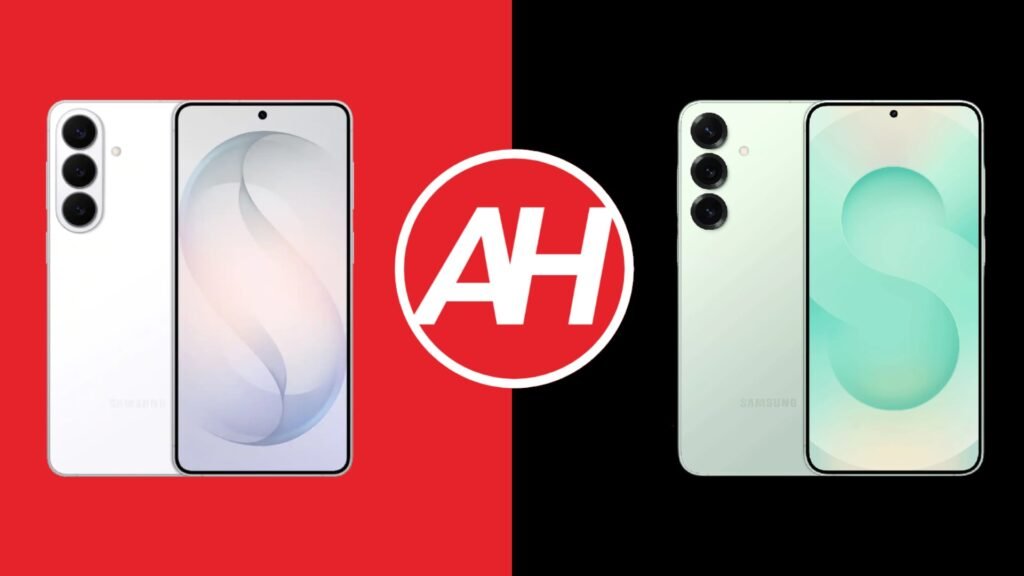

This time around, we’ll be comparing two ‘Plus’ phones from Samsung. One is a member of the current-gen flagship series from the company, while the other was last year. We’re talking about the Samsung Galaxy S26+ vs Samsung Galaxy S25+ comparison here, of course. Neither of these two phones was the most powerful device from Samsung at any point, but they were quite close.
As per usual, we’ll first list the specs of both smartphones and will then compare them across a number of categories. We’ll be comparing their designs, displays, performance, battery life, cameras, and audio output. Samsung did not change much from last year to this year; however, so don’t expect a lot of differences. With that being said, let’s get to it.
Specs

Samsung Galaxy S26+

Samsung Galaxy S25+
| Samsung Galaxy S26+ | Samsung Galaxy S25+ | |
|---|---|---|
| Dimensions | 158.4 x 75.8 x 7.3 mm | 158.4 x 75.8 x 7.3 mm |
| Weight | 190 grams | 190 grams |
| Display | 6.7-inch Dynamic LTPO AMOLED 2X | 6.7-inch Dynamic LTPO AMOLED 2X |
| Refresh rate | 1-120Hz (adaptive) | 1-120Hz (adaptive) |
| Resolution | 3120 x 1440 | 3120 x 1440 |
| Chipset | Qualcomm Snapdragon 8 Elite Gen 5 for Galaxy / Samsung Exynos 2600 | Qualcomm Snapdragon 8 Elite for Galaxy |
| RAM | 8GB/12GB | 12GB LPDDR5X |
| Storage | 256GB/512GB (UFS 4.0) | 256GB/512GB (UFS 4.0) |
| Main camera | 50MP (wide, f/1.8 aperture, 1/1.56-inch sensor size, 1.0um pixel size, dual pixel PDAF, OIS) | 50MP (wide, f/1.8 aperture, 1/1.56-inch sensor size, 1.0um pixel size, dual pixel PDAF, OIS) |
| Ultra-wide camera | 12MP (f/2.2 aperture, 1/2.55-inch sensor size, 120-degree FoV, 1.4um pixel size) | 12MP (f/2.2 aperture, 1/2.55-inch sensor size, 120-degree FoV, 1.4um pixel size) |
| Telephoto camera | 10MP (f/2.4 aperture, 1/3.94-inch sensor size, 1.0um pixel size, PDAF, OIS, 3x optical zoom) | 10MP (f/2.4 aperture, 1/3.94-inch sensor size, 1.0um pixel size, PDAF, OIS, 3x optical zoom) |
| Periscope telephoto camera | N/A | N/A |
| Selfie camera | 12MP (f/2.2 aperture, 1/3.2-inch sensor size, 1.12um pixel size) | 12MP (f/2.2 aperture, 1/3.2-inch sensor size, 1.12um pixel size) |
| Battery size | 4,900mAh | 4,900mAh |
| Charging | 25W wired, 20W wireless (Qi2 Ready), 4.5W reverse wireless (charger not included) | 45W wired, 15W wireless (Qi2 Ready), 4.5W reverse wireless (charger not included) |
| Colors | Cobalt Violet, Sky Blue, Black, White, Silver Shadow, Pink Gold | Icy Blue, Mint, Navy, Silver Shadow, Pink Gold, Coral Red, Blue Black |
Samsung Galaxy S26+ vs Samsung Galaxy S25+: Design
These two smartphones look almost the same. The main differentiating point is on their back sides. The Samsung Galaxy S26+ has a camera island in the top-left corner, where three vertically-aligned cameras sit. The Galaxy S25+ has those three camera cutouts as well, but without the camera island. That’s the only difference here, in addition to the design of the camera protrusions themselves. Even the LED flash is in the same spot.
Both smartphones have a flat display, along with a centered display camera hole. The bezels are thin and uniform on both devices. Even the corner curvature is the same between them. You’ll also notice that they have a flat frame all around. On the right-hand side, you’ll find all the physical buttons on these two devices. The power/lock button sits below the volume up and down keys.
The two phones are made out of aluminum and glass. In fact, they both have Gorilla Glass Victus 2 on the back. That backplate is flat, and only the camera-related hardware breaks that flatness. The two phones are IP68 certified for water and dust resistance. They are even identical in terms of size, completely identical. The same goes for weight as well; actually, they both weigh 190 grams. They’re also quite slippery, by the way.
Samsung Galaxy S26+ vs Samsung Galaxy S25+: Display
These two smartphones also have exactly the same displays. You’ll find a 6.7-inch Dynamic LTPO AMOLED 2X panel on both of these smartphones. That panel is flat on both of them, and it supports an adaptive refresh rate up to 120Hz on both devices. HDR10+ content is supported here, while the peak brightness on both phones is 2,600 nits. The screen-to-body ratio is around 91% on both devices.

What about the resolution? Well, that is the same as well, you’ll be getting a 3120 x 1440 resolution on both devices. The display aspect ratio is 19.5:9, while the Gorilla Glass Victus 2 protects both of these displays. Samsung decided to change nothing when it comes to display hardware on the Galaxy S26+. That is not surprising as the company did basically the same thing on the smaller Galaxy S26 model.
As far as we can tell, there is also no difference in actual usage of these two displays. They look basically the same, which may not be a bad thing. It’s a really good display. It’s bright, vivid, and has great viewing angles. The touch response is also good. They’re not the brightest panels out there, but they’re bright enough. The Galaxy S26 Ultra does have some extra aces up its sleeve, but that’s a whole different story.
Samsung Galaxy S26+ vs Samsung Galaxy S25+: Performance
Qualcomm’s Snapdragon 8 Elite Gen 5 for Galaxy fuels the Galaxy S26+ in some regions. That’s an overclocked variant of Qualcomm’s most powerful chip. In other regions, Samsung’s Exynos 2600 processor is used. The former is a 3nm chip, while the latter is a 2nm processor. Regardless of the chip, the phone comes with 12GB of LPDDR5X RAM, along with UFS 4.0 flash storage, which is not expandable.
The Samsung Galaxy S25+, on the other hand, is fueled by the Snapdragon 8 Elite processor across the globe. Samsung opted to go with a one chip only for the Galaxy S25 series last year. That is a 3nm processor, and it’s backed by 12GB of LPDDR5X RAM. UFS 4.0 flash storage is also used, and it’s not expandable.
Both of these smartphones do a great job performance-wise. Yes, the newer phone is a bit snappier, but that’s not something you’ll always notice. You have to compare them side-by-side to notice it in specific situations. They’re great in both everyday use and for gaming. Yes, both phones will get quite warm during demanding gaming sessions, but we did not have issues with overheating on either device. Do note that we did not use the Exynos variant of the Galaxy S26+, though.
Samsung Galaxy S26+ vs Samsung Galaxy S25+: Battery
A 4,900mAh battery can be found inside both of these smartphones. Samsung decided to stick with the same 4,900mAh Li-Ion battery across generations. The company still didn’t make a switch to silicon-carbon tech, hence the capacity. Despite the fact that this battery pack is smaller than those of Samsung’s competitors, though, neither of these two smartphones offers bad battery life, quite the contrary.
Granted, the Galaxy S26+ does offer notably better battery life in comparison. The Galaxy S25+’s battery life was fine at launch, but it did go downhill after a couple of months. We’re hoping that the same won’t happen with the Galaxy S26+. The Galaxy S26+’s battery longevity will be enough for most people, but note that it’s not on the same level as some other flagships on the market.
When it comes to charging, things are almost identical between the two phones. They have the same wired charging, 45W in terms of speed, and 4.5W reverse wireless charging. Things are different when it comes to wireless charging, though. The Galaxy S26+ offers 20W wireless charging compared to the 15W wireless charging of the Galaxy S25+. Neither phone comes with a charger in the box, though.
Samsung Galaxy S26+ vs Samsung Galaxy S25+: Cameras
The camera situation is completely identical between these two phones. Well, the hardware situation, that is. There are three cameras on the backs of both of these phones. You’ll find a 50-megapixel main camera (1/1.56-inch sensor size) back there, with OIS support, and an f/1.8 aperture.

The second camera on the back is a 12-megapixel ultrawide snapper (1/2.55-inch sensor size, 120-degree FoV), which has an f/2.2 aperture and a 1.4um pixel size. The third camera is a rather underwhelming 10-megapixel telephoto unit with a 1/3.94-inch sensor size, 3x optical zoom, and an f/2.4 aperture.
It’s about time Samsung upgraded camera hardware on its Galaxy S series, and that is especially true for the base and ‘Plus’ models of the devices. Samsung has been keeping the same old hardware for way too long. While both of these phones can provide decent pictures, they’re falling behind the best camera smartphones on the market more and more. The difference is quite jarring, actually. They’re not even close to the top anymore as far as camera performance is concerned.
Audio
You’ll find stereo speakers on both of these smartphones. The ones on the Galaxy S25+ are a bit louder, actually, which is kind of surprising. The difference is not big, but it’s somewhat noticeable. The audio output quality is good on both phones.
There is no audio jack on either phone. You can, however, connect your wired headphones via their Type-C ports. Bluetooth 6.0 is supported on the Galaxy S26+, while Bluetooth 5.4 is available on the Galaxy S25+.
The post Phone Comparisons: Samsung Galaxy S26+ vs Samsung Galaxy S25+ appeared first on Android Headlines.