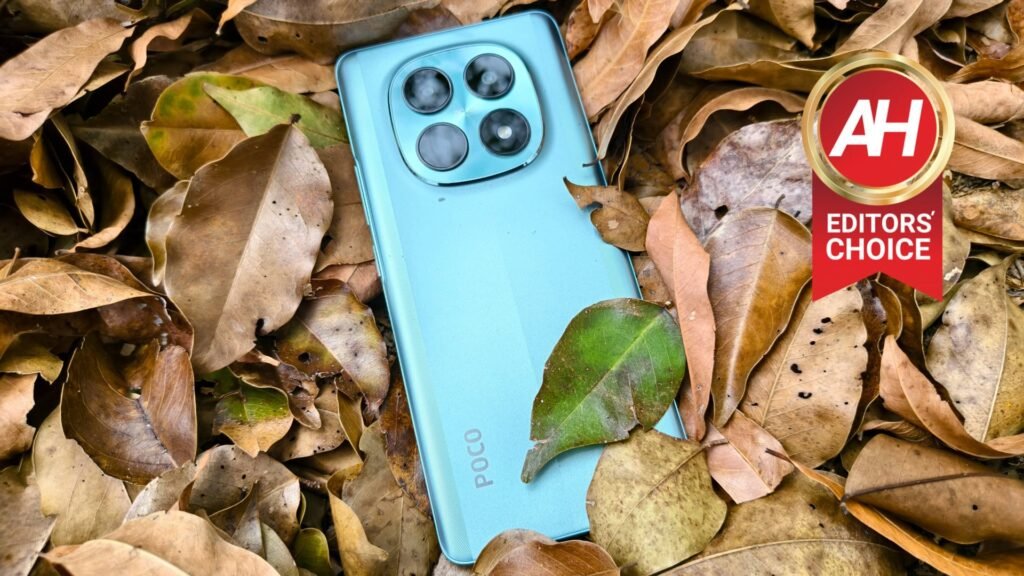

Poco built its reputation on raw power and aggressive pricing. Most of the brand’s devices are designed around the idea of ”offering more for less.” While the Pro models (POCO M8 Pro review) usually grab the headlines, the standard Poco M8 5G often serves as the practical backbone of the lineup. Our Poco M8 5G review unit, the 8GB RAM and 512GB storage variant in a striking “Green” finish, attempts to bridge the gap between affordable utility and premium flair. It’s designed to challenge what a “base” model should look like, offering a design aesthetic that, in a particular way, could feel more daring than its Pro sibling.
As we spent time with the device, we realized that this isn’t just a stripped-down version of a more expensive phone. It has its own personality, differentiating itself in practically every technical aspect. Furthermore, the company sought to push the boundaries of what a phone in this price segment can offer. The competition is increasingly demanding, with brands like Infinix achieving ever-improving results. Will the POCO M8 5G offer the ideal balance of value and features to stand out? Keep reading to find out.

The POCO M8 promises to offer a lot of value for little money, boasting good performance, a vibrant curved AMOLED screen, a large battery with fast charging, and a rather eye-catching design.
Pros
- IP66 rating in this price segment
- High-quality AMOLED display at 120Hz
- Big battery with 45W charging support
- 15W wired charging support doubles it as a capable “power bank”
- Capable camera in daylight for this price segment
Cons
- Misleading camera module design (only one sensor is usable)
- Improvable night photo performance
- Bloatware and ads by default
The manufacturer provided us with review units of the POCO M8 5G. We used it as our primary device for two weeks before writing this review, which was not sponsored.
Poco M8 5G: Specs
Poco M8 5G: Specs
| Display | AMOLED 6.77 inches, 1,080 x 2,392 px |
| Processor | Snapdragon 6 Gen 3 |
| RAM | 6GB/8GB |
| Storage | 128GB/256GB/512GB |
| Battery | 5,520mAh, 45W wired charging, 15W wired reverse charging |
| Cameras | 50MP main (f/1.8 aperture, 1/2.88″, PDAF) |
| Colors | Black, Green, Silver |
Poco M8 5G Review: Hardware and Design
The moment you pull the Poco M8 5G in its “Green” variant out of the box, the first thing that will catch your attention is the finish. Depending on how the light hits the back panel, the hue slightly shifts to a kind of metallic teal-blue. It is an attractive, sophisticated look that moves away from the flat colors of previous years. The back panel uses a high-quality composite material that feels sturdy, although it lacks the textures (frosted or vegan leather) of the Pro model. This makes it a bit more of a magnet for fingerprints, although the way it catches reflections gives it a certain visual appeal.
But the real conversation starter is the display’s architecture. In a curious design move, Poco has equipped the standard M8 5G with a curved display, just like the Pro. However, the degree of curvature here is notably more pronounced. The standard M8 5G features a dramatic wrap-around effect on the long edges. This creates a nearly borderless visual experience when looking at the phone head-on. It is a bold choice for a non-Pro device, making the phone feel incredibly slim in the hand. That said, this could introduce some ergonomic trade-offs that we will discuss in the display section.


The build quality remains impressive for this price segment. The frame provides a rigid structure that resists twisting. Furthermore, the transition between the glass front, the frame, and the back panel feels seamless. On the front, Poco has integrated a reliable optical in-display fingerprint sensor that works really well. I found it to be consistently fast and accurate during my daily use, even with slightly damp fingers. On the right side, the power button sits comfortably within reach. The volume rocker sits just above it, offering a firm, tactile response that suggests good long-term durability.
At the top, Poco refuses to abandon the IR blaster, a fan-favorite feature. The bottom houses a primary speaker, a USB-C port, and a dual SIM tray. While the phone feels light at approximately 180 grams, it doesn’t feel cheap, showing a sweet balance. The camera island on the back follows the design language of the 2026 Poco lineup—a “squircle,” centered island that houses the lenses. It sits slightly higher than we would like, but when you use the included transparent case, the “wobble” on a flat surface becomes non-existent.
Poco M8 5G Review: Display
The display of the Poco M8 5G is undoubtedly its most polarizing feature. It is a 6.7-inch AMOLED panel with a 120Hz refresh rate, providing the punchy colors and deep blacks that have become the hallmark of the brand. But we have to talk about that curve. As mentioned, the curvature is significantly deeper than what you find on the Poco M8 Pro. Visually, it is a nice touch; content seems to spill over the edges, making the side bezels virtually disappear. For social media consumption and watching cinematic videos, this creates an immersion level that you typically only see in “Ultra” flagships.
However, a curve this deep brings some specific challenges. During our testing, we noticed that the extreme edges of the screen occasionally catch glare from overhead lights, creating a bit of a reflection effect that can be distracting when reading text-heavy articles. The good thing is that Poco’s software does a great job with palm rejection. Even when this pronounced curve means that your fingers naturally rest on the active display area more often, you won’t find yourself accidentally pressing icons constantly. Still, if you haven’t done it before, the sensation of holding a “screen-only” edge takes some getting used to.
Brightness levels are just okay for most scenarios. However, we’re talking about HMB brightness levels of 800 nits—peak brightness of 3,200 nits only applies in very specific HDR scenarios and in limited areas of the screen. So, if you’re in bright sunlight, you’ll probably want to find some shade to use your phone comfortably.


The 120Hz refresh rate makes every interaction feel smooth, and the system is quite good at dropping the frequency to 60Hz when you are looking at static images to save power. We also appreciated the inclusion of 2,160Hz PWM dimming, which reduces eye strain during late-night browsing sessions. It is a high-quality panel that offers a “flagship-like” aesthetic, even if the aggressive curvature might not be for everyone.
Color accuracy is another strong point. Out of the box, the “Saturated” mode provides the vibrant look that many consumers love, making photos and games pop with life. If you prefer something more realistic, the “Standard” mode aligns well with the sRGB color space. The viewing angles are generally good, although the deep curves do introduce a slight color shift (a faint blue or gray tint) at the very edges when looking at white backgrounds. It is a characteristic of almost all curved OLEDs, but the intensity of the curve here makes it more apparent than usual. Overall, it is a display that looks twice as expensive as it actually is (except for brightness).
Poco M8 5G Review: Performance
Powering the Poco M8 5G is the Qualcomm Snapdragon 6 Gen 3 chipset, paired with 8GB of RAM. 8GB might seem modest compared to the 12GB or 16GB variants seen elsewhere. However, for the target audience and price of this phone, it’s an adequate amount. During our testing period, the handset handled multitasking with surprising competence. We could switch between Chrome, Spotify, and Instagram without the system aggressively closing apps in the background.
In daily use, the phone feels sufficiently fluid. However, after using the Pro model, it’s clearly not at the same level in terms of snapping speed. That doesn’t mean the POCO M8 5G performs poorly—quite the opposite. It’s just something we should mention so you’re aware of what to expect.
Navigating the home screens, opening the camera app, and scrolling through long web pages happen without any major hits. The chipset is built on an efficient 4nm process, which helps in maintaining a cool temperature even during extended use. We used the phone for long GPS navigation sessions and heavy social media uploading, and it never became uncomfortably warm. This thermal stability does a good job of preventing the processor from throttling down when you need it most.
Gaming performance is respectable for a device in this price bracket. For demanding games like Genshin Impact, the phone defaults to “Low” graphics settings while maintaining key aspects like render resolution, shadow quality, and visual effects at “Medium.” For Honkai Star Rail, another demanding title, settings are also set to “Medium,” though you’ll get a smoother experience by tweaking some of the graphics options to “Low.” On the other hand, the popular Call of Duty Mobile defaults to “High” graphics quality and max frame rate, which is great.


It’s noteworthy that, just like in the Pro model, the phone uses UFS 2.2 storage—which is slower than the UFS 3.1 or 4.0 found in flagship devices. Either way, the choice is more than adequate for this price range.
Poco M8 5G Review: Benchmarks
We conducted our usual set of benchmarks on the Poco M8 5G. As expected, the device showed quite respectable results. However, we’re talking about a price range where the hardware prioritizes energy efficiency over raw power.
Geekbench 6
Starting with the CPU-focused Geekbench 6 benchmark, the device scored a respectable 1,014 and 2,987 points for the single-core and multi-core tests, respectively. In the GPU test, the handset achieved 2,092 points. These figures place it close to the Redmi Note 14 Pro in terms of CPU power, although it falls behind in GPU performance.
| Device | Single-Core | Multi-Core | GPU |
| Poco M8 5G | 1,014 | 2,987 | 2,092 |
| Poco M8 Pro | 1,236 | 3,246 | 2,526 |
| Redmi Note 15 Pro 5G | 1,051 | 2,922 | 3,045 |
AnTuTu V11
In AnTuTu V11, the Poco M8 5G received an overall score of 850,632, which is in line with other affordable mid-range phones in its price range. There’s nothing to call home about here, but nothing to criticize either.
| Device | Score |
|---|---|
| Poco M8 5G | 850,632 |
| Poco M8 Pro | 1,004,233 |
| Redmi Note 15 Pro 5G | 898,129 |
3DMark Wild Life Extreme
The device also underwent the demanding 3DMark Wildlife Extreme test, designed to push hardware to its limits. This test is so severe that some models are even unable to complete it. Fortunately, that wasn’t the case with the Poco M8 5G.
| Device | Best Loop | Lowest Loop | Stability |
| POCO M8 5G | 863 | 858 | 99.4% |
| Poco M8 Pro | 855 | 851 | 99,5% |
| Redmi Note 15 Pro 5G | 1,005 | 990 | 98,5% |
Poco M8 Pro Review: Thermals
The POCO M8 5G exhibited fairly decent thermal management. It’s definitely not the coolest model we’ve tested in this segment, but it does a good enough job that it doesn’t feel uncomfortable in the hand, even during heavy gaming sessions.
| Benchmark | Temperature |
|---|---|
| Geekbench | 37,1 °C/98,78 °F |
| 3D Mark Extreme Stress Test | 42.5 °C/108,5 °F |
| Antutu | 39.4 °C/102.92 °F |
Lastly, below are our usual temperature tests during 4K video recording. The results are consistent with our experience in daily use and benchmarks.
| Device | 5 minutes | 10 minutes |
| Poco M8 5G | 34.5 °C/94.1 °F | 37.6 °C/99.68 °F |
| Poco M8 Pro | 36.70 °C/98.06 °F | 38.2 °C/100.76 °F |
| Redmi Note 15 Pro 5G | 33.70 °C/92.66 °F | 34.6 °C/94.28 °F |
Overall, in our experience, the POCO M8 5G was never a phone that made us think “okay this is too hot,” even during gaming sessions. This is also a positive for maintaining high, sustained performance for longer periods.
Poco M8 5G Review: Battery Life and Charging
The Poco M8 5G houses a 5,520mAh battery. While this is a large battery, it’s not as large as those in some other recent devices. However, don’t let the numbers fool you, as it’s still a very respectable capacity capable of providing long battery life throughout the day.
During our standard battery drain test, the device easily cruised through 19 hours. In real-world terms, this is a “two-day” phone for most users. Even on days with heavy GPS usage and constant data, we frequently ended the evening with more than 40% charge remaining. Standby power consumption is remarkably low. You can leave the phone unplugged overnight and find it has lost only 1% of its charge by morning.
When it does come time to refuel, Poco has stepped up its game by including support for 45W wired fast charging. This is a noticeable improvement over the previous generation (15W). In our testing, a full charge from zero to 100% took approximately 79 minutes. If you are in a rush, a quick 25-minute top-up is enough to get you back to roughly 45%, which—given the large battery capacity—is more than enough to last a full workday. Importantly, Poco still includes the 45W charging brick in the box.
The charging process remains thermally stable, and the phone barely gets warm even during the initial high-wattage phase. It’s noteworthy that the handset can also be your occasional power bank for other devices thanks to its support for 18W reverse wired charging.
Poco M8 5G Review: Software
The Poco M8 5G ships with HyperOS 2.0 based on Android 15. However, during our time with it, we received the Android 16-based HyperOS 3 update. Gaming tests, benchmarks, and camera tests were performed on the latest firmware version.
That said, you’ll find that using HyperOS is a pretty good experience—with a catch. The interface is a notable departure from the stock-like Android look, though whether you like it or not will depend on you. We can say that the brand has taken a lot of inspiration from iOS in the aesthetics of its software. At least the UI feels lightweight and fast, taking full advantage of the 120Hz display, and the animations have a natural fluidity that makes the whole experience feel more premium.


The “Control Center” is customizable, allowing you to put your most-used toggles right where you need them. We also appreciated the Lock Screen customization possibilities, allowing you to create depth effects with your wallpapers. It is a polished, mature software experience that feels miles ahead of the cluttered interfaces we saw just a few years ago.
However, being a Poco device, there is still a noticeable amount of pre-installed software. You will find several games and third-party apps out of the box. While you can uninstall almost all of them, the initial cleanup process is a task every new owner will have to perform. There are also occasional “recommendations” in system apps, though Poco has made them easier to disable in the settings menu. For a phone at this price, these are expected trade-offs. However, it is something to keep in mind if you prefer a “pure” Android experience.
Poco has committed to providing four major Android version updates and three years of security patches for the M8 5G. While this isn’t as long as the support offered for high-end flagships, it is fair for the mid-range segment. The software also includes several AI-enhanced features, such as “AI Expansion” for photos and improved voice recognition for the assistant.
Poco M8 5G Review: Camera
The camera system on the Poco M8 5G is built around a single 50MP sensor. Its performance is a mixed bag, depending on the environmental conditions.
In well-lit settings, the phone performs surprisingly well for a device in this category. It can camera captures photos with decent detail and a good amount of dynamic range. The color science leans toward a natural look, although it does have a slight tendency to boost the greens and blues. The autofocus is quick and accurate, making it easy to snap photos of moving subjects like pets or children.


However, the story changes radically when the light fades. In nighttime and indoor scenarios, the level of detail in the images drops noticeably, while noise increases. This is consistent with the hardware choice, as the sensor is considerably smaller than that of the POCO M8 Pro, and it also lacks OIS (Optical Image Stabilization). This means that, under these conditions, focusing on an object for a close-up can even become difficult. This is definitely not a handset to buy for its photographic versatility—nor does it try to be.


Should You Buy the Poco M8 5G?
The Poco M8 5G is a device that chooses to spend its budget on things you can see and feel. The decision to include a deeply curved AMOLED display on a standard model is a bold one that gives the phone a flagship “vibe.” The performance is reliable, the battery life is good thanks to the 5,520mAh cell, and the 45W charging ensures you aren’t tied to a wall for too long. While the aggressive screen curvature might not suit everyone and the lack of an ultra-wide camera is a missed opportunity, these are trade-offs that many will be happy to make in exchange for the premium look and the massive storage capacity.
However, just like in the “Pro” version, the device’s aggressive price point also translates into a heavy presence of bloatware or “app recommendation” services. These can be uninstalled/disabled in most cases, but you should be aware that they are there.
You should buy the Poco M8 5G if:
- You’re looking for a device that gives you strong value for little money.
- You’re looking for a device that offers battery life that easily lasts more than a day.
- You’re looking for a “pseudo-rugged” device with a vibrant AMOLED screen in the affordable price segment.
You should not buy the Poco M8 5G if:
- You’re looking for a Pixel-like clean OS free of ads and/or pre-installed apps.
- You’re looking for a versatile camera system.
- You’re looking strictly for a flat-screen phone.
The post Poco M8 5G Review: The Affordable Mid-Range Phone with a Flagship Silhouette appeared first on Android Headlines.