Editors’ Highlights are summaries of recent papers by AGU’s journal editors.
Source: Water Resources Research
In groundwater flow and transport modeling, aquifer characterization is still a hot topic. Ultimately, it means giving each grid cell in a numerical model hydraulic property values. This is a daunting task because we cannot readily see into the subsurface, thus, spatially heterogeneity and structure in those properties remain largely uncertain or completely unknown. Indirectly estimating spatial heterogeneity via inverse methods is a huge challenge because correlation of structures occurs over orders of magnitude and does not obey convenient (Gaussian) statistical laws. In addition, inverse methods have strong computational friction, limiting their utility in applied settings.
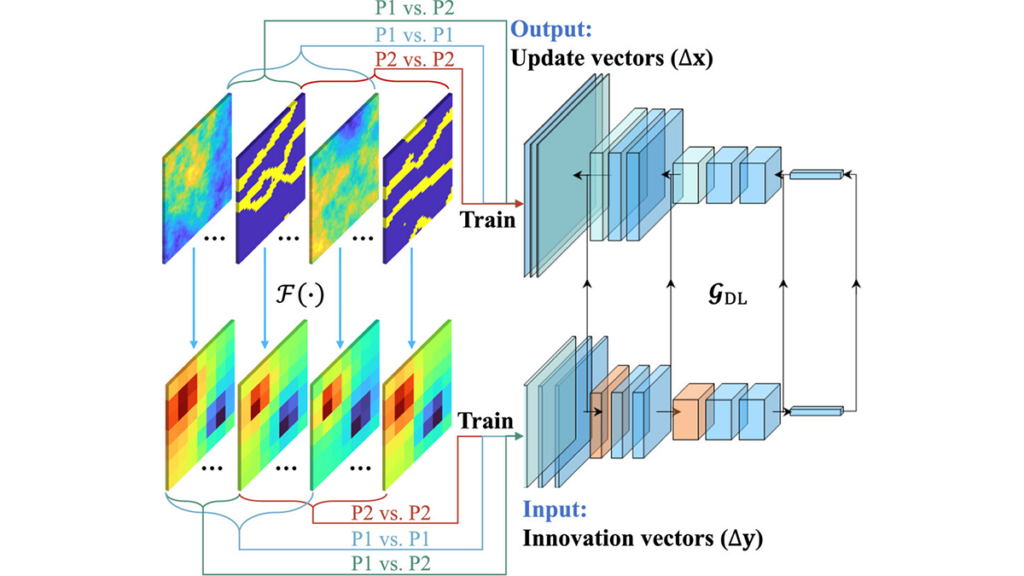
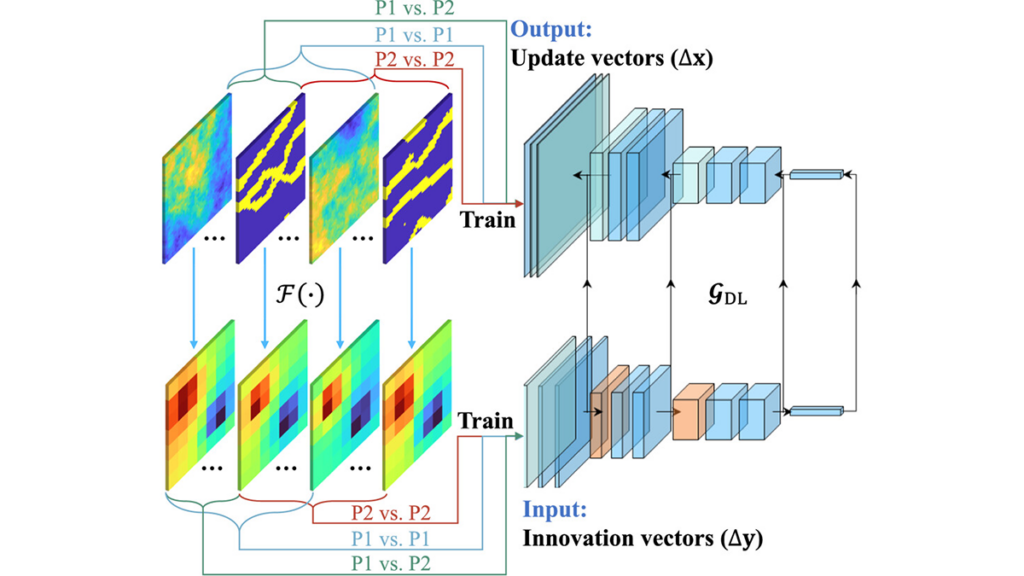
Cao et al. [2026] tackle these challenges at once with a proposed ensemble deep learning smoother, which is beautifully trained with wicked structures, i.e. diverse prior distributions. They call this the hybrid prior strategy, which makes the smoother extremely robust, general, and, on top, transferable. It is great to see that diversity leads to robustness even in tackling such difficult tasks as aquifer characterization.
Citation: Cao, C., Zhang, J., You, F., Nan, T., Yin, J., & Lu, C. (2026). Improving heterogeneous aquifer characterization using a deep learning-based ensemble smoother with a hybrid prior strategy. Water Resources Research, 62, e2025WR040819. https://doi.org/10.1029/2025WR040819
—Stefan Kollet, Editor; and Alberto Bellin, Associate Editor, Water Resources Research
Text © 2026. The authors. CC BY-NC-ND 3.0
Except where otherwise noted, images are subject to copyright. Any reuse without express permission from the copyright owner is prohibited.