Nearly 3,000 kilometers beneath Earth’s surface, the outer core is a slowly churning ocean of molten iron and nickel. The process of heat escaping the core and entering the shallower mantle is known as the “geodynamo” and generates Earth’s magnetic field.
For most of the past 3.5 billion years, Earth’s magnetic field has maintained a north–south alignment akin to that of a bar magnet. Occasionally, however, the field weakens, changes orientation, or flips entirely. Scientists know about these changes from examining igneous rocks that preserve the orientation of the magnetic field at the time their crystals cool. Researchers can also examine a rock’s magnetic inclination, which describes the angle between Earth’s surface and the magnetic field lines that loop from our planet’s magnetic north to magnetic south. A rock’s magnetic inclination provides clues about the latitude at which it formed.
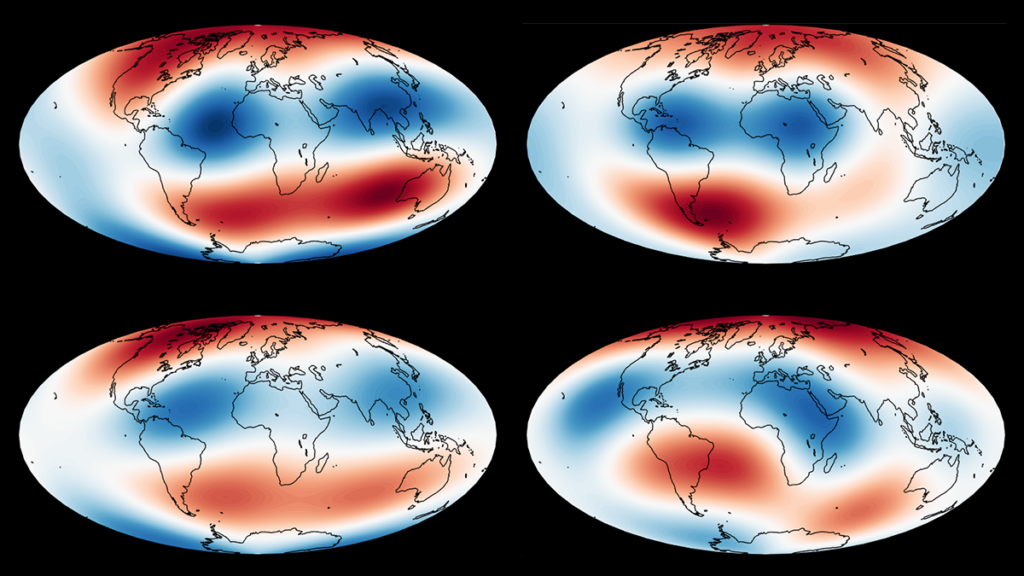
A University of Liverpool team has analyzed paleomagnetic data going back 265 million years and found that the alignment of the magnetic field in rocks varies not only by latitude but also by longitude. That, said Andy Biggin, who led the research, “shouldn’t happen…for a magnetic field generated from a dynamo that is not subject to some sort of external forcing.”
The team published its results in Nature Geoscience.
Enter the BLOBs
Scientists have long been aware that two supercontinent-sized chunks of the mantle sitting directly on top of the outer core don’t behave like the material around them. One of these BLOBs (big lower-mantle basal structures) sits under Africa, and the other sits under the Pacific.
The BLOBs are believed to be much hotter than the surrounding mantle. That, Biggin said, means that heat from the core won’t escape into them as readily. “If you put something hot on top of something else hot, not as much heat flows [between the two objects].”
The researchers believe the BLOBs are insulating parts of the core, stagnating convection currents and putting a damper on magnetic field generation. The BLOBs may also shield the magnetic field in the same way a metal box shields a cell phone’s signal.
For hundreds of millions of years, therefore, the strength and direction of the magnetic field at Earth’s surface have differed slightly depending on the surface position relative to the underlying BLOBs.
The Big Crunch
“The viscosity of the core is so slow…you just can’t reproduce that numerically, even on supercomputers.”
Modeling processes in Earth’s core, Biggin said, is “an impossible problem to [solve] fully because the viscosity of the core is so slow. It’s incredibly turbulent, and there are very small-scale flows everywhere. You just can’t reproduce that numerically, even on supercomputers.”
The team crunched paleomagnetic data and ran simulations on one of the United Kingdom’s most powerful supercomputers, ARCHER2. Even with the immense processing power of this machine (its peak performance equals that of about 250,000 modern laptops combined), each simulation took more than a week to run.
Previous attempts at modeling the effect of uneven core-mantle heat flow on geomagnetism tended to make the magnetic field behave more wildly, sometimes in a way that bore no resemblance to observed reality.
But ARCHER2’s processing power allowed the Liverpool team to run simulations that more accurately reflected deep Earth dynamics.
What they found took them by surprise: The presence of BLOBs in their models stabilized the magnetic field. When the researchers introduced heterogeneity to the models in the form of the BLOBs, Biggin said, “it just wasn’t possible for us to reach that chaotic state.”
That pattern, he said, suggests that the BLOBs not only affect Earth’s magnetic field but are actually controlling it. During times in Earth’s history when the magnetic field collapsed or went awry, the heterogeneity of the mantle may have pulled things back into line and “helped keep the field behaving itself.”
While Earth’s magnetic field frequently weakens or flips, it has, on average, stayed remarkably true to that north–south alignment throughout the planet’s history. The stabilizing influence of the BLOBs, Biggin believes, might be the reason.
A Window into the Deep Past
Nicolas Flament, a geophysicist and geodynamicist with the University of Wollongong in Australia who was not involved in this paper, said the “amazing” research “opens an avenue to investigate heterogeneity in the deep Earth.”
He noted, however, that the models relied on the assumption that the BLOBs remain fixed through time, something his own research has questioned. BLOBs, Flament believes, are regularly disrupted by subducting crust and morph on geological time spans. “I wonder if a model with moving structures would still be compatible with the magnetic data,” he said.
“Paleomagnetism is unique in giving us information more or less direct from the Earth’s core, back for millions, even billions of years.”
Geodynamicist Takashi Nakagawa of Kanazawa University in Japan, who also was not involved in the study, said that the findings confirm the predictions of his and Paul Tackley’s earlier research. He pointed out, however, that because the origin and nature of the BLOBs remain uncertain, it is currently not possible to see whether their effect on the magnetic field existed before the 265 million years covered in the Liverpool research. “It would be great to find that the [BLOBs] might affect the magnetic field generation over billions of years’ timescale,” he said.
Biggin agreed that peering back further into the past will require a lot more research. “Paleomagnetism is unique in giving us information more or less direct from the Earth’s core, back for millions, even billions of years,” he said. “We are seeing a fairly pristine signature of what was going on in the past. But the real challenge, because the geodynamo is so complicated, is to turn that into interpretations of what was happening throughout Earth’s past.” His team’s research, he said, is a “step along that path.”
—Bill Morris, Science Writer
Citation: Morris, B. (2026), What do BLOBs have to do with Earth’s magnetic field? A lot, it turns out, Eos, 107, https://doi.org/10.1029/2026EO260076. Published on 5 March 2026.
Text © 2026. The authors. CC BY-NC-ND 3.0
Except where otherwise noted, images are subject to copyright. Any reuse without express permission from the copyright owner is prohibited.