A landslide that killed four people in Turkey was associated with progressive failure of a slope with known stability issues. Final failure was triggered by heavy, but not exceptional, raifall.

On 8 December 2024, a fatal landslide occurred on the Güngören hillslope in Artvin, northeastern Türkiye. The failure, which occurred at 3:05 am local time, lowed across the D010 (E70) Black Sea coastal road, killing four people. I blogged about this landslide at the time, but now a detailed analysis (Görüm et al. 2026) has been published in the journal Landslides. The paper is both Open Access and published under a Creative Commons Licence, which is very helpful for those of us who write blogs.
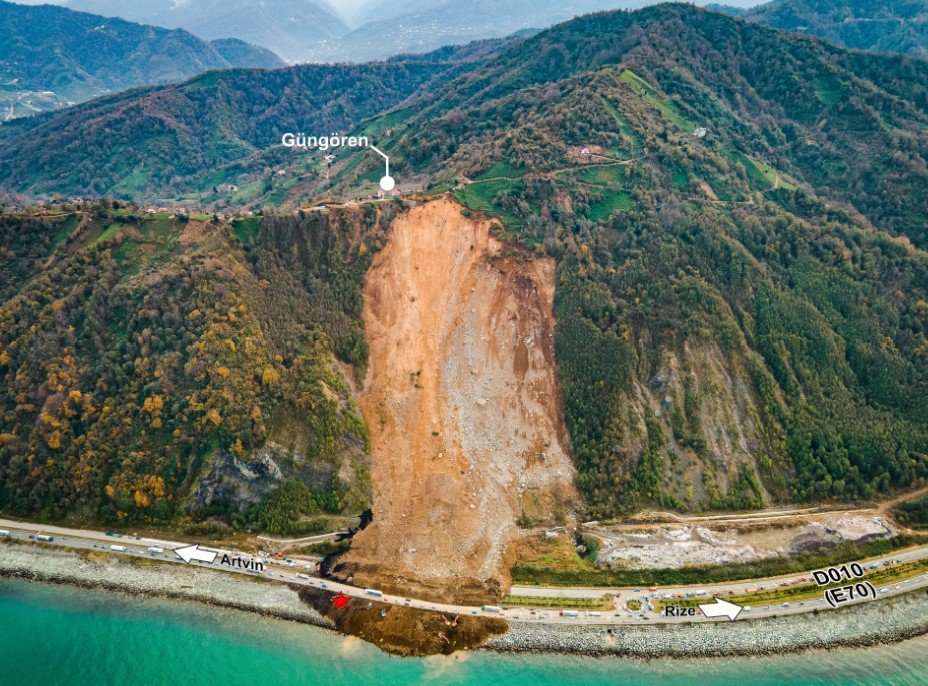
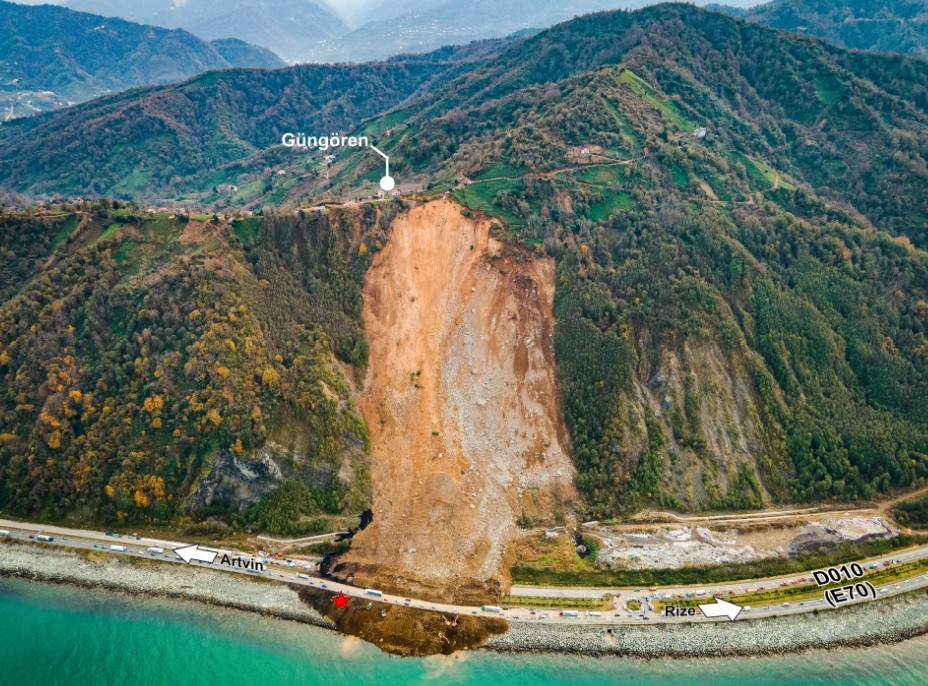
The Güngören hillslope is located at [41.337634, 41.26327]. This image, from Görüm et al. (2026), shows the aftermath of the landslide:-
Görüm et al. (2026) describe this landslide as a debris avalanche with a length of 522 m, a width of 250 m and an elevation difference of 287 m. It has a volume of about 100,000 m3. There have been previous landslides on this slope, one of which (in 2006) was fatal.
The landslide was associated with heavy rainfall (80 mm/day), but this was not exceptional, which means that the history of the slope is important in terms of the development of progressive failure. Görüm et al. (2026). They have used InSAR to show that the slope was deforming in the two years leading up to the failure, with rates in the range of 60 mm per year. Just 23 days before the Güngören hillslope failed, the 15 November 2024 Mw=4.7 Pazar (Rize) earthquake occurred about 45 km from the site. The calculated peak ground accelerations on the Güngören hillslope were low, but this may have played a role in the development of the final failure.
Görüm et al. (2026) also highlight two potentially important human factors in the occurrence of the landslide. First, the slope was quarried in the period leading up to 2006 for construction materials for the Black Sea Coastal Road. Notably, the fatal 3 April 2006 landslide was triggered by quarry blasting. One person died.
Second, the construction of the Black Sea Coastal Road may have destabilised the slope, perhaps through excavation at the toe.
Of course further instability on this slope seems likely, so Görüm et al. (2026) recommend ongoing monitoring of the site.
Reference
Görüm, T., Tanyaş, H., Yılmaz, A. et al. 2026. Fatal debris avalanche on an anthropogenically disturbed, earthquake-perturbed slope during antecedent rainfall. Landslides. https://doi.org/10.1007/s10346-026-02713-0.
Text © 2026. The authors. CC BY-NC-ND 3.0
Except where otherwise noted, images are subject to copyright. Any reuse without express permission from the copyright owner is prohibited.