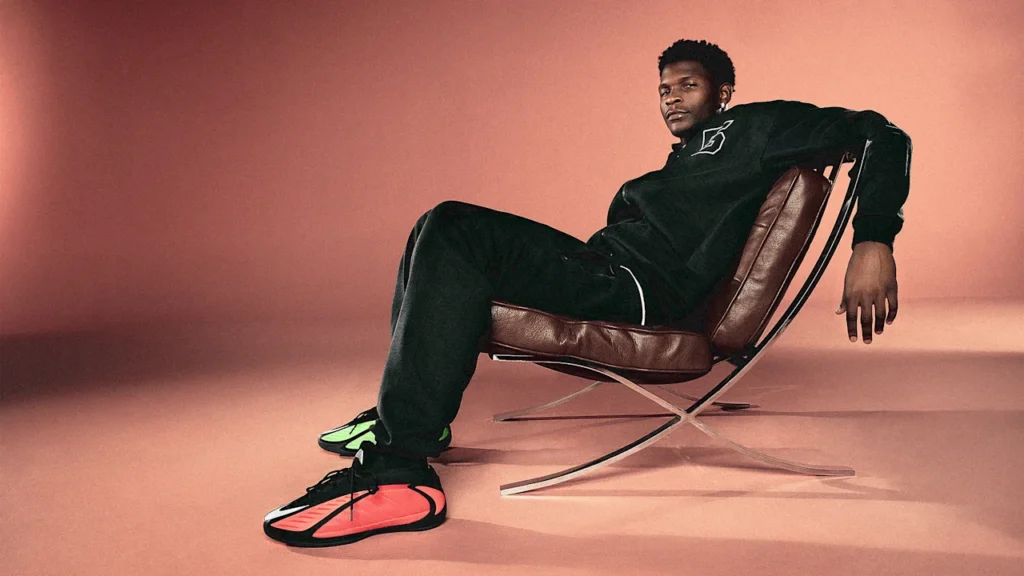
When Minnesota Timberwolves star Anthony Edwards steps onto the NBA All-Star court in Los Angeles with the league’s best players, there will be cameras following his every move.
But it won’t just be NBC clocking the action. Edwards’s own Three-Fifths Media will be there for his ongoing unscripted show, Year Six. It’s the second season chronicling the daily grind of his NBA exploits, building on last year’s Year Five.
Three-Fifths Media started in 2019, with Justin Holland, Edwards’s business partner and manager. They signed a production deal with Wheelhouse in 2024 to collaborate on projects like Year Six. So far, Three-Fifths has produced Serious Business, an unscripted show on Prime Video that challenges celebrities and athletes in their own domains, Year Five, and now Year Six, and the inaugural Believe That Awards, which aired in October on YouTube and had 167 million views across platforms in its first 48 hours. On the side, Edwards also produced a hip-hop album featuring heavyweights Pusha T, Quavo, and Wale.
The 24-year-old Edwards is methodically building his own content and entertainment business clearly influenced by the success some of his on-court heroes have had over the past decade, like Kevin Durant with Boardroom and LeBron James with Fulwell Entertainment (formerly the SpringHill Co.). Of course, there is no guaranteed blueprint—witness SpringHill’s financial struggles, despite strong productions, that led to its merger with Fulwell last year.
The two common threads among Three-Fifths Media’s projects is that they shine a spotlight on a real and (largely) unfiltered Anthony Edwards, and are at least partly owned by the NBA star. Holland says that’s not only at the core of their content, but the overall business strategy.
“We’ve leaned into being authentic in every room we walk into, and prioritize ownership over exposure,” says Holland, who has been working with Edwards since 2016. “Not just looking for deals because of dollar amounts or because they’re cute, but also really leaning into brands that we really can take ownership in, allow us to keep that authenticity, and also look for opportunities where we can actually own our IP.”
Just like Edwards’s on-court career, it’s been an impressive start, and shows potential to help redefine athlete-owned media.
Believe That
Okay, picture this: A remake of the 2001 film Training Day, starring Timothée Chalamet as Ethan Hawke’s character opposite NBA star Anthony Edwards in Denzel Washington’s spot.
It sounds crazy, obviously, but Chalamet and Edwards actually talked about it in October when Edwards awarded the actor his “White Boy of the Year” honor as part of the satirical Believe That Awards show.
The show didn’t feature a red carpet, nor was it drenched in celebrity—though Chalamet and Candace Parker made Zoom appearances. It was shot in Edwards’s actual basement, and had the feel of a Saturday night hang-out with him and his friends. That ability to seamlessly jump from highly produced work like Year Five, to more street-level, vlogger-style content is perhaps Edwards’s biggest media strength.
“You have guys that impact culture, and then you have guys that create,” says Holland. ”Ant’s one of those guys that creates culture. So everything that we do, we’re intentional about not trying to follow the standard, and aim to actually be innovative in our creative process.”
There’s a reason the vibe of hanging with Edwards and his friends permeates so much of his work (his best friend, Nick Maddox, stars in many of his Adidas spots)— it’s because that’s what’s really happening.
“It is actually pretty easy when you have a guy like Anthony and our crew,” says Holland. “We keep everything really tailored to our core group and just want to make sure that we continue to build from there.”
Brand consistent
Holland says that, as a young up-and-coming NBA star, early in his career brands would try to fit him into their box or version of him they wanted. The work they’ve done with partners like Adidas, Sprite, Bose, and Prada represent those that have not only steered away from the old hold-the-product-and-smile approach, but encouraged Edwards to take ownership of the creative.
Most modern athletes will talk about authentic connection with both brands and fans, but tend to serve up only the most curated and choreographed version of it. What makes Edwards work most unique is how it makes fans feel a part of that inner circle, whether in a social post or a big time sneaker ad.
“We try to stay away from just brand endorsements and we really like to be in business with people that really understand who we are and then actually want to collaborate with us,” says Holland.
That translates to having Maddox starring in Adidas ads, or Edwards’s brother’s music featured in a Bose campaign. It also brings Edwards’s natural affinity for trash talk to his brand work. Brands typically shy away from controversy, but Adidas has embraced Edwards’s approach wholeheartedly.
They turned heads last year, launching his first signature shoe with ads that called out other pro shoe models and social media trolls by name. In a spot called “Top Dog” for his AE2 shoe, he beats video game caricatures of his biggest rivals—Luka Dončić, Victor Wembanyama, and Shai Gilgeous-Alexander, among others.
Holland says getting brand partners to embrace Edwards’s authentic self was tougher at first, but the results speak for themselves. “We talk to our partners about our overall picture, looking at it from a wide lens of how we want to operate,” he says. “Now those conversations are a lot easier. They see how we move and how the public actually reacts to the authenticity, and how it resonates, because it just makes all the work that much more relatable.”